huffpost Press
JD Vance Cast An Early Vote In Ohio. Here’s Why His Photo Is Getting Attention.
Images
1 / 10

2 / 10
3 / 10
4 / 10
5 / 10
6 / 10
7 / 10
8 / 10
9 / 10

10 / 10
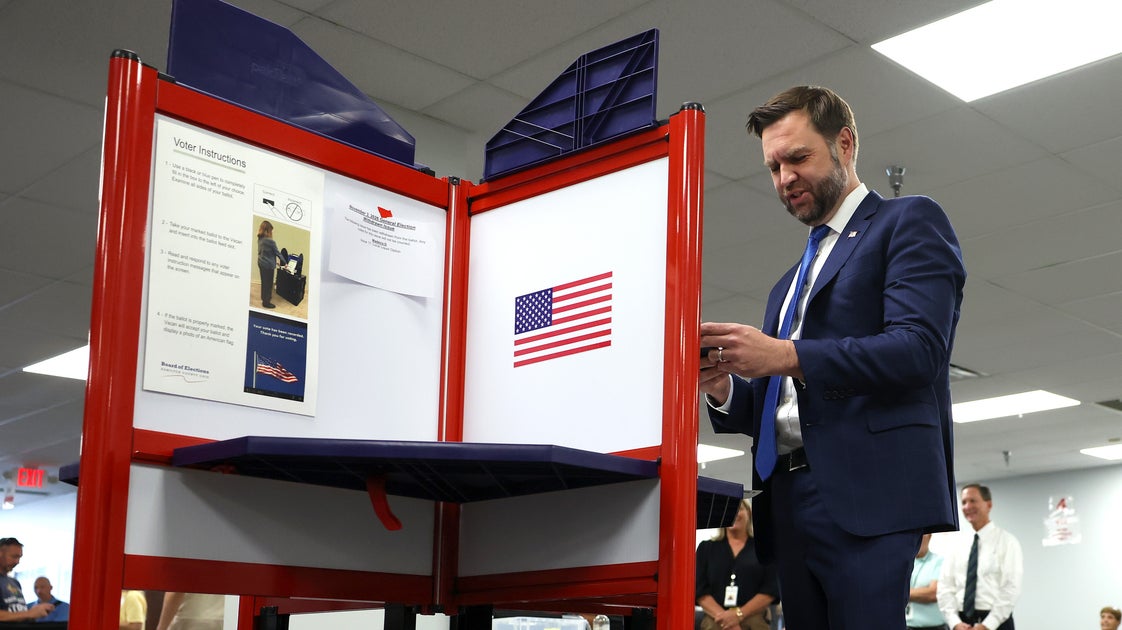
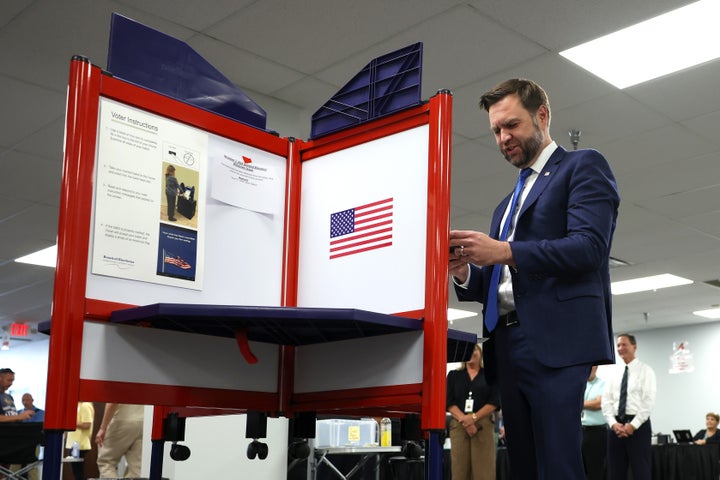
On Friday, Vice President JD Vance cast his ballot in Ohio ahead of the November midterms –– and many were focusing on what Vance appeared to do with his phone in the voting booth.

Online critics wondered if the vice president was taking a photo of his ballot, which can be a serious offense in some states. “The same Republican Party obsessed with screaming about election integrity now has some explaining to do,” one viral Threads comment on Vance’s voting video speculated, while another online commenter questioned if Vance “broke the law by photographing his ballot.”

It’s unclear from the photos and videos if this is what Vance was actually doing while casting his ballot, and no rule-breaking has been formally charged or confirmed. Ohio, the state where Vance voted, has a strict ballot selfie ban and bars voters from sharing a photo of a completed ballot.

HuffPost asked the VP’s press office about what Vance did with his phone but did not receive a response.

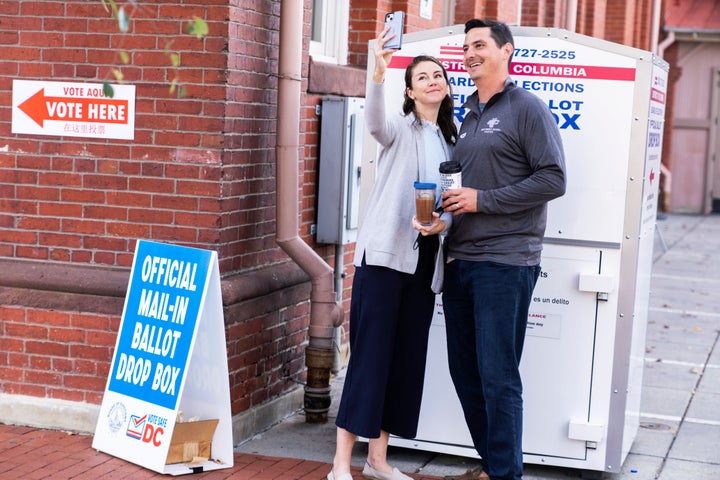
Speculation around Vance’s ballot-casting aside, the act of taking a voting selfie is fairly popular with the general population. If you look on social media in the coming days, you may see many voters share selfies with their ballots, maybe with the hashtag #IVoted.

But before you share your civic engagement with the world, think twice ― that selfie could be illegal, depending on where you live in the United States.

Just ask Justin Timberlake. In 2016, the pop singer posted on Instagram a photo of himself casting a ballot in a voting booth, with the caption: “Get out and VOTE!”

Timberlake deleted the post after he was warned that his ballot selfie was against Tennessee law, which bans photography in polling locations. Two years later, he encouraged his social media followers to vote by reminding them, “Remember: NO voting booth selfies.”

Some states permit ballot selfies under certain conditions. In Arizona, Texas, Tennessee and West Virginia, you can only take pictures with mail-in ballots. In Florida, voters can take a picture with their ballot inside the voting booth but not while inserting the ballot into the tabulator. In Utah, you can share a photo of your ballot, but it is a misdemeanor if you take a photo of someone else’s.

In New York, you might get a threatening reply on X, which is what happened to a 2022 voter who posted his filled-out ballot selfie on the platform. He deleted the image after the New York City Board of Elections replied: “Displaying a voted ballot to anyone is a misdemeanor in NYS [New York State]. Pls remove pictures.”

And in some states, a ballot selfie is not just allowed, it is encouraged. Alabama, California, Colorado, Hawaii and Nebraska all have laws that expressly allow voters to share their ballot, according to the National Conference of State Legislatures. Marc Levine, the then-member of the California State Assembly who led the pro-ballot selfie push in the state, described ballot selfies as a “magnificent display of civic participation.”

The wide spectrum of where states land on sharing these photographs speaks to a conflict between two fundamental aspects of democracy: “free and fair elections versus freedom of expression and freedom of political speech,” Jeff Hermes, deputy director of the Media Law Resource Center, previously told HuffPost.

Critics of ballot selfies say they can make it easier for bad actors to buy your vote or prove that you voted how they wanted you to.

At least 45 states have constitutional provisions that guarantee the right to vote in secret. These laws go back to the 19th century, when vote-buying schemes and violent voter intimidation were rampant. Back then, public bribery for votes was normal; landlords and factory owners bullied tenants and workers on how they should vote, and thugs called “shoulder-strikers” could be hired to frighten voters, as historian Jill Lepore recounts in a 2008 New Yorker article on early paper voting in America.

Nowadays, it’s illegal for someone to pay you to vote their way. “States have prohibited sharing of ballot selfies or ballot photography as part of a broader prohibition on display of marked ballots, because that’s how they’re trying to prevent voter fraud or vote purchasing,” Hermes said.

Texas, for example, bans photographs within 100 feet of a polling location. Hermes said there have been a couple of court decisions saying that a polling place is “a space that the government opens to the public for very specific purposes, but can control what goes on there.” He noted, however, that it can be “problematic” when states wrap electioneering and vote-buying issues into a single statute because they’re “usually trying to restrict too much speech.”

Punishments in jurisdictions with strict ballot selfie bans can range from being asked to put away your phone to hefty fines and jail time. “There’s a lot of discretionary enforcement that goes on in this area,” Hermes said.

In Illinois, knowingly sharing or observing someone’s marked ballot is a felony. The Chicago Board of Elections, however, told HuffPost in 2024 that violations of Illinois’ ballot selfie ban don’t often involve police.

“If a voter is seen doing it, an election judge may ask them to stop, and that’s usually where it ends,” said Max Bever, then the board’s director of public information. “Instead, election workers encourage voters to take a picture with their ‘I Voted’ sticker outside the polling area as a way to show their pride.”

But sometimes, states do investigate and prosecute voters who knowingly take a ballot selfie. In North Carolina, photographing a voted ballot is its own complaint category that people can fill out when reporting a violation of election law.

In 2024, voter Susan Hogarth got a letter from the North Carolina State Board of Elections threatening her with criminal prosecution because she posted a selfie on X with her completed ballot in a voting booth. She was required to “take the post down” because “photographing a voted ballot is prohibited by law and is punishable as a Class 1 Misdemeanor,” according to the letter, which was reviewed by HuffPost.

Instead of taking down her post, Hogarth sued, arguing that the state’s ballot selfie ban violates voters’ First Amendment rights.

“Susan didn’t delay the polling place. She didn’t disrupt anybody’s voting at all. She wasn’t doing this as part of a vote-buying scheme,” said Jeff Zeman, an attorney for the Foundation for Individual Rights and Expression, the free speech group that filed the suit on Hogarth’s behalf. “She was just expressing her enthusiasm for voting.”

“The ballot selfie ban means that North Carolina voters lose their freedom to express themselves as they please, which is what the First Amendment guarantees,” Zeman continued. “Our worry here is that these statutes chill speech, that people aren’t going to take ballot selfies in the first place because they know they’re a crime.”

In response to Hogarth’s litigation, the attorneys representing the board of elections argued that the restrictions on Hogarth’s speech are reasonable, in part, because “voters can take other photographs and share photographs taken in the voting enclosure, as long as the photographs do not include other voters, and they can even do that with permission. They can also take photographs of a marked sample ballot,” according to a September court filing.

Hogarth’s case is still active, according to the Foundation for Individual Rights and Expression. Beyond North Carolina, FIRE estimates at least 13 other states ban ballot selfies.

Because ballot selfie laws and enforcement can differ so widely, your best bet is to go to your local board of elections and ask if your ballot selfie idea will be OK.

Or you could just take a picture of yourself with your “I Voted” sticker, as Micah Rasmussen, the director of the Rebovich Institute for New Jersey Politics, suggested to HuffPost in 2024. He said that’s a way to show off “where you’re not going to run afoul of the law, even in a technical sense.”

But as Zeman noted, what makes a ballot selfie special is what it can uniquely express beyond a sticker.

“Some people like Susan want to express their enthusiasm for voting and who they vote for by posting selfies,” he said. “That is showing the world who you actually voted for, and an ‘I Voted’ sticker can’t do that.”

The original version of this story was published on HuffPost at an earlier date.

By entering your email and clicking Sign Up, you're agreeing to let us send you customized marketing messages about us and our advertising partners. You are also agreeing to our Terms of Service and Privacy Policy.
Comments
You must be logged in to comment.