huffpost Press
Here's What Legal Experts Say About Trump's Appalling Remarks About California
Images
1 / 7

2 / 7
3 / 7
4 / 7
5 / 7
6 / 7

7 / 7
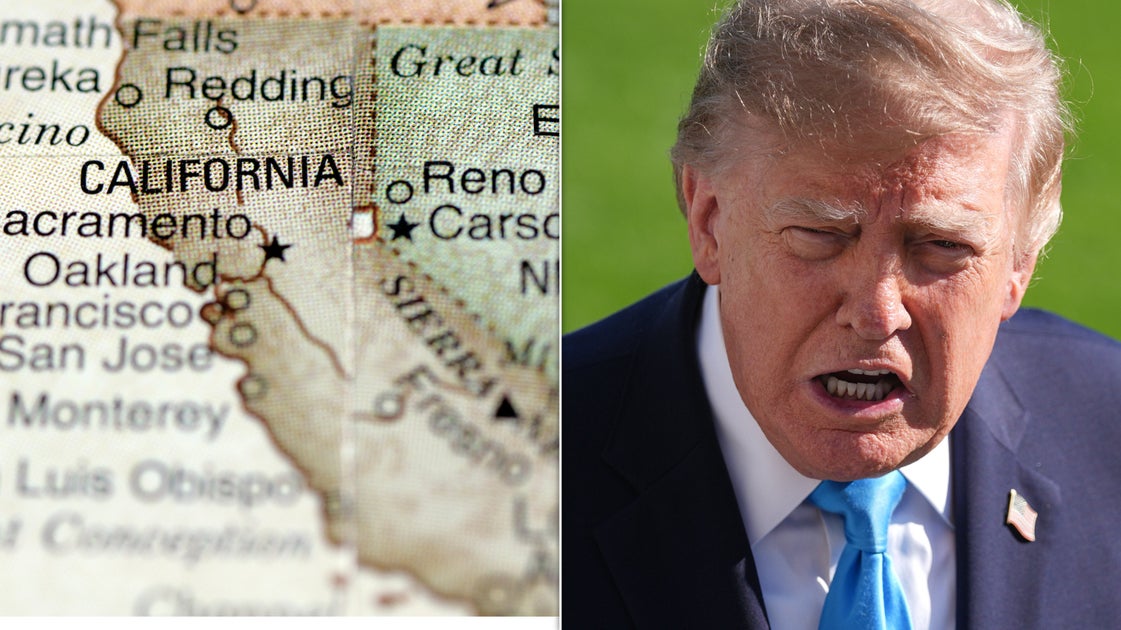
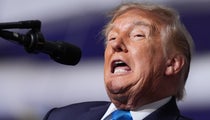
President Donald Trump sparked some alarm while speaking about the Iran war at a midterm campaign rally in Grand Island, Nebraska, on Monday, saying the cost of the war is “a little bit high,” but ultimately “a small price to pay,” and then appeared to suggest Iran could strike two major California cities.

“It’s a small price to pay for keeping the world safe, keeping our country safe. They can take out a city — let ’em take Los Angeles, let ’em take out San Diego,” he said. “This is a very small price to pay, and it’s going to be over very soon. It’s essentially almost over with. And they might keep going a little long, you know, they always say they have a big threshold for pain; they need it. Let me tell you, they need it. But it’s going to end very soon.”

On Tuesday, Trump appeared to ignore a reporter who asked him to clarify what he meant by “let ’em take Los Angeles, let ’em take out San Diego.”

Trump on War/High Prices: It's just artificial. It's a little bit high. It's a small price to pay. They can take out a city. Let them take out Los Angeles. Let them take out San Diego… pic.twitter.com/RtOiv5tZBP

The crowd cheered at the mention of Iran “taking out” the two cities at the event where Trump was campaigning for Sen. Pete Ricketts (R-Neb.).

The U.S. and Israel launched coordinated missile strikes across Iran on Feb. 28, starting the months-long war. The president claimed the war in Iran is necessary to prevent it from developing nuclear weapons and to protect Israel, HuffPost has reported.

California Gov. Gavin Newsom criticized the speech as “dangerous — if not treasonous” in an X post on Tuesday morning. “Putting a target on two of our biggest cities and one of America’s largest naval hubs,” Newsom wrote. “I am directing the State Threat Assessment Center to actively monitor the situation in the event that foreign actors interpret the President’s remarks as an invitation to target California.”

San Diego Mayor Todd Gloria said in an official statement that “President Trump should retract these remarks and apologize to the people of San Diego. A President does not get to decide which American communities are worth protecting.”

Los Angeles Mayor Karen Bass called the president’s remarks “dangerous” in an X post and said the president should be focused on protecting Americans rather than encouraging attacks on U.S. cities.

The White House referred HuffPost to White House Director of Communications Steven Cheung’s X post, where he said that Trump “was clearly stating U.S. cities would have been threatened if a nuclear Iran hadn’t been stopped. America is safer because of the president. Iran has no nuclear, no navy, no air force, and no money.”

Trump has not publicly clarified his comments as of reporting. Ricketts’s office has not responded to HuffPost’s request for comment as of publication.

Luke Winslow, a professor of rhetorical studies in the Department of Communication at Baylor University, told HuffPost that this language is unprecedented when compared to past presidents speaking about war.

“Generally, wartime presidential rhetoric seeks to unite the country rather than divide it,” Winslow said. “At the same time, it’s also in some ways on brand for Trump’s unprecedented presidency.”

Trump has proven throughout his two terms that he is very concerned with loyalty tests, Winslow said, and ahead of the midterm elections, he wants to win over the crowd in the room.

“He says things that are designed to excite and attract attention,” Winslow said. “Most people agree that his political genius is the ability to attract attention and manipulate the news cycle — and we’ve been seeing this for 10 years. What he does is say the thing that he knows will attract the headline or excite the crowd.”

Robert Rowland, a communications professor at the University of Kansas, also pointed to the crowd’s reaction as fuel and validation to the president.

“Why would anyone laugh at the idea that Los Angeles or San Diego could be attacked?” Rowland asked. “People aren’t laughing at the idea of a real attack. Rather, their laughter reflects resentment about how they perceive the elites on the West and East Coast.”

Unlike past presidents, Trump also focuses on separate parties and his personal resentment against particular groups in the U.S., Rowland said.

“The most rhetorically skillful presidents (Reagan and Obama) focused on what people had in common,” he said. “Historically, rhetoric attacking groups as not ‘real’ Americans, as ‘other’ than ‘us’ risks activating extremist groups. There is also a risk that such rhetoric can indirectly feed political violence.”

Newsom’s post raised the possibility that Trump’s language could be described as “treasonous,” a legal term defined by the Constitution as, “levying war against [the United States], or in adhering to their Enemies, giving them Aid and Comfort. No Person shall be convicted of Treason unless on the Testimony of two Witnesses to the same overt Act, or on Confession in open Court.”

But legal experts HuffPost spoke with said what Trump said does not count as treason, which has a very precise definition.

“The constitutional understanding of treason is extremely narrow; it just comes down to making war on the United States or giving aid and comfort to the enemies of the United States, and in this instance, whatever else you say about Trump … he’s talking about this in the context of winning the war,” Greg Magarian, a law professor at Washington University in St. Louis, told HuffPost.

“There’s no indication that, OK, I’m surrendering or I’m opening up, or I’m helping, I want to give Iran the blueprint for how to nuke Los Angeles,” Magarian continued. “So, no, it’s not even close [to treason].”

Cheung’s statement argues that Trump was saying what could have happened if the U.S. hadn’t stopped Iran, not that Iran should target Los Angeles and San Diego. If it had been the latter, Carlton Larson, a law professor at the University of California, Davis School of Law, told HuffPost it could be a case of Trump levying war, but treason would still require force to be used and aid to be provided to Iran.

“The levying war cases all require that some use of force be employed, and here Trump was simply speaking,” Larson said. “The cases [also] require that aid and comfort … to the enemy be actually provided, and this rambling speech may well fall short of true provision of aid and comfort.”

By entering your email and clicking Sign Up, you're agreeing to let us send you customized marketing messages about us and our advertising partners. You are also agreeing to our Terms of Service and Privacy Policy.
Comments
You must be logged in to comment.