yahoo Press
SpaceX Stock Is Already Priced for Perfection. If You Buy Now, It Could Take 15 Years to Pay Off.
Images
1 / 5
2 / 5

3 / 5
4 / 5

5 / 5
The above button links to Coinbase. Yahoo Finance is not a broker-dealer or investment adviser and does not offer securities or cryptocurrencies for sale or facilitate trading. Coinbase pays us for certain activity generated through this link. Prices displayed are informational.

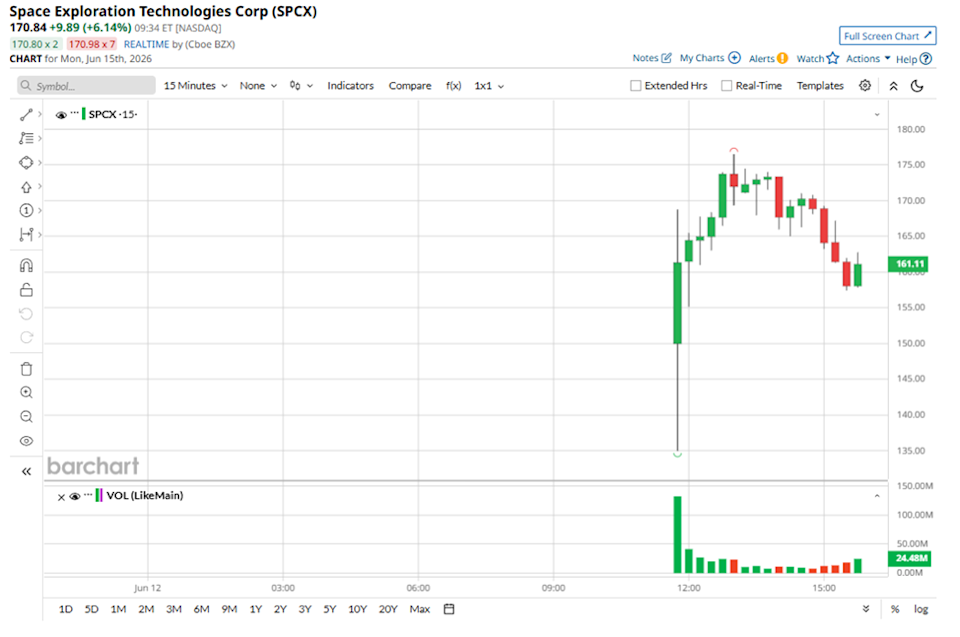
SpaceX (SPCX) reached a massively impressive market capitalization of $2 trillion after its highly anticipated initial public offering (IPO) on June 12. Nevertheless, a more sober view of the company requires a strict distinction between Elon Musk’s engineering triumphs and cold financial math. SpaceX's recent valuation clearly demonstrates that market players priced in the most positive sequence of events for the space firm well in advance.

That has created a classic paradox, as this truly outstanding and disruptive business runs the risk of turning into a stagnant asset for a long time in terms of returns. In my view, this anomaly should be dissected in detail through the lens of fundamental metrics and classic risk management. Let's take a closer look.

Rocket Lab vs. Redwire: 1 Stock Has the Stronger Growth Story for the Next Decade

Dear SpaceX Stock Fans, Mark Your Calendars for June 16

Dear Western Digital Stock Fans, Mark Your Calendars for June 22

Tired of missing midday reversals? The FREE Barchart Brief newsletter keeps you in the know. Sign up now!

SpaceX's current multiples rely on optimistic long-term forecasts of a specialized industry. Consensus forecasts project the expansion of the global space sector to $1.5 trillion somewhere around 2035 to 2040. That is a solid, impressive figure. However, to justify its $2 trillion IPO valuation at a moderate price-to-earnings (P/E) ratio of around 25 times, SpaceX would have to deliver about $80 billion in net profit annually. If we assume profit margins at a level of 20% to 25% — which is extreme for heavy industry — SpaceX would need to generate around $400 billion or more in revenue. Is that realistic?

We cannot rule out such an outcome. But for that to happen, SpaceX would have to become a total hegemon. The company would need to capture about a third of the entire global space industry, completely lock logistics chains onto the Starship system, get corporations and governments to use Starlink without any alternatives, and monopolize satellite platform assembly. Current prices indicate that investors practically view this ultra-complex task as already solved.

The key risk of buying SPCX stock at current levels is not connected at all with the quality of the business or management errors. The problem is more mundane: SpaceX's market cap has essentially nowhere to grow. The practical deployment of orbital constellations, the scaling of B2B contracts, and the basic construction of the Starship fleet could take at least a decade and a half.

Wall Street pulled a typical forward maneuver with the SpaceX IPO. Investors took hypothetical triumphs from the year 2040 and fully paid for them at the exchange rate of 2026.

Now, SpaceX will likely have to chase its own valuation for years. Shares risk getting stuck in a grueling sideways trend for a long time. We could see strong quarterly reports, an exponential surge in operating income, and new records in net profit all while the SPCX stock price remains motionless. All incoming fundamental upside will be spent exclusively on deflating anomalous multiples down to ordinary market-average values. In my view, no new shareholder value will be created for current buyers, since factoring something more massive into the model than an absolute global monopoly is mathematically impossible. Basically, there's nothing left to fuel further stock price growth.

The basic law of investing hinges on a strict parity of risk and potential return. SpaceX's $2 trillion IPO price tag completely cancels this axiom. At that valuation, the market de facto assigned SpaceX a 100% probability of perfect execution, which never happens in the real world.

The chance of a flawless realization of plans rarely exceeds 30%, and SpaceX itself faces a whole list of long-term threats. First, competition will inevitably intensify from both ambitious private startups and sovereign states pouring billions into their own launch systems and satellite constellations. Second, investors should not discount technological shifts; a three-to-five-year delay in programs — standard for the space industry — would completely break any neat spreadsheet. Finally, profit margins will inevitably shrink due to both future market saturation and the need to inflate capex as aging satellites require upgrades.

If we assume a more realistic outcome where SpaceX captures not 40% but merely 20% of the market, the fair value of SPCX should be calculated with a huge discount. Personally, I believe that buying shares at current prices shifts the entire weight of systemic risks onto investors' shoulders without offering any risk premium in return, although shares have since cooled off a bit from their post-IPO all-time high.

SpaceX holds all the cards it needs to turn into one of the key infrastructure pillars of this century. In 15 years, its actual financial flows could very well grow to $2 trillion.

But a pragmatic investor today appears to be deprived of any margin of safety. SpaceX will have to work hard for a decade or more under perfect conditions to merely justify a $2 trillion market cap.

On the date of publication, Mikhail Fedorov did not have (either directly or indirectly) positions in any of the securities mentioned in this article. All information and data in this article is solely for informational purposes. This article was originally published on Barchart.com
Comments
You must be logged in to comment.