yahoo Press
LVMH’s Innovation Awards Focus on Traceability, AI Discovery and Training
Images
1 / 5
2 / 5

3 / 5
4 / 5

5 / 5
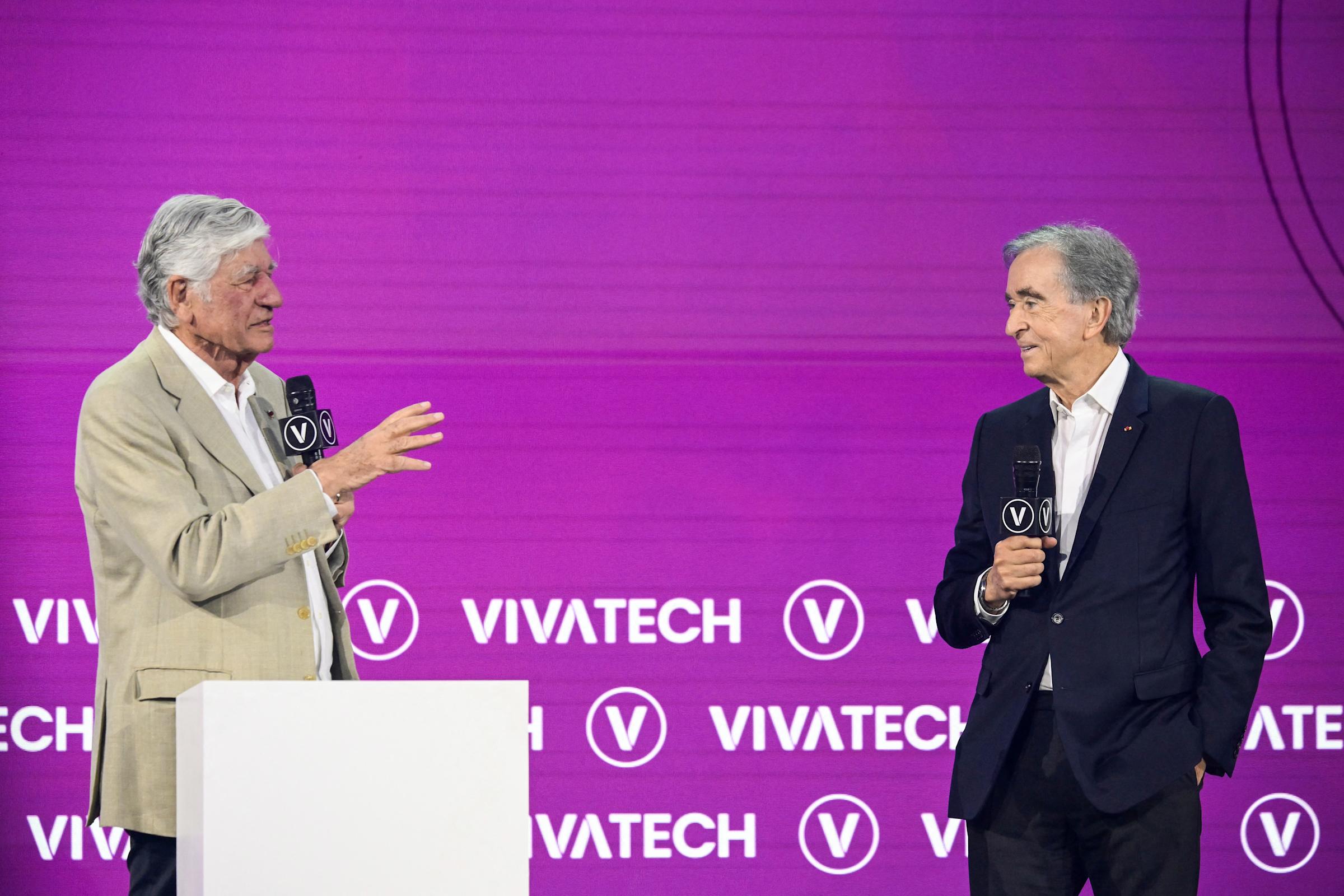
PARIS — LVMH Moët Hennessy Louis Vuitton chairman and chief executive officer Bernard Arnault opened the 10th edition of Viva Tech — calling itself the “Fashion Week of Tech” — singing the praises of progress.

“Bureaucracy, it’s a word that is too much present in Europe,” he said, taking the stage for a conversation with Viva Tech founder Maurice Levy. “When we started 10 years ago, nobody was talking about AI, it was not even a word. But now thanks to AI, we are able to kill part of the bureaucracy.”

More from WWD

How Fashion Retail Is Talking the AI Talk

Credit Cards, Tax Refunds Fuel May Retail Sales

SGM Sells BHV Marais, Incoming Owners Will End Shein Deal

The head of the world’s most valuable fashion conglomerate said he still thinks of his group as a start-up.

“I still consider my group a start-up. We are a conglomerate of start-ups,” he said. “The goal [of a start-up] is to grow and become a big company…but you must keep the spirit, and the spirit is still there.”

The group revealed the winners of its Innovation Awards, betting that the next wave of growth will come not only from generative AI, but from tech that improves transparency, brand discovery and operational efficiency across its businesses.

The winners offer a peek into the group’s overall tech priorities as LVMH increasingly invests in artificial intelligence while navigating shifting consumer expectations on sustainability, authenticity and customer experience.

This year it recognized supply chain transparency platform Fairly Made, AI search optimization start-up Bluefish and video generation company Synthesia.

Fairly Made received the Best Impact Award for its work helping brands trace raw materials and components throughout their supply chains.

“There was no debate. I think this one was clearly standing out,” said Gonzague de Pirey, LVMH’s chief omnichannel and data officer, describing the jury’s selection process.

“It’s a big challenge for the luxury industry,” said LVMH group IT and technology director Franck Le Moal.

The group began working with Fairly Made four years ago on traceability and it has become an important partner as luxury consumers demand greater transparency around sourcing of raw materials and the environmental impact of production.

“They are becoming a mix between a start-up and scale-up, and really this is a company we are using at scale,” he said. Fairly Made is used across 14 maisons, including Louis Vuitton, Dior and Celine, among others.

Traceability has become both a sustainability requirement and a luxury advantage, particularly among younger consumers. “It’s more and more critical for the brands and it’s valued very much by the customers, especially for the young generations,” de Pirey said.

The Most Promising Award went to Bluefish, a U.S.-based start-up founded in 2024 that operates in the emerging field of generative engine optimization, or GEO. The platform helps brands understand how they are represented across large language models such as ChatGPT, Gemini and Perplexity.

De Pirey and Le Moal described the technology as increasingly important as consumers shift from traditional search engines toward AI assistants when researching products and brands.

“We see a significant turnaround where customers are looking for information,” said Le Moal. “A significant number of customers are now going to LLM first.”

Bluefish allows brands to measure how they rank within AI-generated answers and provides recommendations to improve visibility and representation across different platforms.

“Because this is where people will discover the brand, it is critical to the brand to ensure that we have the right representation of the brand in this agentic world,” de Pirey said.

Synthesia received the Best Business Award for its AI-powered video generation platform, which LVMH is using to create training content for employees across its maisons.

The tech has so far been used throughout the group to rapidly produce multilingual training materials and educational content without the high cost of traditional video production. Videos are generated for each product and fashion collection.

“The time you gain, the money you save, and the quality of the outcome is so good,” de Pirey said.

However, the duo maintained that the human touch remains central to luxury. Both emphasized that the generative tech will be used only in-house, and not on customer-facing advertising or media. “As soon as we are customer-facing, we prefer a human,” Le Moal said.

Speaking with WWD ahead of the announcement, de Pirey and Le Moal jointly noted that the awarded start-ups are more than stand-alone companies, but examples of how tech is being integrated into the luxury business.

“The perspective for LVMH is really to tell a story and to showcase how tech, digital and data are supporting the whole value chain, from creation to design, to manufacturing to logistics, to omnichannel, to the store and supporting the customer experience,” said Le Moal.

Bluefish might be the clearest indication of luxury’s latest challenge. De Pirey said the tech addresses a fundamental shift in how consumers discover brands online. According to their in-house research, 80 percent of in-store transactions are influenced by a digital touchpoint beforehand.

Historically, much of that discovery occurred through websites and traditional search engines. “What agentic AI is changing is this upstream part, which used to be basically on the website, basically on Google, and is now shifting massively and rapidly to ChatGPT and Gemini,” he said.

As consumers increasingly turn to AI assistants for product recommendations and brand information, the challenge is that the houses can no longer completely control their narrative, despite all their in-house emphasis on “storytelling.”

“It’s super important to appear properly on those platforms,” said Le Moal. “If we are not talking properly about our brand, some others will talk about us.”

He noted forums like Reddit, where users discuss products, as one place where key conversations take place.

In addition, LLMs increasingly draw on verified journalistic written sources and specialist media when generating responses.

“The media piece is far more important than before with SEO,” de Pirey added.

Alongside start-ups, LVMH is building partnerships with some of the tech giants, including global deals with Google Cloud, Alibaba and Salesforce. Le Moal indicated a partnership with Anthropic is “on its way.”

The objective is to “avoid fragmentation,” with maisons adopting common tech across the group while maintaining their individual brand identities.

“We want to make sure that all our maisons are able to adopt the same platform,” Le Moal said. “At the end, the final content will, of course, be maison by maison.”

Yet despite the focus on technology, de Pirey noted that “the main challenge is not on the tech side anymore — it’s more on the transformation side.”

“Thanks to AI, we are now able not only to gain individually in terms of productivity, but also collectively…we can now rethink entirely the processes to have them be far more efficient,” he said. “But this takes a lot of energy, a lot of sponsorship at the highest levels to make sure that we can drive this transformation.”

He said that AI deployment across LVMH is roughly 10 percent building the algorithms themselves, 20 percent the technical integration, while 70 percent is dependent on change management.

That has resulted in the creation of an “All for AI” program to prepare human employees.

“We totally acknowledge that AI will change a lot of things in the company,” de Pirey said. “But we will be on the side of every talent in the company to help them to go through this transformation.”

Asked about the group’s Life360 goals and the seemingly opposed broad implementation of AI with all of its associated energy and water use concerns, de Pirey said it’s “a fair question,” considering the group’s sustainability positioning.

He said they are operating on two fronts with catchy names — “Green AI” and “AI for Green.”

The Green AI track is attempting to reduce the footprint of its technology operations, which Le Moal said have reduced tech-related energy consumption by 20 percent over the past three years.

The AI for Green track aims to improve sustainability and reduce environmental impacts throughout the company. De Pirey cited initiatives such as CropX, which uses data and AI to help optimize irrigation in agriculture. He said the technology has helped reduce water consumption in rose cultivation by 30 percent at Parfums Christian Dior, for example.

Inside LVMH’s slimmed-down booth, which showcased each maison’s initiatives, group head of image and environment Antoine Arnault told WWD he believes the two are not in conflict.

“We try to do it with the right tempo, with the right rhythm, and without diving into any innovation, not without having audited and analyzed its sustainability relevance,” he said. “It’s very important for us to do things well, to try to be more efficient, but not at the cost of our values. This is what I’m here for, is to try to also sometimes put the brakes on innovations that go too fast and that are not sustainable anymore.”

Speaking on stage earlier in the day, Antoine Arnault joked about past “next big things” touted at VivaTech, such as the metaverse.

“Some companies even changed their names,” he joked, adding that LVMH did not jump in with both feet (even before the tech had legs). “And what did it do? It completely failed. I think we were right to take our time. Our vocation is not to be the first ones to embrace innovation. When it’s relevant, when it has already proven its success, then definitely we will be the ones that embrace it. And AI already today is very, very active and is helping us to be more efficient.”

Best of WWD

Retailers Leverage First Insight for ESG Alignment

What Steph Curry's Sneaker NFTs Can Teach Fashion

Year in Review: Brands, Retailers Go Hyper-digital in a Challenging Landscape

Sign up for WWD's Newsletter. For the latest news, follow us on Facebook, Twitter, and Instagram.
Comments
You must be logged in to comment.