huffpost Press
The Right Hates Indian Americans. It Might Cost Republicans Texas.
Images
1 / 4

2 / 4
3 / 4

4 / 4
SUGAR LAND, Texas ― The responses to Vasant Bhatt’s post proved his point.

Bhatt, the son of an Indian immigrant and a 21-year-old student at the University of Houston, has about as long a history in conservative politics as a college student can have: He interned for Sen. Ted Cruz’s reelection campaign in 2024, and he was a correspondent for Campus Reform, a right-wing news site focused on higher education.

So he had some idea what to expect when he posted on social media he was backing Democrat James Talarico in this year’s Texas Senate race, explaining he was “disgusted by the xenophobia, racial resentment, and increasingly brazen attacks on my identity” as an Indian American.

But the responses from conservatives to his post were even more venomous. One writer for the right-wing outlet The Federalist called it “a really strong case for limited legal immigration,” a conservative streamer labeled him a “parasite,” and the prominent conservative podcaster Jack Posobiec suggested Bhatt was a secret liberal all along.

But Republicans, and the conservative movement, are facing a problem they cannot insult their way out of. The right has developed an obsession with Indian Americans that has only grown during the first two years of President Donald Trump’s second administration, resulting in calls to limit Indian immigration, eliminate H1-B visas, podcasts pondering “the Indian Question” and social media posts suggesting Indian American students are out of place at a University of Texas football game.

None of it has escaped notice by the Indian American community, one of the best educated and most prosperous immigrant groups in the country. And it’s a problem for the GOP.

Indian Americans have historically leaned toward Democrats, but the community swung significantly toward Trump in 2024. The outright racism from many in the conservative movement is playing a role in pushing them back to the left ahead of the midterm elections. A recent poll commissioned by an Indian American advocacy group found a quarter of Indian Americans who backed Trump in 2024 planned to vote for Democrats in the midterm elections.

The poll also found that, like most voters, the rising cost of living and healthcare were top issues for the community. And while Democrats led Republicans among likely voters at around 66%, nearly two-thirds of Independent South Asian voters said they were undecided ahead of the midterms.

But, no matter how you slice it, it’s bad news for the GOP.

“There are a large chunk of [Indian American] voters who are, for lack of a better word, having buyers remorse,” said Chintan Patel, the executive director of Indian American Impact, the company that conducted the survey. “That’s something that is building across the community as we’re talking about hate and discrimination.”

The tension could be a key factor in races around the country: New Jersey’s 7th District and Pennsylvania’s 1st, both major Democratic pick-up opportunities, boast significant Indian American populations, as do the swing states of Georgia and Michigan. Vivek Ramaswamy, the GOP candidate for governor in Ohio, has faced conservative skepticism because of his ancestry and Hindu faith.

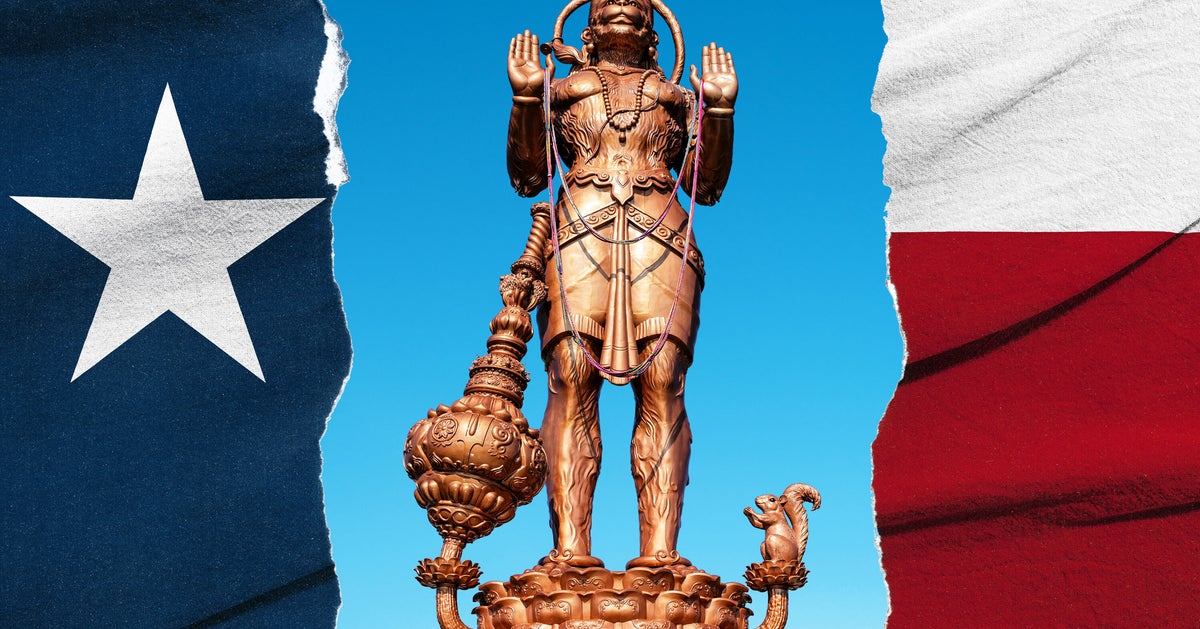
But the problems for the GOP may be most visible in Texas, home to the nation’s most expensive Senate race. Sugar Land, a prosperous suburb of Houston, is home to a 90-foot statue of Hanuman — the mace-toting half-monkey deity revered in Hindu mythology — located on the grounds of Sri Ashtalakshmi Temple.

The unveiling of the statue, the fourth-tallest in the United States, spurred some of the earliest evidence of the right-wing’s fixation on Indian immigration. Some called the towering monument to the Hindu deity of courage and self-restraint “demonic” and suggested it would invoke the “wrath” of a Christian God. Alexander Duncan, a former law enforcement officer who ran in the Republican primary for Texas Senate, said in a social media post last year that the statue honored a “false” god.

But the issue burst into the national spotlight last month. Bo French, Republican candidate for the Texas Railroad Commission, posted an image of a crowd of South Asian students at a University of Texas, Austin, football game and claimed the racial makeup of the stands was proof Americans were being “displaced by foreigners.”

French’s post, which he has defended, was widely panned. But elected Republican leaders largely ignored his obvious anti-Indian rhetoric. Gov. Greg Abbott, one of the few to weigh in, simply observed it was “not my message.”

Others on the right followed French’s lead. Conservative thought leader Chris Rufo hosted an episode of his podcast last month ominously titled “The Indian Question,” in which he and co-host Jonathan Keeperman claimed Indian immigrants were from an “alien” culture and were less likely to assimilate in the U.S.

The discourse spurred by the French controversy and other anti-Indian and South Asian rhetoric hasn’t been confined to the internet, either. In September, Gurvinder Singh, a Sikh truck driver, was stabbed 17 times at a highway rest stop in Wyoming. The attack came amid a Trump administration crackdown on immigrant truck drivers that singled out Sikhs.

And authorities in Illinois earlier this month foiled an attempted mass shooting at a Hindu temple after one of the suspect’s coworkers alerted them to his plan to “kill Indian people.” Local leaders have tied the planned shooting to online anti-Indian hate.

“We could have been talking about a massive tragedy,” said Patel. “That’s the kind of environment we’re in right now.”

In Texas and the greater Houston area, which boasts nearly 30% of the Lone Star State’s Indian American population, community leaders said the rise in anti-Indian sentiment on the right has made many people reconsider their relationship with the Republican party.

“I’ve seen a few people who say they’re just going to vote D[emocrat] straight down the ballot, to send a message to the Republican Party that they’re not going to tolerate it,” said Rishi Bhutada, a Houston businessman and board member of the Hindu American Foundation.

Bhutada told HuffPost in an interview that much of the past right-wing backlash against Indian Americans — such as the protests against Sugar Land’s Hanuman statue — felt “online” and confined to the fringe. But the French post and attempted Illinois temple shooting shook the community awake.

“I think that really changed the conversation,” he said. “A lot of people got concerned very quickly.”

Judge Manpreet Monica Singh, who sits on the bench at Harris County’s civil court and is Texas’ first-ever Sikh jurist, pointed to other “fear-inducing” examples of anti-Indian sentiment coming from the Trump administration, such as the Homeland Security Department’s crackdown on Sikh truck drivers and rhetoric against H-1B visas.

Singh, a Democrat, told HuffPost she’s seen more conservative members of the Houston Sikh community rethinking their political affiliation.

“They’re questioning: What have we been backing, and why have we been OK with this?” she said. “I see regret and the regression of support.”

Texas state Rep. Suleman Lalani (D) said he’d heard similar things from conservative-leaning Indian Americans and other South Asians in his district in the Houston suburbs.

“Some of them have been told to their face that they don’t belong,” he told HuffPost Wednesday on the sidelines of a Talarico campaign event in Richmond, Texas. “It’s not only happening to the Indian community. It’s happening to immigrants all over, in temples and mosques and other places.”

In the Lone Star State, the collapsing South Asian vote could fall hard on Paxton, who is fighting a crucial battle to keep the Senate under Republican control and prevent Democrats from flipping a seat that has been reliably red for a generation.

Paxton was notably among the large swath of Republican political figures who failed to weigh in on French’s post maligning South Asian university students. Bhutada noted that the GOP Senate candidate’s most substantive response to the controversy was to attack his opponent Talarico.

“That was it,” he added. “No one else said anything.”

Other than Abbott, only a few Republicans with national platforms have spoken out against rising anti-Indian rhetoric on the right. Sen. John Cornyn (R-Texas), the outgoing Republican lawmaker who lost to Paxton in a fierce primary battle, said he would not vote for French after his outburst and called him an “embarrassment to the Republican Party.” Longtime GOP strategist Karl Rove similarly said he’d vote for a Democrat over French following his post.

The silence of other national GOPers about the spike in anti-Indian rhetoric and violence has been similarly deafening for the South Asian community.

“JD Vance has said absolutely nothing about this attempted mass shooting in Illinois,” said Patel, who pointed out the vice president’s muteness on the issue was particularly offensive because his wife, Usha, is Hindu.

Vance, widely regarded as the front-runner for the 2028 GOP presidential nomination, has already taken sides on key policy issues facing the Indian American community, most notably H-1B visas — which he said this month should be eliminated completely.

As voters head to the polls in key battleground states like Texas, and as both parties look ahead to the next presidential election, it’s unclear whether Republicans will be able to win back members of the Indian American community with whom they made inroads in 2024.

Already, some on the right are reading the tea leaves and looking to temper anti-Indian sentiment among their compatriots. Right-wing provocateur Laura Loomer, no stranger to anti-immigrant commentary, nonetheless wrote in a post on X Thursday that “a lot of people on the right have been conditioned to irrationally hate Indians.”

But even if the conservative movement relegates anti-Indian hate back to the fringe, the damage may be done for formerly Republican voters in the community.

“Right now, it’s very difficult for me to say if I could ever return to the GOP,” said Bhatt. “It’s a difficult thing for me to admit, because I’ve had real conservative convictions. But seeing all this rhetoric, I’m asking myself why I was working so hard to defend a political party where I felt increasingly compelled to defend my own place within it.”

By entering your email and clicking Sign Up, you're agreeing to let us send you customized marketing messages about us and our advertising partners. You are also agreeing to our Terms of Service and Privacy Policy.
Comments
You must be logged in to comment.