huffpost Press
Relationship Experts Share Why That Elizabeth Holmes 'Egg Scene' Is 'Hard To Watch'
Images

1 / 8

2 / 8
3 / 8

4 / 8

5 / 8

6 / 8

7 / 8

8 / 8
There’s no shortage of head-spinning moments for audiences to unpack in “You Can See Everything,” the much-talked-about documentary about convicted fraudster Elizabeth Holmes.

Directed by Nathan Fielder and Lance Oppenheim, the buzzy A24 project offers an unusually personal look at the disgraced Theranos founder in the weeks leading up to her prison sentence. The film’s cryptic trailer, released weeks before its Oct. 16 debut, gave audiences an early taste of just how intimate — and unsettling — it gets as it examines Holmes’ life. But the three-hour documentary goes well beyond exploring the circumstances surrounding her downfall.

It also takes a close look at Holmes’ relationship with fiancé Billy Evans, including one particular exchange that has left viewers baffled.

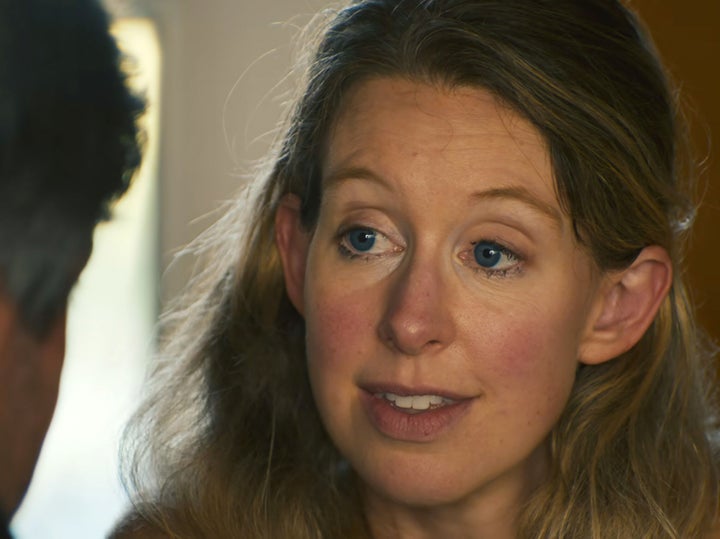
Early in the film, Fielder interviews Evans and Holmes while the latter scrambles a bowl of eggs. Seemingly frustrated by her pace, Evans abruptly snatches the bowl from her and whisks the eggs himself.

When Fielder asks why he stepped in, Holmes interjects, saying Evans doesn’t think she makes eggs properly and believes he can do it faster.

The awkward interaction is one of several moments that have sent the internet buzzing since the film’s release. But HuffPost spoke with relationship experts to get their take on the scene.

“This is a hard [scene] to watch for the viewer, as it’s a clear moment of coercive control,” said Sabrina Romanoff, a clinical psychologist and clinical assistant professor in the Department of Psychiatry at NYU Grossman School of Medicine.

Coercive control refers to a pattern of behavior in which one partner seeks to dominate the other and restrict their autonomy. Romanoff’s observations aren’t a formal diagnosis of Holmes and Evans’ relationship.

Still, she noted that the egg-whisking scene could reflect a larger issue in how the couple interacts.

“He has full control and say, and is the authority in their relationship,” Romanoff said. “Over time, partners on the receiving end of coercive control tend to suffer from a lack of self-trust, chronic self-doubt and become incredibly reliant and dependent on their partner, as they grow to believe that they truly know best.”

Of course, stepping in to help a partner isn’t inherently a red flag. But Tracy Ross, a New York City-based couples and family therapist, said that taking over without being asked can also signal a more controlling dynamic.

“This is not a complicated task. He just moves in and takes over, and she doesn’t question it,” Ross said of the scene. “Another person might say, ‘What are you doing? I’m doing this already,’ but it’s so suggestive that it’s not the first time [this has happened], or that this is something she’s used to.”

Citing research by psychologists John and Julie Gottman, Ross explained that a healthier relationship would reflect a dynamic rooted in mutual influence rather than one partner dominating the other. That means respecting one another’s different opinions and approaches, even over something as simple as how to prepare eggs.

“Accepting influence is not accepting dominance or power,” Ross said. “It’s like, ‘Hey, I don’t want you to help me with this, but I prefer you help me with that.’”

As Ross explained, the key difference between a partner who genuinely wants to help and one who seeks to maintain control is whether the other person feels they have a say in the relationship.

“Is it a back and forth? Is it a give-and-take? ... Or are you going along with it because you’re afraid of the reaction from your partner?” she asked.

Another detail that stood out to licensed marriage and family therapist Caitlyn Oscarson was how quickly Holmes excused Evans’ behavior rather than making a bigger issue of it. That kind of response, she said, can also point to controlling elements in a relationship.

“The person who we might see as being controlled is also trying to make sense of what happened and trying to smooth things over,” Oscarson told HuffPost, “either not wanting the other partner to be upset or not wanting to create a fight later.”

Seemingly minor moments, like Evans taking over breakfast prep from Holmes, can offer real insight into a couple’s dynamic, especially when an imbalance of power seems apparent. As Oscarson noted, while arguments make tension more obvious, subtle, unspoken interactions can reveal underlying issues that might otherwise go unnoticed.

“No one has to say, ‘I have to control everything that he or she does because they can’t survive without me,’” she said, “but it’s suddenly shown in that way.”

“I’m not diagnosing any relationships from afar, but he didn’t mean to reveal something in that moment, would be my guess,” Oscarson added. “He just reacted immediately, like there was something about that situation that made him uncomfortable and he had to take charge of it. And so it sort of shows maybe what’s going on beneath the surface.”

But the egg scene wasn’t the only moment in the documentary that raised experts’ concerns.

Later in the film, Evans reveals that he’s been managing Holmes’ X (formerly Twitter) account and posting as her while she remains incarcerated. Although he says Holmes gave him permission to access her account and post on her behalf, he also acknowledges that he often shares content without consulting her first. In other words, Holmes isn’t always aware of how her identity and likeness are being represented online.

“This is a really clear example of how boundaries aren’t respected, or in many cases, don’t exist in a relationship with a controlling partner,” Romanoff said. “They believe they are entitled to every aspect of your life, especially how you present yourself to others.”

Romanoff added that people who seek control in their relationships often care deeply about the image they project to others. They may also be attracted to partners who exude power or influence, but over time those same qualities can become threatening, prompting them to try to take control themselves.

“We see this in the ease with which he makes social media posts in her name, as if she is an extension of his identity,” Romanoff said. “It’s almost like she is an object, or an external source of success, that he can wield for his own benefit.”

When partners lose sight of each other’s individuality, it can signal an unhealthy relationship — one that can chip away at a person’s sense of independence over time.

According to Romanoff, controlling relationships often start with seemingly harmless behaviors that gradually escalate. It might be something as simple as one partner insisting on taking over small tasks while cooking together or refusing to let the other plan a trip.

“In the beginning, people think this is a green flag, and that their partner is just ‘overeager’ to please them,” Romanoff said.

But these behaviors can sometimes stem from a desire to be right and maintain control. Romanoff said a more concerning sign is when one partner starts speaking for the other around friends or family, or answering questions on their behalf without checking with them first.

As she explained, the idea of being a “we” can seem positive in a relationship, but it becomes problematic when it comes at the expense of one partner’s voice or autonomy in other relationships.

“They start putting their beliefs or decisions over yours,” Romanoff added. “For example, they start directing you on how to dress, what you should weigh, what you should eat and who you should socialize with. This tends to feel good at first because it’s under the guise of wanting the best for you and having your best interests in mind, but it usually devolves into them having their own agenda and almost unattainable standards that you never feel you can reach.”

But experts say there are ways to address these behaviors, both on your own and as a couple.

Ross believes it ultimately starts with working through personal insecurities and developing self-worth that doesn’t depend on a partner’s approval.

“It really has to do with believing in yourself, empowering yourself and knowing who you are,” she said. “And that looks different for different people ... You can’t control another person. You can only work on yourself.”

But improving your well-being also means changing the relationship itself. Instead of avoiding conflict and enabling controlling behavior, Romanoff suggests people be direct and call out the behavior in the moment.

“This also means using non-violent communication, e.g., statements that won’t trigger the other person’s defensiveness,” she added. “Then watch for their response. If they are open to feedback and adjust, then they are showing signs of change and accountability; if not, it shows there may be a more pervasive pattern and lack of insight.”

Ross also noted that it’s important to set clear boundaries, even if someone has complied with specific requests in the past.

“If you’ve always gone along with certain things, then at first your partner is going to really react and push back, and things might get worse before they get better,” she said.

Based on what’s shown in “You Can See Everything,” Ross noted that Holmes doesn’t appear to have established clear boundaries around how Evans uses her public image and likeness or maintained space for her own independence, even while incarcerated. Ultimately, she said, the former CEO would have to decide what she is and isn’t willing to accept and “be true” to that.

Again, the public can glean only so much about Holmes and Evans’ relationship from the moments captured in “You Can See Everything.” But the unprecedented access the couple granted the film’s crew may have revealed more than they anticipated.

Audiences can draw their own conclusions now that “You Can See Everything” is in theaters.

By entering your email and clicking Sign Up, you're agreeing to let us send you customized marketing messages about us and our advertising partners. You are also agreeing to our Terms of Service and Privacy Policy.
Comments
You must be logged in to comment.