huffpost Press
‘If I Go Will They Miss Me’ Asks What Happens When A Child’s Hero Is Just Human
Images
1 / 13

2 / 13
3 / 13

4 / 13

5 / 13

6 / 13

7 / 13
8 / 13
9 / 13

10 / 13

11 / 13

12 / 13

13 / 13
This article contains light spoilers for “If I Go Will They Miss Me.”

One of the most heartbreaking parts of “If I Go Will They Miss Me,” the semi-autobiographical coming-of-age story set beneath the flight paths of South Los Angeles, isn’t just the fractured family at its center searching for healing. It’s the fragile innocence of childhood.

When you’re too young to fully understand the world around you, it’s easy to believe there’s goodness in everything, especially in the adults you admire most, like your parents. But with age comes the realization that those same adults are often flawed, complicated people, too, and that can make a child’s innocence all the more difficult to protect. It’s this gap between perception and reality that director Walter Thompson-Hernández explores wholeheartedly in his tender family drama, as a conflicted father tries to understand how his 12-year-old son sees him.

The New York Times journalist-turned-filmmaker has spent much of his life trying to make sense of such mysteries, beginning with his own childhood. Raised by his Mexican mother in Huntington Park, a southeast LA neighborhood, Thompson-Hernández grew up without his father and didn’t meet him until adulthood. Before then, he relied only on his imagination to fill in the blanks and help him picture the man he had never known.

“I always had to construct ideas and images of what my dad would look like,” the writer-director told me during a recent Zoom call. As a child, Thompson-Hernández’s unanswered questions about his father were joined by other enigmas he struggled to understand. Like, for instance, watching as other men in his life — a friend’s brother or father, his uncles, etc. — disappeared and returned to his neighborhood, sometimes as if they had never left at all. But to him, there was never a clear answer as to why.

“Sometimes they would just leave,” Thompson-Hernández explained. “They’d be gone for a week, two weeks, a month, a year, five years, and we wouldn’t know where they went.”

“We didn’t know if they got locked up. We didn’t know if they had other families,” he continued. “They would just leave, and then they would come back and pick up like nothing happened.”

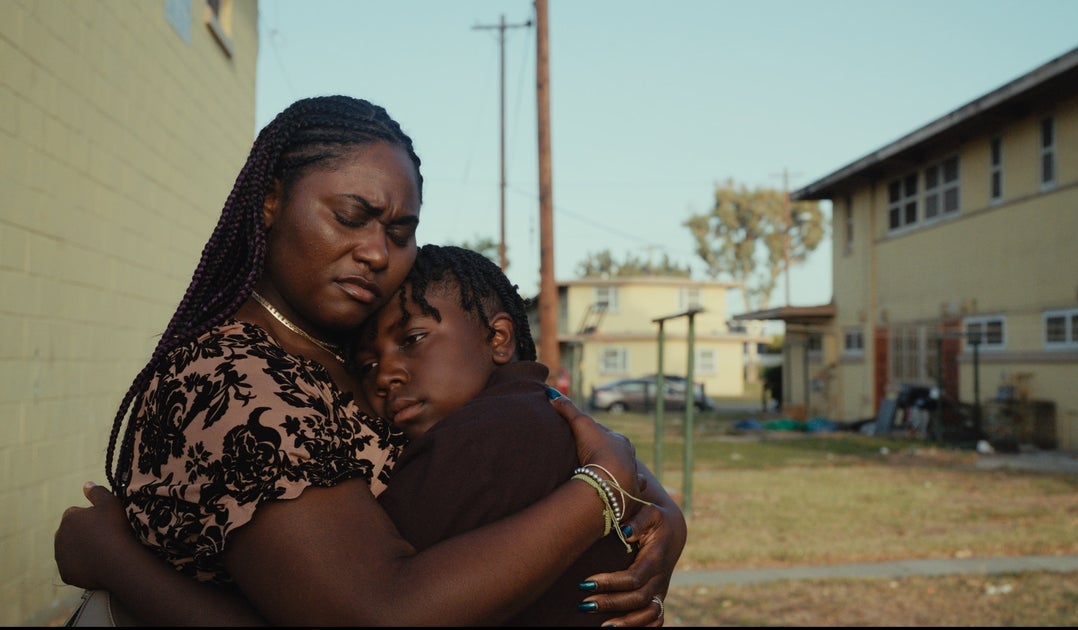
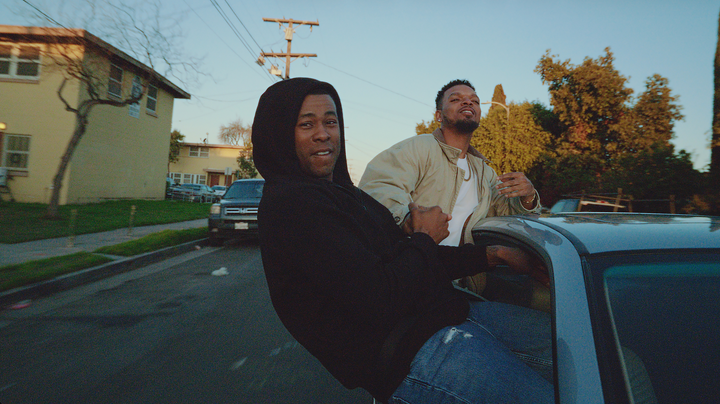
That’s sort of how the story goes in “If I Go Will They Miss Me.” Set in LA’s Watts neighborhood, the film opens with a warm welcome-home party for Big Ant (J. Alphonse Nicholson), who has just returned from a stint in prison, hoping to pick up life as he left it with his children and his wife, Lozita (Danielle Brooks).

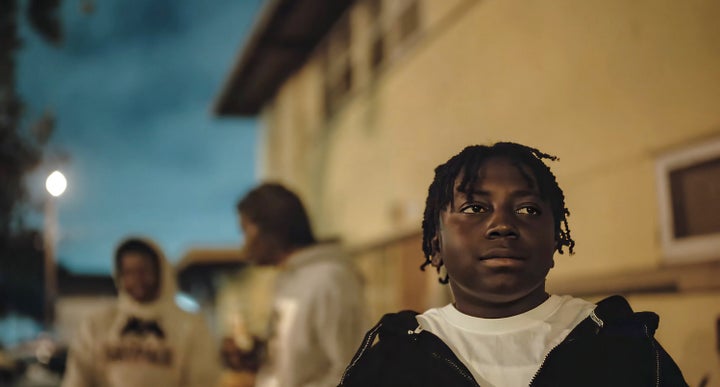
But time and distance have changed things, particularly his relationship with his son, Lil Ant (played by newcomer Bodhi Dell). Even so, the 12-year-old sees his father — and the world around him — with the same childlike wonder and awe that comes naturally to kids with active imaginations.

Lil Ant admires his father so much, in fact, that he sometimes draws him as Poseidon, “the most powerful god of the ocean,” dressed in a white toga and wielding a mighty trident — an image that comes to life in one of Lil Ant’s surreal daydreams. For a school project, he even builds a Pegasus costume, complete with wings resembling those on the airplanes that fly over his house at the nearby Los Angeles International Airport (LAX).

But Big Ant resents these mythical images of him and what they represent. He chastises his son for the drawings and eventually throws his Pegasus project in the trash. The scenes are heartbreaking: a father rejecting his son’s love. Yet, as Thompson-Hernández explains, they also reveal Big Ant’s deep fear of what he suspects may ultimately await his son’s future.

“He’s afraid of his child’s growth, [which means] he’s essentially afraid of his child’s flight,” Thompson-Hernández said of the troubled father and his film’s recurring plane imagery, which also evokes the Flying African folklore passed down from slavery.

“He’s afraid of flight, which is such a contradictory phrase,” he continued, “because flight for so many of us — historically, for Black people especially — has symbolized freedom, manumission, ascension and escape. But in this context, flight is so much more complicated than that.”

Flight and Greek mythology are central to the story of “If I Go,” in large part because both were equally important to Thompson-Hernández’s own childhood. As he recalls, he discovered Greek mythology around the same age as his young protagonist, finding in its stories a way to better “understand the mysteries of the universe,” including the complex people in his own life.

“It’s a way to understand the complicated men who were and were not in my life growing up,” he explained further. “And to try to understand the genesis of how Greek mythology can help us make sense of people who we love and also people who hurt us, and how we choose to live with them and make sense of them.”

That’s also what pulls Lil Ant toward Greek mythology. He discovers it at the cusp of adolescence, when the ancient stories of gods and heroes start to take on a new resonance and echo the people and experiences in his own life. Seeking comfort, Lil Ant begins weaving those same myths into his vivid imagination, using them to navigate the complicated world around him. It’s a part of childhood that still blows Thompson-Hernández away.

“It’s so beautiful and so interesting because I don’t think we give young people enough credit,” he said. “Like, how somebody so young can make such an astute and timely observation of how this person in their real life can also reflect Poseidon or Medusa, and make these really beautiful connections.”

The director finds that same sense of wonder in the way children imagine flight, too. In one scene of “If I Go,” young Black boys sprint down the block, their arms outstretched in an inverted V as though they might take off at any moment.

The striking image echoes Thompson-Hernández’s own childhood memories of running through the streets of South LA with his friends, pretending to fly like the planes they watched coming and going from LAX. To them, those machines in the sky were simply symbols of freedom. They weren’t yet aware of the harm they could cause.

“For a lot of us who grew up under the LAX path, flight is complicated,” the director said, recalling that, as a child, all he wanted was the chance to fly and see the world.

“On one hand, it’s inviting us to wonder about the world and triggering curiosity about where these airplanes are going and coming from,” he added. But at the time, Thompson-Hernández didn’t realize that those same planes passing over his neighborhood were also taking a toll on the health of him and his friends.

For a lot of us who grew up under the LAX path, flight is complicated.

“These fumes and the jet fuel ― we have asthma because of it,” he shared. “So flight for me is a complicated thing, because I’m able to dream and imagine about these beautiful pieces of metal in the sky. But these pieces of metal are also damaging me, and hurting us.”

“If I Go” considers flight as both a literal and metaphorical idea, reflecting the freedom to imagine a life beyond the circumstances we inherit and the uncertainty of where that path might lead. For Lil Ant, flight represents possibility. Meanwhile, for Big Ant, it carries the weight of everything that could possibly go wrong.

At the heart of it all is a father’s fear of his son’s maturation, and ultimately, of what he might come to see in the man he has long placed on a pedestal.

Like Lil Ant, Thompson-Hernández tended to focus on the good in the people around him as a kid rather than their flaws. Growing up in a working-class neighborhood, many of the men he knew were either gangsters or people who “worked in non-traditional jobs.” Even so, he saw them as role models.

“These were godlike figures who could do no wrong [in my eyes],” he said, “who maybe weren’t doing the best things in life, but we all thought they were the coolest.”

Looking back, he recalls, “We thought they were larger than life, and we all wanted to be like them.” But it’s not until you get older that you realize humans are so much more complex than that.

That perspective has yet to come for 12-year-old Ant in “If I Go.” To him, his father is still someone to admire and emulate. That’s why he shaves an imaginary beard and absentmindedly fiddles with the gold “A” chain around his neck just like his dad. He doesn’t know that Big Ant cheats on his mother or that he struggles with how to show up as the parent his children need. Those aren’t the kinds of questions you typically ask as a kid. And if you did, answers rarely came.

Thompson-Hernández remembers something similar from his younger years. He didn’t question why the men in his life seemed to disappear and reappear without warning. Instead of wondering where they had gone or why they kept leaving, he simply accepted their absence as part of his reality.

“I looked up to a lot of these men in my life, and had so much grace and compassion, and welcomed them back every time they left,” he remembered. “That’s literally what we did. If we would ask questions, we’d have no answers. So we just kind of developed this process of welcoming them back and meeting them wherever they’re at.”

It’s for that reason that Big Ant approaches his newfound freedom in “If I Go” almost like an exercise in muscle memory. He goes back to his job at the horse ranch, reconnects with his best friend JJ (Myles Bullock) and even takes Lil Ant to his happy place — the beach — just like he used to.

Returning to these familiar routines helps him find his footing in a world that has since moved on without him, as he hopes his memories will be enough to make it feel like his again. But, as Brooks’ Lozita is quick to remind him, he can’t “expect everything to go back to normal” after spending so much time away.

While “If I Go” largely centers on the distant relationship between Big Ant and his junior, Lozita is just as integral to the story, serving as the film’s emotional linchpin as her family begins to unravel. A working mother of three, she does everything she can to hold her household together while watching the people she loves drift further apart. It’s a more restrained role than audiences might expect from Brooks, but, according to her co-star, one she plays with breathtaking strength and depth.

“I can’t see anyone else playing this role,” Nicholson told me of Brooks’ performance. “She was meant for this. Her skill set and her vulnerability, her range that she was able to show in this piece, I think, will live on for a long time. And I think people will be so impressed, but also so moved by her work.”

Nicholson had just as much praise for Dell, whose quiet portrayal of Lil Ant left an equally strong impression on him. The actor was particularly struck by the young star’s restraint, arguing that Dell could hold his own alongside some of the more seasoned performers he’s worked with.

“One of my favorite scenes is when I come in, and we’re both sitting there watching the TV,” Nicholson recalled of the film, “and I say, ‘Hey man, I don’t want to have to keep telling you to quit drawing me.’ We’re improving in this scene, and he just so simply said, ‘Why not?’ And it was just like, oh man. I remember, I stopped in one of the takes, and said, ‘Man, what? You’re gonna make me cry.’”

“A lot of adult actors don’t know how to do that,” he added of Dell. “They’ll try to do something that outshines the next person, or try to steal a line, or just do something that does not work with the scene. But he was able to really find himself, matching tone and energy, looking me in the eyes and understanding, as a storyteller, how to move through a pace without feeling like you’re presenting something.”

Thompson-Hernández’s fly-on-the-wall approach in “If I Go” reveals the understated beauty of everyday life in the film’s Watts neighborhood, pushing back against a cinematic tradition that has too often looked at South LA through a lens of violence and hardship.

“I grew up on all the Black and Brown hood movies,” the director recalled, naming films like “Boyz n the Hood,” “Blood In Blood Out,” “South Central” and ’Boulevard Nights.”

Those movies made their own mark for LA. But what does it mean to bring something different to that legacy? For Thompson-Hernández, the first answer was to film on the ground in Watts’ Nickerson Gardens housing projects to capture the neighborhood as it truly is. Local residents also helped make the film feel more authentic.

“It was beautiful,” said Nicholson, “being in what’s considered one of the most dangerous neighborhoods in California. For me, it felt like paradise being there. All these children out running around playing; no cell phones, no laptops. And all the community members, they’re saying hey to each other, walking outside, cooking food, bringing beers up to each other’s houses.”

So much of the experience reminded him of the love he had grown up with back home in North Carolina. And to think that, out of budget concerns, the film’s former producers once considered shooting in completely different states that looked and felt almost nothing like the community Thompson-Hernández was determined to portray. His answer was always no.

“Because Watts and South Central are so specific, sonically, artistically, emotionally and spiritually,” Thompson-Hernández explained. And he’s right. It’s hard to imagine the film without the neighborhood’s distinct sounds becoming part of the story itself — from the loud plane that passes by during the climactic confrontation between Big Ant and Lil Ant to the everyday rhythms that ground the community.

“Our ears are so smart and in tune with what’s happening. I wanted to have a bigger conversation, too,” Thompson-Hernández said of his vision for the film, which quietly draws attention to Watts’ dramatic change from a once overwhelmingly Black neighborhood to one that is now predominantly Latino.

“How do I talk about what this Black family is going through in the middle of demographic change and all these things going on?” That question stayed with Thompson-Hernández throughout the making of his film, informing even his sonic choices, such as letting “Mexican music from a neighbor’s house always seep through the walls.” It’s a subtle nod to the broader conversations he hopes “If I Go” will spark beyond its heartbreaking father-son story.

“Instead of having someone on a soapbox talking about this is a Black neighborhood that’s not Black anymore,” he explained, “I’m trying to have that conversation sonically.”

That clever approach is part of what sets Thompson-Hernández’s filmmaking apart from most. It’s a sensibility shaped in part by his wide-ranging career in radio, journalism and book writing. But he also attributes much of it to his upbringing, having grown up around “the best storytellers who could spin a narrative in the craziest way.”

“For me, the most beautiful and intricate storytellers are people who are in my family,” he shared, “who never went to school, never got a master’s or a PhD and never worked at The New York Times [like me]. I come from a family and community of deep oral storytelling.”

That influence comes through in the compelling dialogue and narration of “If I Go,” another element that caught Nicholson’s attention when he learned about the project.

“When I first read the script, I knew exactly who these people were,” the actor said of the film’s characters. “I could tell who they were off the page. They reminded me of my family, cousins and aunties. I think Walter Thompson-Thompson-Hernández has the August Wilson bug in him, where we did a lot of improv, but the scenes that were on the page were very much scenes that you could just hear.”

Indeed, Nicholson found an unmistakable familiarity in the film’s characters after learning that some — including Big Ant and Brooks’ Lozita — were based on real people. Perhaps that’s what made it all the more natural for Nicholson to inhabit Big Ant while simultaneously taking on another complicated version of fatherhood in HBO’s superhero series “Lanterns”: “That was pretty fun,” the actor joked.

Still, he welcomed the perspective the two roles gave him as he shaped Big Ant into a character he could connect with on a deeper level.

“We had certain similarities,” Nicholson said of relating to the real Big Ant. “He’s a father. I’m a father. I know what it is to be flawed and complex. I also know what it’s like to have run-ins with the law; all those things.”

But what stood out most to the actor was Big Ant’s “courage and strength” in facing the difficult situations in his life, including his strained relationship with his son. Those qualities gave Nicholson a way into the character that extended beyond the specifics of his story. While he hasn’t faced the exact same circumstances, the emotions behind them still resonated.

“I know what that feeling is to know that your child sees you in a certain way. But at the same time, you know that you got a lot of work to do,” he said. “I’ve never been quite on the spectrum of not wanting my child to see me in a good way, but also understanding what it is to have conversations with them to say, ‘Hey, look, I’m not perfect. I’ve messed up in life.’ That part I can relate to.”

Even more personally, Nicholson connected with Big Ant’s struggle to confront his shortcomings as a father and partner, as well as the grace Lil Ant continues to extend despite them. “It’s something about your children, where they can be very forgiving and loving in that way,” the actor added.

That’s essentially the idea Thompson-Hernández set out to explore in both his short and feature film, applying the intimacy of a documentary and the visual language of a poem to his delicate coming-of-age story.

“This is a movie about what grace looks like, and what redemption can feel and look like for somebody in our family, in our lives, who has harmed us,” he said. “How do we learn from this 12-year-old boy? How do we learn to extend more grace? How are we reminded that sometimes it’s these children and young people in our lives who can teach us so much about extending grace and, in spite of someone’s flaws, how can we still see them as human and lovable and worthy of redemption?”

Moving films like “If I Go Will They Miss Me” tend to have a big impact on audiences who rarely get to see such thoughtful portrayals of Black and Brown people from inner-city communities onscreen. Perhaps that’s why, even before the film opened nationwide on Sept. 18, people were already rallying on social media and encouraging one another to support it.

“Seeing all my folks say, ‘Oh, we’re going to see that,’ and ‘We’ve got to pull up’— that is amazing,” Nicholson said of the positive response. “That’s what I do it for. I do it for us.”

For Thompson-Hernández, the fact that his film came together the way it did feels almost miraculous, especially as he reflects on how support for Black filmmakers has waned in recent years, following the wave of corporate investment in DEI initiatives after 2020’s anti-racism protests.

“Everyone says, if we would’ve made this movie in 2016 or 2020, we would have had this big budget and all these sort of things,” he noted. But it seems his film never needed any of that. Just a story that would make audiences feel something real.

Today, those mainstream opportunities are still pretty limited for “niche stories.” But Thompson-Hernández takes comfort in being able to bring his own to the screen and, in doing so, perhaps change how audiences see them.

“The word that people always talk about is universal,” he noted. “But I think the universality exists in the specific.”

“I’m not the first to say that, but it’s so true,” he continued. “I think the more specific I get about my experience of being a 12-year-old boy who was yearning for his father and to make sense of a mystery in the world, the more that comes out on screen; the more someone who doesn’t share my experience can maybe have a similar sort of experience.”

The filmmaker says it’s “been beautiful” to have the chance to screen his film at festivals around the world. It almost feels full-circle to the days when he wondered what else was out there beyond the confines of his neighborhood.

“It’s even more beautiful that I’ll be in Korea or Asia or somewhere in Europe, and I get a question about someone’s father or about the craft of the movie or about Watts,” he shared. “People are seeing themselves in this movie, and I never imagined.”

But that’s the kind of art Thompson-Hernández wants to continue making at this point in his career — films that are rooted in discovery, honesty and genuine curiosity. And that work is ultimately rooted in where he comes from.

“It’s a love letter. It’s a poem. It’s an offering,” he concluded. “I grew up on very specific LA movies … So for me, this is just an ode to my childhood.”

“If I Go Will They Miss Me” is now playing in theaters.

By entering your email and clicking Sign Up, you're agreeing to let us send you customized marketing messages about us and our advertising partners. You are also agreeing to our Terms of Service and Privacy Policy.
Comments
You must be logged in to comment.