huffpost Press
She Lost Her Dog To A Surprising Household Item. Now She's Warning Every Pet Owner.
Images
1 / 9

2 / 9

3 / 9
4 / 9
5 / 9

6 / 9

7 / 9

8 / 9

9 / 9
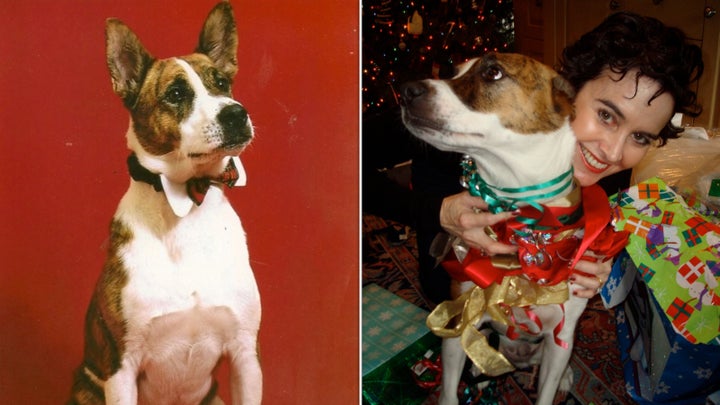
It was 10 days before Christmas in 2011, and Bonnie Harlan had stepped out for about 45 minutes to run some errands. When she returned home, her 4-year-old rescue dog Blue was missing from his usual spot.

“He was not there to greet me at the door, which was very unusual,” Harlan told HuffPost. “I kept looking and calling him, and I couldn’t find him. Finally, when I was upstairs, I saw him out of the corner of my eye, lying under a table, and I could see from far away that there was a Cheetos bag over his head, and he wasn’t moving. I instantly knew he had suffocated.”

Blue had knocked over a trash bag in the kitchen, found the nine-ounce snack bag and gotten his head stuck inside, unable to remove it with his paws. As he inhaled, the flexible plastic material started to seal around his neck and cut off his oxygen supply.

“He was still warm, and I could hardly get the bag off his head,” Harlan recalled. “I called my vet, hysterical, and he walked me through CPR, but it was too late. My vet later said, ‘You know, Bonnie, I could have warned you of 100 things, but a chip bag would not have been on the list.’ At that moment, I knew that if I had never heard of this, a lot of people hadn’t heard of it either.”

That realization led Harlan to found her nonprofit, Prevent Pet Suffocation, in early 2012 to raise awareness around the dangers that chip bags and other similar household packaging pose to animals.

When it happens, people are shocked. They find their dog or cat, and they think it’s a freak accident, a fluke.

Most chip bags, snack bags and similar food packaging are made from Mylar-like materials, which are strong, flexible and designed to keep food fresh. When a dog or cat puts their head inside a bag to sniff out leftover crumbs, the bag can create a vacuum-like seal around their neck. As the pet gets anxious and breathes faster, the bag tightens further, and there’s no way out unless someone finds them and removes it.

“When an animal puts their head in this kind of bag and starts breathing, it pulls the bag tighter around their neck, creating the seal,” Harlan said. “Dogs don’t have thumbs. They can’t pull it off, they can’t see and they start to panic. It’s a terrifying experience, and it only takes about three to five minutes for them to lose their life.”

She emphasized that dogs and cats of all breeds and sizes are vulnerable to pet suffocation, and she’s on a mission to keep pet owners informed of the risk.

“It doesn’t matter if it’s a Chihuahua or a Great Dane, there is a bag that could suffocate them,” Harlan said. “I typically hear from two to three people a week, sometimes more, who have experienced this with their pets. I’ve heard from people in France, Australia, England, Canada, South America and more.”

Classic chip bags tend to be the biggest culprit in these kinds of incidents, according to a survey conducted by Prevent Pet Suffocation.

“Chip bags came in at almost half ― 47%” of pet suffocation incidents, Harlan said. “Part of the reason is because they’re so popular. Everybody loves chips. They’re everywhere.”

Snack bags for other items, like cookies, crackers, popcorn and cheese balls, are also common sources of pet suffocation, as are pet food bags.

“Basically any container that has held food ― any plastic food bag, frozen food bags, yogurt cups, peanut butter jars, mayonnaise jars ― is a risk,” Harlan explained. “An animal can get their head stuck in it because they smell food and go for it.”

Cats face their own specific risks.

“Cats are very vulnerable too because they’re so agile,” Harlan said. “They jump up on refrigerators, dryers, washers and countertops in a second and can get to whatever you have up there. And I’ve had so many people contact me who said their cat jumped on the counter, knocked a food bag off, and then their dog got into it.”

She added that cats love to squeeze into tight spaces, and some have suffocated inside bins, boxes and other containers with lids that close on top of them.

One of the most important points Harlan emphasizes is that the risk extends beyond the kitchen and beyond times when the owner is out.

“Some people think, ‘Well, I crate my dog when I’m gone, so it’s OK,’ but so many dogs have suffocated while the owners were home,” she said. “They were in the shower. They were watching TV. They were having a party. They were distracted, and their dog or cat got into trouble.”

Cars are another frequently overlooked danger zone.

“People get fast food and leave food packaging in the car,” Harlan said. “Maybe they run in to do an errand, come back and their dog has gotten into the food bag or even the paper cups.”

She recalled one case in which a dog was left briefly in a car and began suffocating in a food bag. The owner found him just in time to remove it and rush him to a vet to put the animal on oxygen. Garages, yards and guest rooms present risks, too.

“People travel with snacks, and they just put them out on the side table, not thinking that someone’s animal can get into it,” Harlan said. “I tell all my guests, ‘Do you have any food in your suitcase? Do you have any in your purse? If so, you need to lock it up, because a dog can smell food from a mile away.’ You want to educate your guests, pet sitters, house sitters, kids, kids’ friends, anyone that comes into contact with your home and your pets.”

Fortunately, there are simple steps people can take to help prevent pet suffocation.

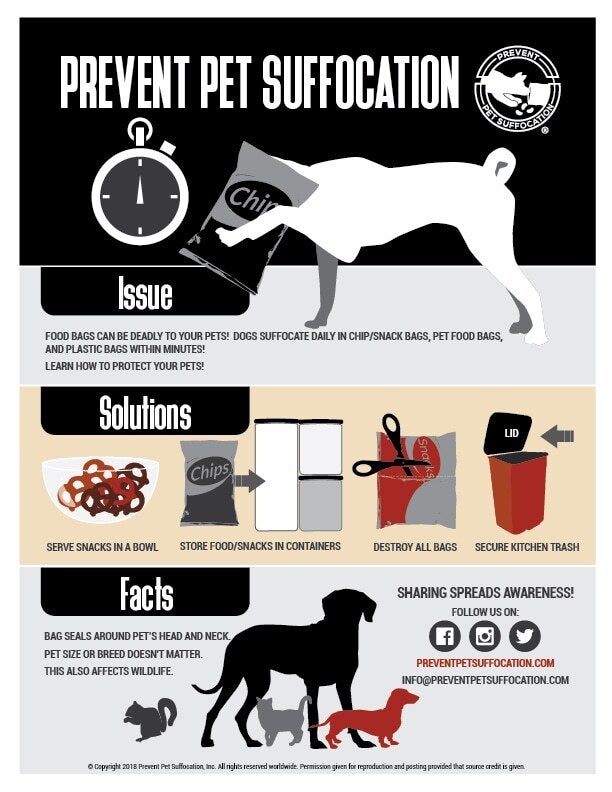
“One of the first things I tell people is when you bring home food bags, chip bags, snack bags, take the food out of the the bags and store them in containers high up on a shelf,” Harlan said. “Then cut those bags up ― vertically, diagonally, in pieces, however. You don’t want to leave a portion of it that a pet can get into. And if you cut them up, you’re not only protecting pets, but you’re protecting wildlife, stray dogs and feral cats because this is all going to end up in a landfill.”

Cutting up your snack bags is especially important if you aren’t taking your trash out right away and you have a nosy dog.

“Put the lids back on jars before you throw them out,” Harlan added. “And keep your trash can locked. Keep it behind a cabinet or in a pantry with your pantry door closed. And serve chips and snacks in bowls instead of food bags.”

The Prevent Pet Suffocation website offers additional recommendations, like checking your vehicles for food and drink containers, learning pet CPR and storing pet food bags out of reach of your animal instead of on the floor of your garage.

“I tell everyone, look around your house every day and ask ‘What is the suffocation risk to my to my pet?’” Harlan said.

She also urges people to spread the word around pet suffocation to friends and family and on social media.

“When it happens, people are shocked,” Harlan said. “They find their dog or cat, and they think it’s a freak accident, a fluke. They’re grief stricken. They might be embarrassed. They think they’re a terrible pet owner. And they just don’t bring it up to many people. And they don’t necessarily know how common it is. So I’m on a mission to educate the public.”

She believes spreading awareness is the best defense against these incidents.

“Making people aware of little simple things they can do is the key,” Harlan said. “The best tool you can have in your kitchen is a pair of scissors. That can make all the difference.”

By entering your email and clicking Sign Up, you're agreeing to let us send you customized marketing messages about us and our advertising partners. You are also agreeing to our Terms of Service and Privacy Policy.
Comments
You must be logged in to comment.