huffpost Press
Aw, Kash Patel Thinks He Can Pull Off This Trump Trademark
Images
1 / 9

2 / 9
3 / 9

4 / 9
5 / 9

6 / 9
7 / 9

8 / 9

9 / 9
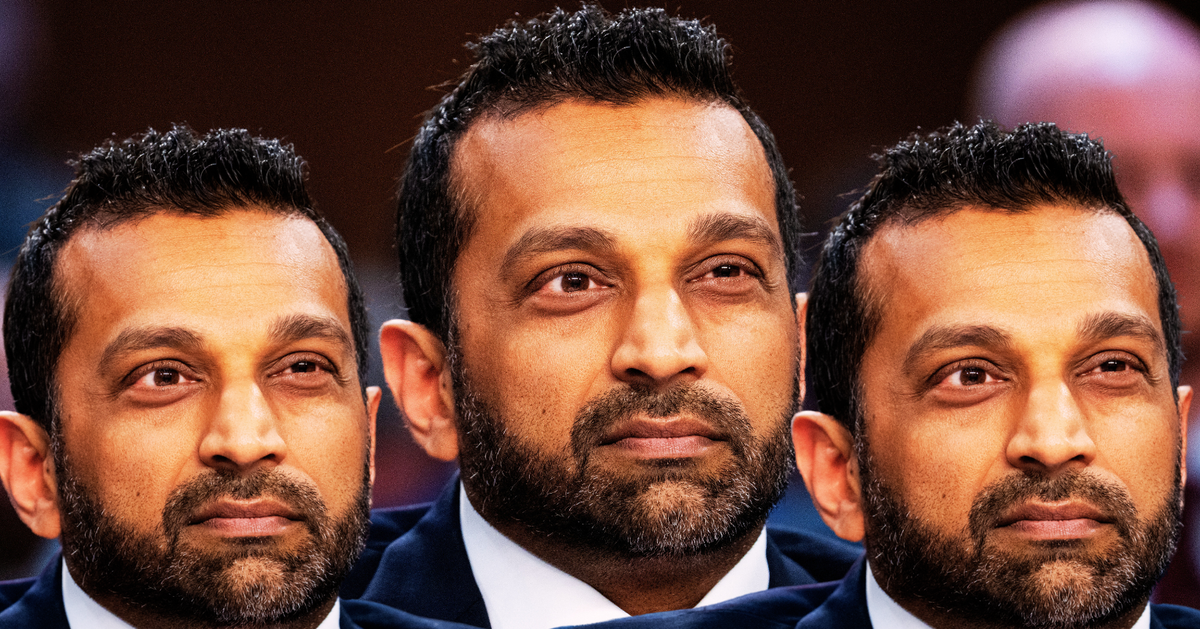
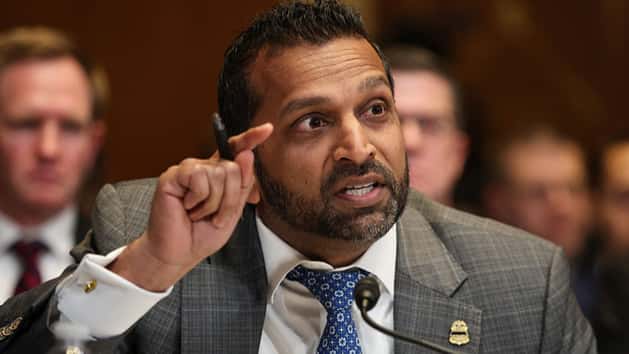
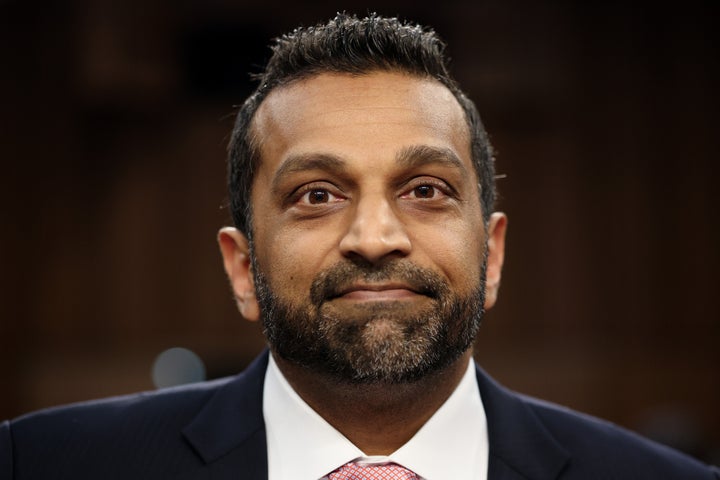
Taking a page from Trump’s playbook, FBI Director Kash Patel has started talking about himself in the third person.

In an interview with Sean Hannity on Fox News Tuesday night, Patel discussed his nearly five-hour Senate Judiciary Committee hearing, where he faced questions about the Epstein files and whether he would rule out sending federal agents to polling stations during the November midterms. (Asked by Democratic Sen. Peter Welch of Vermont if he would pledge not to interfere with the voting in the November elections, Patel replied, “I pledge unequivocally that I will not participate in your charade of lies.”)

Debriefing with Hannity later in the night, Patel couldn’t help slipping into a Trumpian third-person. (Using names or pronouns like “he” or “she” to refer to yourself instead of the first person ― “I” or “me.”)

Kash is now referring to himself in the third person pic.twitter.com/i8EEAlEJVw

“President Trump, Director Kash Patel, and his team have delivered what [Democrats] never could. And the fact that we delivered it is ticking them off more than anything they could possibly think of,” he said. “So when you’re over the target, what are they gonna do, Sean? They’re gonna yell at you about your personal life, lie about it, and threaten the ones you love, which they did repeatedly today.”

Clearly, his boss’ communication style has rubbed off on him. Trump talks ― and writes ― in third person so often, The Washington Post was able to cobble together a one-minute, 46-second video of his best third-person moments in 2019. (If it were updated for 2026, the length would be unendurable.)

“They all want the endorsement of Trump,” Trump said of his political influence in 2021, for instance. “It’s a very important treasure.”

“Somebody please explain to Michelle Obama that Donald J. Trump would not be here, in the beautiful White House, if it weren’t for the job done by your husband, Barack Obama,” a petulant tweet of his read in August 2022, after the former first lady criticized a then-in-office Trump.

Trump has made the third person part of his self-aggrandizing political persona, but not everyone has the ego to pull it off.

“I don’t think Patel pulls off the third person reference very effectively. It comes off as forced and contrived,” said Jeff McCall, a communication professor at DePauw University who has researched Trump’s media strategies and unique political communication style.

It’s another example of how those in the Trump administration try to mimic the president’s habits, whether it’s the golden Trump tan or his social media taunts and crude stump-speech humor. It rarely pays off for them in the same way it does for their leader.

“Whatever one thinks of Trump, it is clear he is an original,” McCall said. “Trying to copy his speaking style, habits or rhetoric comes off as inauthentic and will likely fail.”

Illeism — the vaguely ridiculous academic term for referring to yourself in the third person — is usually the province of 3-year-olds (“Charlie hungry,” “Charlie wants Bluey on”). But it works for Trump, fitting neatly into his bombastic self-narrative and inimitable, straight-from-the-hip rhetoric style.

When Trump does it, it’s “grandiosity, pure and simple, not some ironic joke,” Chris Stevens, a psychologist and the host of the podcast “Psychology to Live By,” previously told HuffPost.

“I think Trump deliberately uses it as a rhetorical device,” Stevens said. “He speaks a lot in the third person generally: note his use of the words ‘everyone,’ ‘people,’ ‘everybody.’ This is a standard rhetorical trick to give a sense of facticity: What he says isn’t his opinion but an objective fact.”

Speaking in the third person was a common communication strategy for two other politicians, too: Richard Nixon, the 37th president of the United States, though only in his written memos to White House staff, not so much verbally. Bob Dole famously referred to himself in the third person throughout his lengthy political career, most notably during his 1996 presidential campaign. (You see how that worked out for him.)

Mark Brockway, a teaching professor of political science at Syracuse University and the co-author of “The Shadow Gospel: How Anti-liberal Demonology Possessed U.S. Religion, Media, and Politics,” thinks Trump may employ illeism to distance himself from his own unpopular decisions.

“He can describe past events or decisions as if they were done by a completely different person,” Brockway told HuffPost. “This allows him to pivot seamlessly from one side of an issue to another, completely without consequence.”

In Patel’s case Tuesday night, perhaps it gave him a confidence boost to use the third person after that tense Senate hearing. While it may sound awkward and a little self-aggrandizing, a 2014 study found that talking to yourself in the third person, at least in your internal self-talk, can have a calming effect and bolster confidence.

Using the third person, the researchers found, helps people create emotional distance from their problems and make more neutral assessments of how they come across in public. (But again, that’s using third-person in their inner self-talk, not during a Fox News appearance.)

Social psychology research also explains why people mirror others’ speech patterns and gestures, including those of their bosses. Coined in the 1970s by social psychologist Howard Giles, communication accommodation theory (CAT) holds that people adjust their speech and nonverbal behavior in response to one another. Workers may converge — matching or adapting their communication style to sound more like their boss — to gain approval, show respect or reduce social distance.

Patel, who served in several key national security and defense roles during Trump’s first administration, has long been one of the president’s most loyal allies. After leaving office, he authored a series of children’s books about “deep state” enemies trying to steal “King Trump’s” crown (casting himself, natch, as the wizard who saves the king.)

And when the Justice Department began investigating Trump’s handling of classified documents in 2022, Patel publicly defended Trump’s claims about the records and later testified before the grand jury investigating the case.

That unwavering loyalty to Trump paid off; in 2025, Trump tapped him to run the nation’s premier law enforcement agency, even if the president joked that Patel did not quite fit his own central-casting image of a bulldog FBI director. (“He’s no J. Edgar Hoover,” Trump reportedly told an adviser, according to the New York Times.)

But copying Trump’s patented speech patterns may not do Patel any favors, especially as he continues to take heat for his tenure at the FBI.

“When Patel mimics Trump‘s speech patterns or media strategies, he draws more attention to himself and not in a good way, especially for his relationship with Trump,” Brockway told HuffPost.

What Patel and others are saying when they speak in the third person is, “I am the leader, I am so important that I have transcended everyone around me, and I am now something bigger,” Brockway said.

“But the Republican Party and Trump‘s federal government can only have one leader,” he said. “So Patel’s use of illeism is dangerous ground; Trump may see it as a signal that Patel is trying to gain too much power and attention for himself at the expense of Trump.”

In other words, better watch it, Director Kash Patel — you’re no J. Edgar Hoover.

By entering your email and clicking Sign Up, you're agreeing to let us send you customized marketing messages about us and our advertising partners. You are also agreeing to our Terms of Service and Privacy Policy.
Comments
You must be logged in to comment.