yahoo Press
2 key trucking groups in filing raise alarm on Penske decision fallout
Images
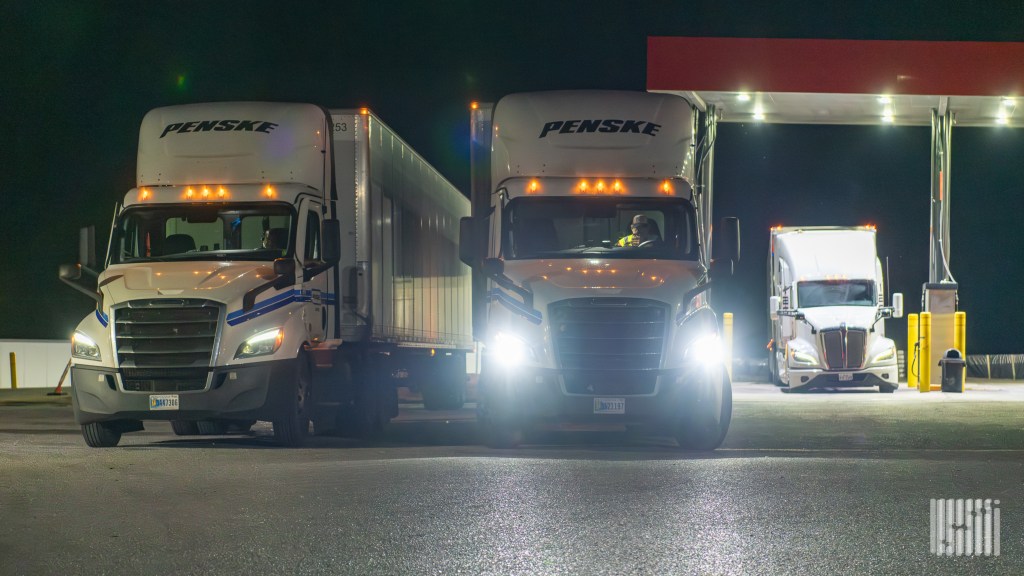
1 / 5
2 / 5

3 / 5
4 / 5

5 / 5
The liability case involving parts of the Penske network of companies that has bounced from a federal court in Texas to a Penske loss at the appellate level is being viewed by two key industry associations as so important it wants a full Fifth Circuit hearing following the case being  remanded to the lower court.

The American Trucking Associations (ATA) and the Truckload Carriers of America (TCA) last week filed a joint amicus brief with the Fifth Circuit asking for an en banc hearing to reconsider the August 4 decision by a three-judge panel. That appellate court decision remanded the case back to the U.S. District Court for the Southern District of Texas.

The two trade groups are represented in their action by the trucking-focused Scopelitis law firm.

Groups not focused on Montgomery

While part of that appellate ruling was impacted by the fallout from the Supreme Court decision in Montgomery vs. Caribe Transport II, the ATA/TCA request for an en banc hearing is aimed squarely at the other part of the case involving Penske Logistics, a carrier.

Penske Logistics is part of Penske Transportation Solutions which in turn is part of several companies bearing the Penske name, as well as indirect ownership by Mitsui & Co.

In that August 4 decision, the Fifth Circuit overturned two lower court decisions that were favorable for Penske Logistics and its brokerage affiliate, Penske Transportation Management (PTM).

The appellate court's overturning of the favorable lower court decision for PTM rested on the Supreme Court's Montgomery precedent. PTM on the lower court level had been granted summary judgment and removed as a defendant under a then widely-held interpretation of the Federal Aviation Administration Authorization Act (F4A).

But the early May Montgomery decision ended that F4A protection for brokers, and the Fifth Circuit overturned PTM's summary judgement finding.

The chain of how the freight moved

The pathway of the freight whose history is at the core of the case, with a large number of defendants and plaintiffs and which has become known as Crane vs. Liberty Lane, is not just for background information. It's at the heart of the legal debate that has seen Penske-related companies win one (district court) and lose one (Fifth Circuit), and which ATA and TCA are now trying to get the appellate court to review after the Penske losses at the appellate level.

The players in the multi-company supply chain were Adient, a manufacturer of car seats; Penske Logistics, a carrier that contracted with Adient to move their product; PTM; Liberty Lane, a carrier that PTM contracted with to actually ship the product; OK Trans, which Liberty Lane double-brokered the load to, unbeknownst to Penske Logistics or PTM; and Satnam Singh Lehal, behind the wheel of an OK Trans truck that in December 2018 collided with a pick-up truck driven by Lyndon Dean Meyer in Bee County, Texas. Meyer was killed in the crash.

Liability moves up the chain

The en banc request filed by ATA and TCA is aimed at the potential liability of Penske Logistics created by the appellate court decision. That the Penske-related carrier could have any liability at all, which was the core of the Fifth Circuit decision, is being viewed with something bordering on horror by several in the trucking industry.

The key sentence in the appellate court's August 4 reversal of the lower court is citing precedents–the interpretation of which the ATA/TCA filing is contesting–that led the judges to conclude "Penske's assumption of control and responsibility of the vehicle made Penske Lehal's (the driver involved in the crash) statutory employer, regardless of whether Penske and Liberty Lane complied with the formal regulatory requirements."

The ATA/TCA filing acknowledges that "since the earliest days of trucking, a motor carrier was liable for accidents caused by its employee drivers."

At issue: 'statutory employment liabiilty'

But that is not what ATA/TCA says is what the appellate court decision. The Fifth Circuit found that Penske had "statutory employment liability" as a result of it hiring a trucking company with motor carrier authority (which then hired another carrier), and that the liability created by the accident passes up the line to the initial carrier, which is Penske.

The ATA/TCA amicus brief says that "Under (the Fifth Circuit) precedent, that means a motor carrier leasing a specific vehicle from an owner-operator to operate under the motor carrier's authority is liable for accidents caused by that owner-operator."

That conflicts with Federal Leasing Regulations (FLR), according to the Scopelitis-authored brief.

"The (Fifth Circuit) imposed statutory employment liability on Penske Logistics under the FLRs for an accident caused by an employee driver (Lehal) for a separate, authorized carrier (OK Trans), which Penske Logistics knew nothing about," the brief says.

Double brokering, but it isn't the legal issue

While double-brokering has been a recent industry focus, the fact that the load was double-brokered to OK Trans is not raised as a legal issue by the brief. The statutory employment liability that ATA/TCA see as having been imposed on Penske Logistics by the Fifth Circuit would have generated the same legal argument if the supply chain had ended with Liberty Lane and it was involved in the fatal crash.

Since OK Trans was operating under its authority, the ATA/TCA argument goes, its involvement in the wreck does not extend back to Penske Logistics. The FLRs that spell out the responsibility of a company like Penske Logistics when a carrier is operating under the Penske motor carrier authority "do not apply to agreements to have an authorized motor carrier provide delivery services under its own authority," according to the brief.

Those FLRs, the brief says, were set up to regulate relationships where a carrier leases equipment from a company with no authority to be operated under the carrier's authority instead.

But the argument being made by ATA/TCA is as a subheading in the brief says, "the FLRs do not apply when carriers transport goods on equipment under their own authority."

"The (Fifth Circuit) theorized an agreement between Penske Logistics and Liberty Lane or OK Trans to use the OK Trans vehicle driven by Lehal to transport the shipper's goods," the brief says. "But there was no evidence in the record of a written or oral agreement of that kind."

Upending the entire model

If the Fifth Circuit precedent were to stand, the brief says, the "upshot…is that the entire industry has been in violation of the FLRs for decades, because upstream carriers have not been executing FLR-compliant leases with downstream carriers."

The ATA/TCA argument sees an enormous impact on the trucking industry.

"Whether due to lack of available equipment or drivers, motor carriers have long turned to other motor carriers to supplement capacity to safely and efficiently meet a shipper's needs," the brief says in its closing arguments. "The panel's decision will chill that option, constrict the safe and timely flow of freight and increase costs as insurers account for a new, judicially-created liability regime. "

More articles by John Kingston

Likely BMO swan song shows trucking credit strengthening

A newcomer to Roadcheck driver violations top 5: speaking English

One man paints challenging outlook for brokers' insurance

The post 2 key trucking groups in filing raise alarm on Penske decision fallout appeared first on FreightWaves.
Comments
You must be logged in to comment.