huffpost Press
Mamdani Got Some Blunt Feedback From New Yorkers — And His Response Is Shocking People
Images
1 / 9

2 / 9
3 / 9

4 / 9

5 / 9

6 / 9

7 / 9
8 / 9

9 / 9
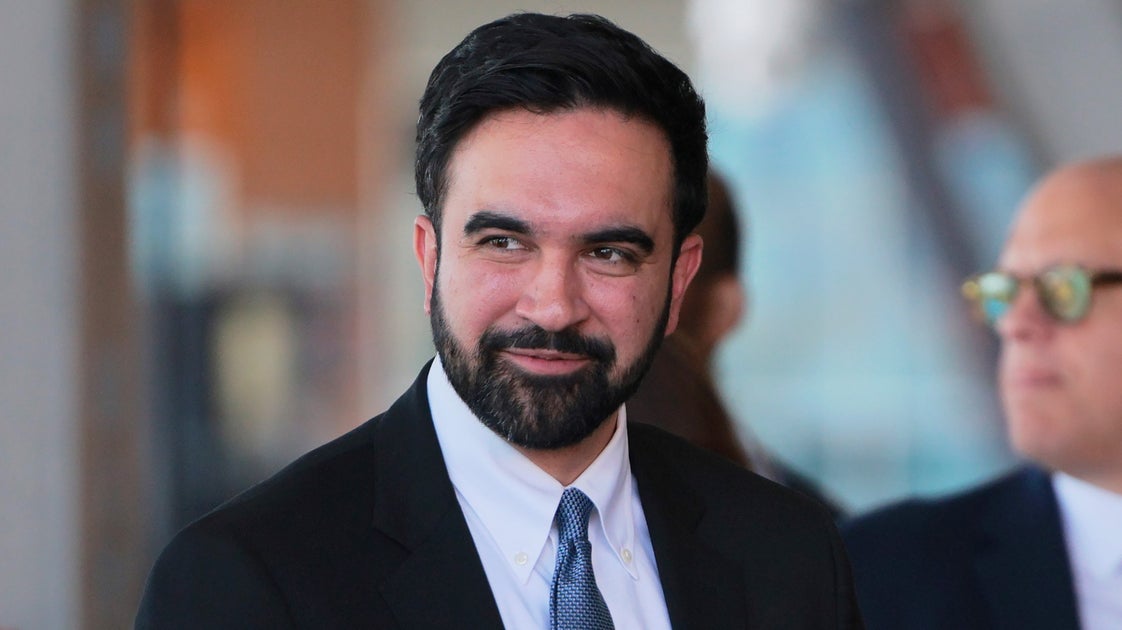
New York City Mayor Zohran Mamdani is often spotted riding a bike around town in his signature suit and tie. But one important accessory he’s missing is a helmet ― an absence that’s drawn pointed comments from his constituents.

But instead of ignoring the criticism or getting defensive, the politician did something so apparently groundbreaking that it broke the internet: He listened.

In new Instagram video from the mayor, Mamdani responds to the comments, stating simply: “You’re right. I’ve got to do better.” He then unboxes a new bike helmet to hit the streets with proper protection. His caption: “I’m listening, I’m learning. Safety first, NYC.”

The response was strong.

“First in my bloodline to hear a politician say ‘you’re right, I’ve got to do better,’” one commenter wrote. “I honestly feel like witnessing a politician simply say ‘you’re right, I’ve gotta do better’ just healed something within me. It’s so easy to do and yet SO FEW PEOPLE (not just politicians) have the humility to do it,” said another.

Beyond the small but refreshing display of political humility, Mamdani’s helmet moment is also a timely reminder of an important step too many cyclists overlook.

“A helmet is designed to act as a shock absorber,” Dr. Alina Mitina, an emergency medicine specialist with Hackensack University Medical Center, told HuffPost. “When you hit the ground, the helmet’s inner foam layer crushes inward, absorbing the destructive energy of the impact so your skull doesn’t have to.”

But without a helmet, your unprotected head takes the full, blunt force of the pavement, vehicle, utility pole, etc.

“That sudden deceleration causes your brain to slam against the inside of your skull, turning a simple fall into life-threatening skull fractures, brain bleeds and severe traumatic brain injuries,” Mitina said.

Trauma surgeon and SurgeOn co-founder Dr. Jeremy Heffner believes people dramatically underestimate how much damage a seemingly slow impact can do.

“At casual riding speeds of 10 to 15 miles per hour, a rider thrown from a bike can suffer bleeding on the brain, skull fractures, diffuse brain injury and death,” he explained. “Picture being flung headfirst over the handlebars at 15 miles per hour, watching the cold, hard asphalt rushing up at your face. A helmet is built to take the energy that would otherwise slam into your skull and route it into a material designed to crush and deform, absorbing and spreading that force away from your brain.”

And that’s not just a hypothetical. Emergency doctors see the results of wearing and not wearing a helmet play out every day.

“I’ve treated many cyclists who were able to go home to their families purely because their helmet took the brunt of the damage instead of their brain,” Mitina said.

The data backs this up as well.

“Bike helmets can reduce risk of serious injury by as much as 50 to 60%,” said Dr. Daniel Bachmann, an emergency medicine physician at The Ohio State University Wexner Medical Center. “This can include injuries such as scalp lacerations, concussions, intracranial bleeding and skull fractures.”

According to large systemic reviews spanning multiple countries, helmet use has been associated with about a 65% reduction in fatal head injuries and reduction in severe head injuries by up to 70%.

Children face particular risks when it comes to these kinds of injuries.

“While adults may fall from greater heights or travel at higher speeds, children are especially vulnerable to head trauma due to lower bone density, flexible cranial sutures and weaker neck musculature,” said Harrison Kroos, an avid cyclist and customer experience manager at woom Bikes. “When parents wear helmets consistently, they do more than protect themselves ― they model lifelong safety habits for their kids.”

The good news is that helmet technology ― from the materials to the engineering ― only continues to improve. Barry Miller, the director of outreach and business development at the Virginia Tech Helmet Lab, noted that the lab’s bike helmet ratings actually had to be rescaled recently just to account for how much better they’ve have gotten.

“Bike helmets are generally what we call ‘single impact’ helmets because they are designed to deform on impact,” Miller said. “They crack, crush, crumble ― and that’s how the helmets absorb impact energy so less is transferred to the rider’s head. Bike helmets have really improved the last two years and significantly reduce the impact energy to a rider’s head. A top performing helmet could very well be the difference between life or death.”

But simply owning a high-quality bike helmet is only half the battle. Too many people wear them wrong, which reduces their effectiveness.

“A helmet that is too loose, tilted back or improperly buckled cannot provide the protection it was designed to offer,” said Michelle Jamison, a community health program manager at Intermountain Primary Children’s Hospital. “Proper fit is just as important as wearing a helmet in the first place.”

For starters, your bike helmet should not be angled forward or back on your head like you might with a baseball cap.

“A helmet should sit level on the head, low on the forehead, about two finger widths above the eyebrows,” Jamison said. “The side straps should form a ‘V’ around the ears, and the chin strap should be snug enough that only one finger fits between the strap and the chin.”

Kroos recommended three quick checks to verify fit. First, the two-finger rule: Make sure the front edge of the helmet sits level, two finger-widths above your eyebrows. Second, the one-finger rule: Buckle the chin strap so that no more than one finger fits between the strap and your chin. And third, the snugness test.

“Gently shake your head,” he said. “The helmet shouldn’t wobble or slide around. Adjust the rear dial or pad inserts until it fits snugly yet comfortably.”

Heffner offered another suggestion to test for bike helmet fit.

“Open your mouth wide and you should feel the helmet pull down against the top of your head,” he said. “That is how you know it is actually secured. Get those things right, and the helmet can do what it was built to do. Get them wrong and you are essentially wearing a very expensive hat.”

When it comes to choosing the right helmet, the experts who spoke to HuffPost recommended looking for a CPSC (Consumer Product Safety Commission) certification sticker.

“Riders using e-bikes should look for a helmet that meets the NTA-8776 standard, which is designed and tested for the higher speeds associated with e-bikes,” Jamison said.

It’s also worth knowing that not all helmet designs are created equal. Michael Bottlang, director of the biomechanics laboratory at Legacy Research Institute, noted that helmets typically have a liner made of EPS (expanded polystyrene), a crushable foam layer that reduces skull fracture risk.

“Brain injuries result from torsional forces, or torque to the head, as the head hits the ground,” he said. “Torque may not be reduced by a standard EPS liner. There are several impact liners on the market that were specifically designed and tested to reduce the brain injury risk ― Nuro, MIPS, WaveCel ― by absorbing torque during impact.”

Trauma and general surgeon Dr. Brian Blackwood agreed. “Helmets with rotation-damping systems such as MIPS reduce both peak linear and rotational acceleration, which can help reduce brain injury,” he said. “Consider impact mitigation technology when choosing your helmet.”

The Bicycle Helmet Safety Institute has lots of resources online, and helmet retailers can usually help their customers choose and fit the right product. For children, experts recommend encouraging them to pick out a fun helmet that they will actually want to wear.

Don’t forget that bike helmets expire, and some might need to be replaced before that time as well.

“Any helmet that has sustained a significant impact should be replaced,” Heffner said. “The material is designed to absorb the energy of the crash, and it cannot do that safely more than once. Do not skimp on a few bucks protecting that ole noggin of yours. Seriously, if you need to replace it, you have already learned the hard way that crashes happen.”

As a cyclist, you cannot control the actions of your fellow cyclists or someone driving a car, but there are things you can do to promote your safety. Wearing a helmet is your first step, but keep these other best practices in mind.

“Cyclists should take measures to make themselves highly visible,” Bachmann said. “This includes steps such as brightly-colored clothes, headlights and taillights and reflective devices on the bike or person.”

Using a white front light and flashing rear light can drastically increase your visibility. You should also stay alert as you navigate, watching for parked car doors or other unpredictable moves that could cause an accident. Don’t ride wearing headphones or otherwise distracted.

“Put your helmet on, be aware of your surroundings ― cars, foot traffic, road conditions ― wear bright clothing, use lights and reflectors so vehicles and others can easily see you,” Miller said.

“Maintain a straight, steady line,” Kroos said. “Avoid swerving around parked cars, shooting narrow traffic gaps, or running stop signs or red lights.”

He also recommended signaling early.

“Give plenty of advance notice using hand signals before turning, changing lanes or stopping,” Kroos said.

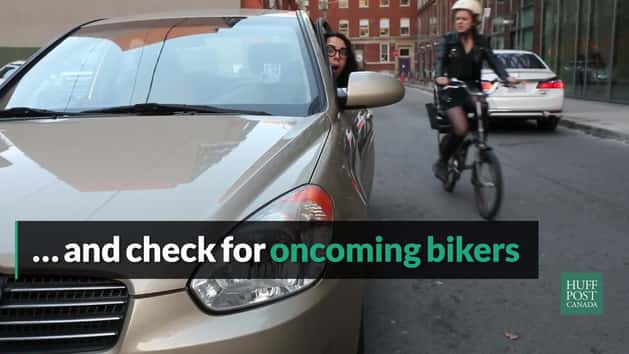
“Make eye contact with drivers whenever possible,” Jamison urged.

This is especially important in busy urban environments like New York City.

“Never assume a driver sees you at a street corner or driveway,” Kroos said. “Look directly at the driver before crossing their path.”

“Ride 3 to 5 feet away from parked cars, because a door swinging open at the wrong moment can drop you fast or fling you into traffic,” Heffner said. “When a lane is too narrow to share safely, take the whole lane. It makes you visible and keeps cars from squeezing past you with inches to spare.”

He also emphasized never sitting on the blind side of a truck or bus at an intersection. “Those sweeping right turns are exactly how cyclists end up under the rear wheels,” Heffner said.

Opt for safer routes and riding conditions whenever possible, Blackwood said.

“Use dedicated or protected bike lanes and separated paths,” he advised. “If riding on roads, try to stick to lower-speed areas. Be especially cautious in areas where there are going to be large vehicles.”

“Pay close attention to traffic signals, always stop at red lights and follow local traffic laws,” Mitina urged. “E-bikes and e-scooters are prohibited from going above 15 mph on city streets. Always stop at red lights, stop signs and adhere to the new state safety regulations. Those laws are there for a reason ― to keep you safe and out of my emergency room.”

And if you’re a parent, take time to practice cycling routes with your children and teach them how to safely navigate risky intersections, driveways, etc.

“Parents should model the behavior they want to see,” Jamison said. “Research and experience show that children are much more likely to wear a helmet when the adults around them wear one consistently. When parents wear a helmet every ride, they send a powerful message that helmet use is a normal and expected part of biking. Setting the example is one of the most effective ways to increase helmet use among children.”

By entering your email and clicking Sign Up, you're agreeing to let us send you customized marketing messages about us and our advertising partners. You are also agreeing to our Terms of Service and Privacy Policy.
Comments
You must be logged in to comment.