huffpost Press
Supreme Court Slaps Down Republicans’ Attempt At Dismissing Late Mail-In Ballots
Images
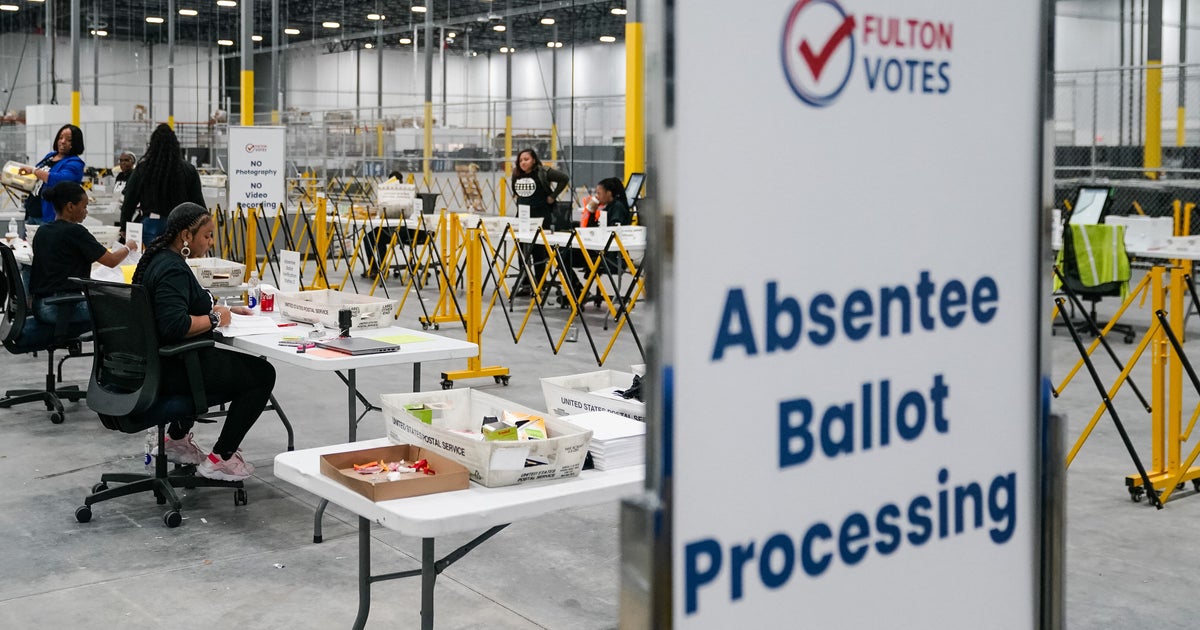
1 / 7

2 / 7

3 / 7
4 / 7
5 / 7

6 / 7

7 / 7
WASHINGTON ― In a decision with national implications, the U.S. Supreme Court ruled to uphold mail-in voting in Mississippi.

Justice Amy Coney Barrett wrote for the 5-4 majority, finding that statutes setting federal election days do not preempt Mississippi’s laws permitting mail-in ballots to be counted as long as they are postmarked and received within five days of Election Day. Chief Justice John Roberts and Justices Sonia Sotomayor, Elena Kagan and Ketanji Brown Jackson concurred.

“The federal election-day statutes do not preempt Mississippi’s law because the defining element of an ‘election’ has always been the electorate’s choice of candidate,” Barrett wrote, adding that existing law, including the Uniformed and Overseas Citizens Absentee Voting Act, “confirms” that while the federal government dictates how ballots must be cast, it is the state that determines how they are received.

“The electorate’s choice is made when voting is complete, not when ballots are received. The most recent amendment to the Presidential election-day statute bears this out,” Barrett wrote. “While inserting the phrase ‘election day’ into the statute and marking that date as a specific Tuesday, Congress also provided that when States ‘modify the period of voting’ in response to certain force majeure events, the term ‘election day’ shall ‘include the modified period of voting.’” [Emphasis added by Justice Barrett.]

Justices heard oral arguments in Watson v. Republican National Committee in March, with many of the high court’s conservative majority signaling they would agree to limit how and when mail-in voters’ ballots are counted.

Mississippi passed a bipartisan law in 2020 that allowed voters to cast their ballots by mail with a postmark as late as Election Day. That law also permitted counting of mail-in ballots for up to five days afterward. The Republican National Committee and the Mississippi Republican and Libertarian parties sued the state, claiming that counting ballots after Election Day violated federal law.

According to the RNC, Election Day is a single day and therefore, any vote counted after that day is unconstitutional and an unnecessary drain on party resources. The political parties also claimed mail-in voting opened the door to widespread voter fraud but failed to provide any evidence of the supposed fraud.

At arguments, state officials maintained that a grace period for counting mail-in votes is not only legal and consistent with 28 other states that have mail-in voting options, but also logical: Tabulation cannot be finished in a single day. Plus, Mississippi officials argued it is the state that sets the terms of its elections, not the federal government.

The Trump administration has been vehemently opposed to mail-in voting, and the president has falsely claimed that it is “cheating.” Trump regularly casts mail-in ballots, however, and when this hypocrisy was recently raised to the president, he told reporters: “You know what, because I’m president of the United States, and because of the fact that I’m president of the United States, I did a mail-in ballot for elections that took place in Florida.”

Barrett briefly addressed concerns over fraud in the ruling, noting that the Uniformed and Overseas Citizens Absentee Voting Act, or UOCAVA, already accounts for issues like “double counting” of votes.

“[UOCAVA] provides that federal absentee ballots ‘shall not be counted’ if a state receives the voter’s state absentee ballot by ’the deadline for receipt of [that] ballot under state law,” Barrett wrote. “If the election-day statutes established a nationwide ballot-receipt deadline, UOCAVA’s references to state-ballot receipt deadlines would make little sense.”

And in any event, the opinion continued, “policy arguments about election integrity and voter confidence are properly directed to the legislatures, not the courts.”

A ruling overturning the law would have severely restricted the ability to count votes, including by voters who serve in the military, live overseas or are over 65.

Public Rights Project, which filed an amicus brief on behalf of local election officials and local governments supporting the absentee grace period in Mississippi, celebrated Monday.

“Today’s decision supports what we’ve argued all along: there is no legal basis for eliminating absentee ballot grace periods. Hundreds of thousands of voters depend on this protection and local election officials can now focus on running fair elections instead of shouldering an impossible administrative burden,” Jill Habig, Public Rights Project founder, said.

In dissent, Justice Samuel Alito explained that he did not see it this way.

“Both voting by mail and early voting have become popular and respondents do not dispute the lawfulness of these modern practices. Nor do I,” Alito wrote. “But acceptance of these practices cannot change the fact that under federal law, the electorate’s collective choice must still be authoritatively expressed on election day.”

If election day statutes “merely” required that each person cast a vote on or before election day, Alito continued, then “there is no sense in which the electorate as a whole can be seen making its choice on election day.” [Emphasis original]

“Rather, the electorate’s choice would be made piecemeal over an extended period prior to election day, and that prospect is blatantly contrary to what the election-day statues demand,” he wrote. “Election day is a specific date, not a span of multiple days.”

Alito also accused the majority of “brush[ing] aside” an “impressive historical record” where Election Day was described as a single day or when a particular date meant all ballots would be collected by that date.

But if that is what Congress intended, Barrett responded in a footnote of the ruling. “Congress could have simply directed the designee to ensure all ballots are received by the ‘election,’” she wrote.

“That Congress did not so here suggests that the ‘election’ is not synonymous with the ‘date by which an absentee ballot must be received in order to be counted in the election,’” the footnote states.

Alito also argued that during World War I, while absentee ballots were logistically necessary, they were short-lived. Barrett didn’t let that stand either, writing in another footnote: “The dissent brushes off these World War I statutes as ‘short-lived outlier[s]’... but relies heavily on Civil War mail-in voting statutes that were themselves ‘short lived outlier[s].’”

When reached for comment, the White House responded with a tantrum President Donald Trump’s threw on Truth Social.

Calling the decision a “tremendous loss” for voters’ rights, he urged Congress to pass the currently stalled Save America Act, which requires voters to show a Real ID, prove citizenship using a passport or birth certificate and forbids mail-in ballots except for illness, military deployment and disability.

“There is only one reason to oppose — CHEATING! The House of Representatives has approved this vital Act, THREE TIMES. The United States Senate seems unable to do so. In a time when there is a powerful Communist Movement taking place in our Country, one more dangerous than World War I, World War II, Pearl Harbor, or September 11th, all Dumocrats, and our five Republican Senate Hold Outs, Lisa Murkowski, Susan Collins, Thom Tillis, Bill Cassidy, and Mitch McConnell must vote to SAVE OUR COUNTRY. There can be no more excuses!” Trump wrote.

Some 14 states and Washington, D.C., currently have postmark rules that allow ballots to be counted during a defined grace period after Election Day. In addition to those 14 states, 15 more accept military or overseas ballots postmarked by Election Day, even if they are received afterward.

Rebekah Caruthers, president and CEO of Fair Elections Center, said the ruling on Monday affirmed one of the most basic principles in American democracy.

“Voters who follow the rules and mail their ballots on time should not lose their voice due to delays beyond their control,” Caruthers said. “By upholding postmark rules, the Court protects millions who rely on mail voting — in particular senior citizens, rural voters, people with disabilities, and military and overseas voters. This was the right decision, and reflects the realities of modern mail processing. We have a duty to count all ballots cast in good faith, and with nearly one-third of Americans voting by mail, it reinforces a system voters trust.”

By entering your email and clicking Sign Up, you're agreeing to let us send you customized marketing messages about us and our advertising partners. You are also agreeing to our Terms of Service and Privacy Policy.
Comments
You must be logged in to comment.