yahoo Press
Tech stocks today: Semiconductor company earnings in focus amid AI boom, Musk vs. Altman fight continues
Images
1 / 8

2 / 8

3 / 8

4 / 8

5 / 8

6 / 8

7 / 8

8 / 8
The above button links to Coinbase. Yahoo Finance is not a broker-dealer or investment adviser and does not offer securities or cryptocurrencies for sale or facilitate trading. Coinbase pays us for certain activity generated through this link. Prices displayed are informational.

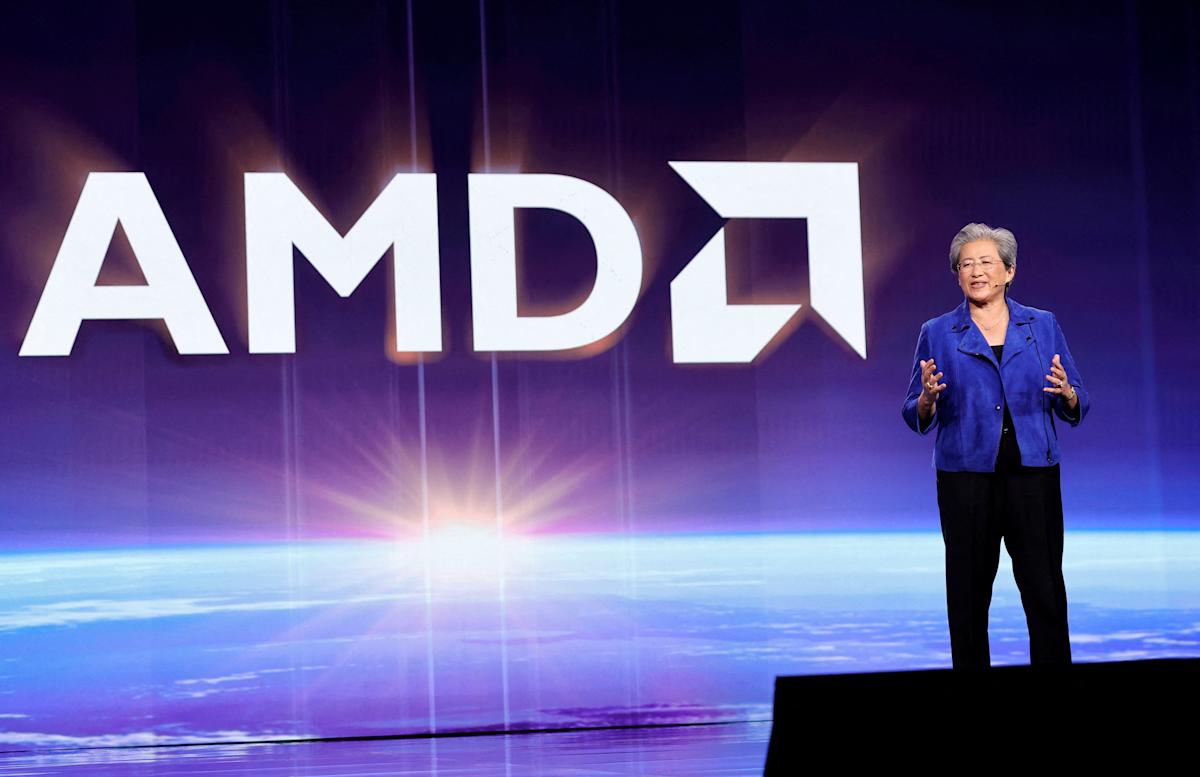
The artificial intelligence trade helped power stocks to all-time highs last week following “Magnificent Seven” earnings. This week, semiconductor company earnings from firms like Advanced Micro Devices (AMD) and Arm Holdings (ARM) could provide another catalyst for tech stocks.

In focus will be the demand for data center chips as well as supply constraints that could affect shortages for other components like memory chips.

Investors have continued to reward companies that can monetize AI, as ballooning capital expenditures overshadowed solid results from Google parent Alphabet (GOOG, GOOGL), Amazon (AMZN), Meta (META), and Microsoft (MSFT). Apple’s (AAPL) earnings report last week also remains in focus after the tech giant said it anticipates strong demand for the iPhone 17 line despite supply constraints.

In addition to earnings, the tech industry continues to watch the California courtroom where Elon Musk’s years-long legal fight against Sam Altman and OpenAI (OPAI.PVT)is finally going to trial.

Musk is accusing Altman and company of duping him into donating money to OpenAI by saying it would remain a nonprofit organization, only to turn it into a for-profit later. But Altman and OpenAI have rebutted, saying that Musk was on board with the transition to a for-profit and is hurt that he didn’t stick with the company now that it’s such a massive presence in the AI space.

Yahoo Finance’s Jake Conley reports on what to watch this week from semiconductor names:

This week, investors will get a look at another piece of the pie: the semiconductors underpinning the AI boom. Lattice Semiconductor Corporation will kick things off with first quarter results on Monday, followed by reports from Advanced Micro Devices on Tuesday and Arm Holdings on Wednesday.

If the Magnificent Seven companies provide the buyer’s perspective, semiconductor designs are a bellwether for the supply side of the AI build-out. The sector has been a bright spot for the equity market even as other pockets have taken a hit from the effects of the war in Iran.

The PHLX Semiconductor Index (^SOX) surged more than 40% and had its best month since February 2000 in April — extending the record-setting semiconductor run that has been driving the AI trade. AMD is up 70% over the past month heading into earnings. Lattice is up 25%, and Arm is up 40%

The sector’s lofty performance has put it at risk for a potential pullback, noted Steve Sosnick, chief strategist at Interactive Brokers. But that said, he added, “If key components of SOX can continue to deliver positive surprises … it becomes much more difficult to bet against.”

Read more here.

Meta (META) is acquiring AI robot company Assured Robot Intelligence, as the company looks to build out its own humanoid robotics capabilities.

"We acquired Assured Robot Intelligence, a company at the frontier of robotic intelligence designed to enable robots to understand, predict, and adapt to human behaviors in complex and dynamic environments,” a Meta spokesperson said in a statement.

Assured Robot Intelligence cofounders Lerrel Pinto and Xiaolong Wang will lead the effort, the spokesperson said, and provide “expertise in how we can design our models and frontier capabilities for robot control and self-learning to whole-body humanoid control.”

Humanoid robots, which were once the stuff of science-fiction movies, are becoming increasingly sophisticated thanks to improving AI capabilities.

A wide range of companies, including Boston Dynamics, Tesla (TSLA), Agility Robotics (AGRO.PVT), and Figure AI, are working to develop the technology with the hopes that they’ll be first to market with a robot that can perform a variety of actions on par with or better than humans.

In general, the initial idea is to place robots in environments that are too dangerous for humans or have them work in positions that require repetitive movements that can cause injuries over time.

Apple (AAPL) stock climbed roughly 5% on Friday, after the company posted better-than-anticipated results on Thursday on the back of strong iPhone revenue and continued growth out of China.

For the second quarter, Apple reported earnings per share (EPS) of $2.01 on revenue of $111.2 billion. Analysts were anticipating EPS of $1.96 and revenue of $109.66 billion, according to Bloomberg analyst consensus estimates.

Apple’s iPhone revenue grew 20% for the second consecutive quarter to $56.99 billion, while China revenue ticked in at $20.49 billion, ahead of expectations of $18.9 billion.

That, coupled with strong Services sales, seemed to give investors more confidence in Apple’s outlook. And with the company’s WWDC event scheduled for June 8, we should get more insight into Apple’s AI strategy after a series of fits and starts that have been an overhang for the smartphone maker.

Throw the expected foldable iPhone and planned CEO transition from Tim Cook to John Ternus in September into the mix, and things are certainly looking interesting for Apple at the moment.

Silicon Valley’s favorite AI tool is making it harder to get Macs, and Apple (AAPL) CEO Tim Cook says it could take the company some time to catch up with demand.

AI developers and enthusiasts have been snatching up Mac minis and Mac Studios to run the AI agent platform OpenClaw, thanks to their relative affordability and ease of use. That’s made it difficult for some customers to get their hands on the compact, screenless desktop systems.

“The Mac Mini and the Mac Studio, both of these are amazing platforms for AI and agentic tools, and the customer recognition of that is happening faster than what we had predicted. And so we saw higher-than-expected demand,” Cook said during the company’s Q2 earnings call.

“We think, looking forward, that the Mac mini and the Mac Studio may take several months to reach supply-demand balance,” he added.

Read more here.

Nvidia (NVDA) stock tumbled more than 4% on Thursday as other chipmakers gained.

Investors may be weighing rising competition for Nvidia, which has so far been the dominant play in the AI infrastructure space.

In its earnings call on Wednesday, Amazon (AMZN) noted its in-house chips business is booming, while Alphabet’s Google (GOOG, GOOGL) said it plans to sell its custom Tensor Processing Units (TPUs) to select customers who will install the chips in their own data centers.

Amazon’s and Google’s in-house chips are different than the ones Nvidia offers, and the AI chip heavy has largely dismissed any fears that other tech giants will erode its lead in the space, saying that its chips offer greater flexibility for AI developers.

Amazon and Alphabet are also big buyers of Nvidia’s AI infrastructure hardware.

Read more here.

Apple (AAPL) reported its second quarter earnings on Thursday, topping analysts’ estimates on the top and bottom lines on strong iPhone sales.

Apple stock rose roughly 1% on the news.

For the quarter, Apple saw earnings per share (EPS) of $2.01 on revenue of $111.2 billion. Analysts were anticipating EPS of $1.96 and revenue of $109.66 billion, according to Bloomberg analyst consensus estimates.

That’s up from the EPS of $1.65 and $95.35 billion the company saw in the same quarter last year.

Apple’s iPhone revenue came in at $56.99 billion, just ahead of Wall Street’s projections. This marks the second consecutive quarter of more than 20% revenue growth in the segment.

Read more here.

Elon Musk took the stand for a second day in his trial with OpenAI on Thursday, facing cross-examination from the AI firm’s lawyer.

A Reuters report from inside the courtroom painted a picture of a tense series of exchanges between Musk and OpenAI’s counsel, with a couple of key headlines emerging.

Most notably, Musk saying under oath that he, “didn't read the fine print, just the headline” regarding OpenAI’s move from a non-profit to a for-profit entity overseen by a non-profit.

Understandable in that OpenAI’s corporate structure remains unique and, in some ways, still inscrutable. But bringing a lawsuit is a big step to take in order to gain an understanding of the situation.

The second key headline to emerge was Musk saying that his AI startup, xAI, has used OpenAI to train its own models, saying that it is, “standard practice to use other AIs to validate your AI."

Read the full story from Reuters here.

Yahoo Finance's Jared Blikre reports:

Amazon (AMZN) has an answer for investors questioning its massive spending on artificial intelligence: Demand for its cloud business is surging.

The company’s cloud backlog — future business Amazon has already contracted but has not yet turned into revenue — jumped to $364 billion in the first quarter, CEO Andy Jassy said on the company’s earnings call.

And that figure doesn’t include Amazon’s recently announced Anthropic (ANTH.PVT) deal for more than $100 billion.

The increase is a sharp jump from the $244 billion in cloud backlog Amazon disclosed at the end of the fourth quarter. Back then, investors were still digesting the company’s roughly $200 billion capital spending plan for 2026.

The backlog is the key counterpoint to the cash-flow pressure that showed up in Amazon’s first quarter results. The company is spending heavily on data centers, chips, servers, and other infrastructure before it can collect the revenue from that capacity.

Read more here.

The great AI flippening is fast approaching: Anthropic looks set to overtake OpenAI’s valuation.

According to a Bloomberg report late Wednesday, Anthropic is planning another fundraising round that would value the company at $900 billion, making it the more valuable of the two major AI labs that have defined the current boom for the first time.

OpenAI last raised capital at a valuation of $852 billion.

As Bloomberg noted, Anthropic has raised new money from Alphabet (GOOG, GOOGL) and Amazon (AMZN) in recent weeks, both at a valuation of $350 billion.

Both companies, which committed $10 billion and $5 billion in new money, respectively, retained an option to increase their investment in the startup later.

Google parent Alphabet (GOOG, GOOGL) on Wednesday said that it plans to sell its custom Tensor Processing Units (TPUs) to select customers who will install the chips in their own data centers.

The move is a change from Google’s prior strategy, which saw it rent out TPU capacity to customers from its own data centers — and is yet another strike at AI chip king Nvidia (NVDA).

The announcement, during the company’s Q1 earnings call, comes a week after Alphabet announced two new TPUs: its TPU 8t for AI training and TPU 8i for inferencing.

“As TPU demand grows from AI labs, capital markets firms, and high-performance computing applications, we’ll begin to deliver TPUs to a select group of customers in their own data centers in a hardware configuration to expand our addressable market opportunity,” Alphabet CEO Sundar Pichai said during the company’s first quarter earnings call.

Read more here.

Meta stock fell 6% as the earnings call was underway. As Yahoo Finance’s Myles Udland points out, two key risks Meta touched on in its quarterly report could be putting pressure on shares.

Myles writes:

The first is costs — namely, costs related to its artificial intelligence investments. Meta raised the range for its expected capital expenditures this year to $125 billion-$145 billion, up $10 billion from January on both the high and low ends, citing “expectations for higher component pricing this year and, to a lesser extent, additional data center costs to support future year capacity.”

Meta’s increased investment is, in part, about the opportunity presented by AI. But it is also a result of higher prices across a number of inputs — chips, raw materials, land, permitting — that go into this build-out. Inflation isn’t only a household phenomenon.

The second challenge is regulatory. In its earnings statement, the company wrote, “We continue to monitor active legal and regulatory matters, including headwinds in the EU and the U.S. that could significantly impact our business and financial results.

Read more here.

YouTube continues to play an important part in Alphabet’s ecosystem.

“In the living room, US viewers are watching over 200 million hours of YouTube content daily,” Google CEO Sundar Pichai said on the earnings call. He touted that YouTube Premium saw its largest quarterly increase in non-trial subscribers.

YouTube advertising revenue rose 11% to $9.88 billion in the first quarter, underscoring the platform's strong momentum. Google said its overall number of paid subscriptions has now reached 350 million, with YouTube and Google One being the key drivers.

But YouTube and other social media platforms are facing growing legal risks as usage balloons. In March, Google (GOOG, GOOGL) lost in a landmark social media addiction lawsuit that found that YouTube’s design caused harm in young users.

Four of the “Magnificent Seven” megacap tech stocks just reported earnings — and all of them beat profit expectations. Yet, only Alphabet stock seemed to gain a favorable reaction from investors after hours. Here’s a recap:

Alphabet (GOOG, GOOGL): Google reported strength in its cloud business and Gemini artificial intelligence models, which lifted first quarter earnings $5.11 per share, a beat compared to estimates of $2.62. Google stock jumped 6% after hours.

Microsoft (MSFT): Microsoft beat analysts’ expectations on the top and bottom lines, but the stock fell 2% in extended trading. Ahead of earnings, Microsoft said it had reworked its relationship with OpenAI (OPAI.PVT).

Meta (META): The social media giant once again raised its plans for capex spending. Meta plans to spend between $125 billion-$145 billion on AI ventures, a staggering amount that helps explain why the stock fell 6% despite a Q1 earnings beat.

Amazon (AMZN): Amazon’s cloud unit reported its fastest growth in 15 quarters and its Q1 profits beat estimates. The stock fell around 4%, however, as AI spending weighed on free cash flow.

Meta Platforms (META) is set to report first quarter earnings after the market close on Wednesday, with investor focus likely to center on the company’s massive AI investments and recent staff cuts aimed at reshaping the organization for the AI age.

The company is expected to report adjusted earnings per share (EPS) of $8.15 on revenue of $55.5 billion, according to Bloomberg estimates. In January, the company guided to first quarter revenue of $53.5 billion-$56.5 billion.

Meta stock is up about 2% this year, against a 6% gain for the Nasdaq Composite (^IXIC).

In the first quarter last year, Meta reported EPS of $6.43 on revenue of $42.3 billion. In that report, the company said it expected total expenses in 2025 to reach $113 billion to $118 billion, with capital expenditures forecast at $64 billion to $72 billion.

By the end of the year, Meta’s realized expenses hit $117.7 billion, and its capital expenditures tallied $72.2 billion. In January, the company said it expected 2026 expenses to come in between $162 billion and $169 billion and its capital expenditures to reach $115 billion and $135 billion.

Read more here.

Google parent Alphabet (GOOG, GOOGL) will report its first quarter results on Wednesday, with the company set to offer key updates on its Gemini model, Google Cloud revenue, and its investment plans as investors see the company as one of the big AI winners this year.

Alphabet stock has climbed roughly 30% over the past six months, beating out Amazon (AMZN), up 13%, and Microsoft (MSFT), which is off about 20%.

Much of that is thanks to the success of Google’s cloud platform and Gemini artificial intelligence models. That’s helped the company’s cloud revenue accelerate over the last few quarters, topping $17.66 billion in Q4, and it doesn’t look like it’s slowing down anytime soon.

Google Cloud revenue is projected to be $18.4 billion. That would amount to a 50% year-over-year increase.

Read more here.

Microsoft (MSFT) will report its third quarter results after the bell on Wednesday as Wall Street looks for signs that the company can keep up with AI demand and steady its position in the artificial intelligence race.

Microsoft’s stock has plunged in recent months on concerns about its Azure and AI growth. In its last quarter, Microsoft reported 38% growth in its Azure business but said it would have reached 40% if not for capacity constraints.

This concern, as well as questions about Copilot adoption, risks to Microsoft’s enterprise software business, and its relationship with OpenAI, has hung over the business in recent months, with its stock down over 20% in the last six months and serving as a laggard among its “Magnificent Seven” peers.

For the quarter, Microsoft is expected to report earnings per share of $4.04 on revenue of $81.46 billion, according to Bloomberg analyst consensus estimates, up from the same period last year when it saw EPS of $3.46 and revenue of $70.06 billion.

The company’s Productivity and Business Processes segment is expected to generate $34.48 billion, while the Intelligent Cloud business is expected to see $34.31 billion.

Azure revenue is expected to increase 38.24%.

Read more here.

Amazon (AMZN) will report its first quarter earnings alongside rivals Google (GOOG, GOOGL), Meta (META), and Microsoft (MSFT) on Wednesday, with investors looking for more signs that the company’s massive artificial intelligence spending is paying off.

All totaled, the AI hyperscalers are expected to spend a whopping $650 billion in capital expenditures in 2026, and Amazon will account for $200 billion of that.

Despite that, Wall Street has been largely positive on Amazon, with the stock of the cloud and e-commerce giant up 13% year to date. That’s better than Google’s 12% increase, and well ahead of Microsoft, which is down 12%.

Amazon, however, is also dealing with increased shipping costs due to rising fuel prices, which could impact e-commerce revenue in the quarter.

Read more here.

Tesla (TSLA) and SpaceX (SPAX.PVT) CEO Elon Musk took the stand on Monday to offer testimony in a high-profile legal battle with OpenAI and Sam Altman.

Musk is accusing Altman, OpenAI president Greg Brockman, and others of misleading him about the company’s plans to transition from a nonprofit to a for-profit business. Other notable names, including Microsoft CEO Satya Nadella and Altman himself are expected to take the stand as well.

In his initial remarks, Musk spoke in his characteristic style of apocalyptic pronouncements.

“If we make it OK to loot a charity, the entire foundation of charitable giving in America will be destroyed. That’s my concern,” Musk said, according to Reuters.

Read more here.

Yahoo Finance's Brian Sozzi reports:

Investors should brace for eye-popping capital expenditures numbers from major cloud service providers like Amazon (AMZN) and Microsoft (MSFT) when they report earnings this week.

In a new note, JPMorgan strategist Samik Chatterjee offered some fresh estimates on accelerating AI infrastructure spending.

"Data center capex among the top 4 US cloud service providers continues to trend higher for 2026 following our last update, ... driving another upward revision to the outlook — from +52% to +63% growth in 2026 — with robust double-digit growth increases evident across all US hyperscalers," Chatterjee wrote.

Read more here.

Yahoo Finance's Ines Ferré reports:

Oracle (ORCL), AMD (AMD), CoreWeave (CRWV), and other AI-driven names sank on Tuesday. Investors sold off shares of companies tied to OpenAI (OPAI.PVT) after The Wall Street Journal reported the AI developer recently missed sales and user targets, renewing concerns about overspending in the sector.

Citing people familiar with the matter, the report said the startup fell short of its internal goal of 1 billion weekly active users for its chatbot ChatGPT by year-end. It also reportedly missed its annual revenue target for the product. Meanwhile, Google’s (GOOG) competing AI bot, Gemini, grew over the past year, eating into OpenAI’s market share.

Read more here.
Comments
You must be logged in to comment.