yahoo Press
Starbirth shuts down 40,000 light-years from the Milky Way's core — and astronomers don't know why
Images
1 / 11
2 / 11

3 / 11

4 / 11

5 / 11

6 / 11
7 / 11
8 / 11

9 / 11

10 / 11

11 / 11
When you buy through links on our articles, Future and its syndication partners may earn a commission.

Astronomers have found the boundary of star formation in the Milky Way's spiral disk — and it's not as far out from the center of our galaxy as you might imagine.

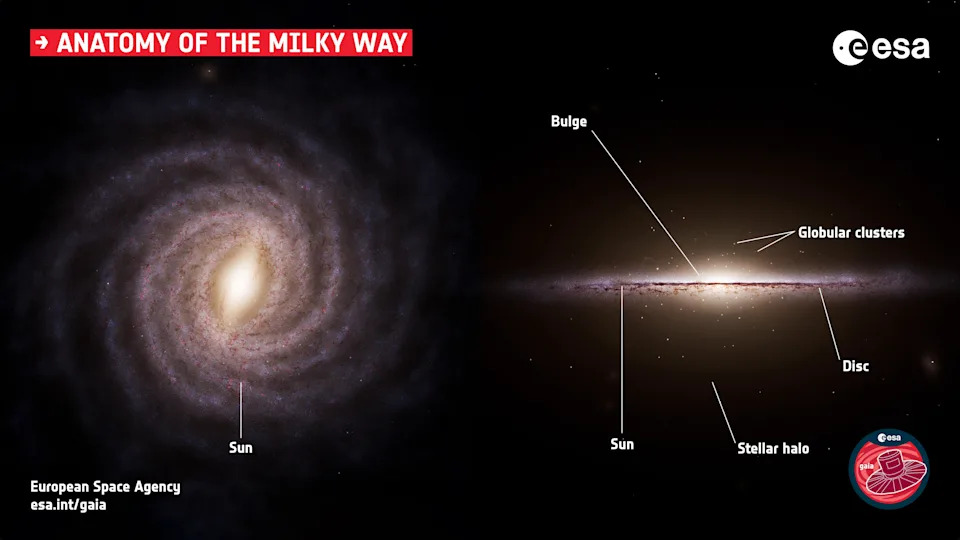
The Milky Way is at least 100,000 light-years across, but the new results suggest that the galaxy's star formation takes place within a region that extends to a radius of 40,000 light-years from the galactic center.

"The extent of the Milky Way's star-forming disk has long been an open question in galactic archaeology," said the study's lead author, Karl Fiteni of the University of Insubria in Italy, in a statement. "By mapping how stellar ages change across the disk, we now have a clear, quantitative answer."

Fiteni's international team focused on 100,000 luminous giant stars spread across the Milky Way's spiral disk, obtaining spectroscopic data describing their temperatures and ages from the LAMOST (Large Sky Area Multi-Object Fiber Spectroscopic Telescope) telescope in China and the Apache Point Observatory Galactic Evolution Experiment (APOGEE) at the Sloan Digital Sky Survey in the United States, plus additional data from the European Space Agency's Gaia mission.

"Gaia is delivering on its promise: by combining its data with ground-based spectroscopy and galaxy simulations, it allows us to decipher the formation history of our galaxy," said Laurent Eyer of the University of Geneva.

Galaxies grow from the inside out, and the Milky Way is no different, with the average age of stars decreasing with radius from the galactic center. Fiteni's team found that the average age reaches a minimum at a radius of 40,000 light-years from the center. For comparison, our sun is located 26,000 light-years from the galactic center, well inside the star-forming boundary. Beyond this point, the stars begin steadily getting older again, with the oldest stars found both in the center and at the very edge of the Milky Way's disk, creating a U-shaped distribution of ages.

The Milky Way is not unique in having a U-shaped age distribution of stars with radius; other galaxies have also previously been found to share a similar distribution. The computer simulations conducted by Fiteni's team suggest what the cause of this U-shaped age distribution is.

"In astrophysics, we use simulations run on supercomputers to identify the physical mechanisms responsible for the features we observe in galaxies," said João S. Amarante from Shanghai Jiao Tong University in China. "They allowed us to demonstrate how stellar migration shapes the age profile of the disk and to identify where the star-forming region ends."

They found from the simulations that, at a radius of about 40,000 light-years, the efficiency at which the galaxy forms stars suddenly drops, marking the edge of the Milky Way's disk-shaped region of star formation.

So, why are there stars beyond 40,000 light-years if they didn't form there? One big clue is the shape of their orbits.

"A key point about the stars in the outer disk is that they are on close to circular orbits, meaning that they had to have formed in the disk," said Victor Debattista of the University of Lancashire in England. "These are not stars that have been scattered to large radii by an infalling satellite galaxy."

So collisions with other galaxies are not to blame. Instead, what probably happens is a phenomenon called radial migration. Like surfers riding waves to the shore, stars can ride the density waves that form the Milky Way's spiral arms out to greater distances from the galactic center. It takes longer for stars to reach the very edge of the Milky Way's disk, 50,000 light-years or more from the galactic center, explaining why we find the oldest stars on the very fringes of the galaxy.

This all begs the question of why star formation staggers to a halt at 40,000 light-years from the galactic center. One possibility is that it is related to the structure of the Milky Way. Perhaps our galaxy's central bar, measurements of the length of which vary between radii of 11,000 to 15,000 light-years, causes gas to pool out to a certain distance from the galactic center. Alternatively, the warp in our galaxy's spiral disk, which has been attributed to a gravitational interaction with another dwarf galaxy, could disrupt star formation in the galaxy, cutting it off at 40,000 light-years.

The findings were published on April 13 in the journal Astronomy & Astrophysics.
Comments
You must be logged in to comment.