yahoo Press
‘Keeps me awake at night’: Bank of England warns stocks may crash as market risks build. Protect your portfolio now
Images
1 / 4
2 / 4

3 / 4

4 / 4
Moneywise and Yahoo Finance LLC may earn commission or revenue through links in the content below.

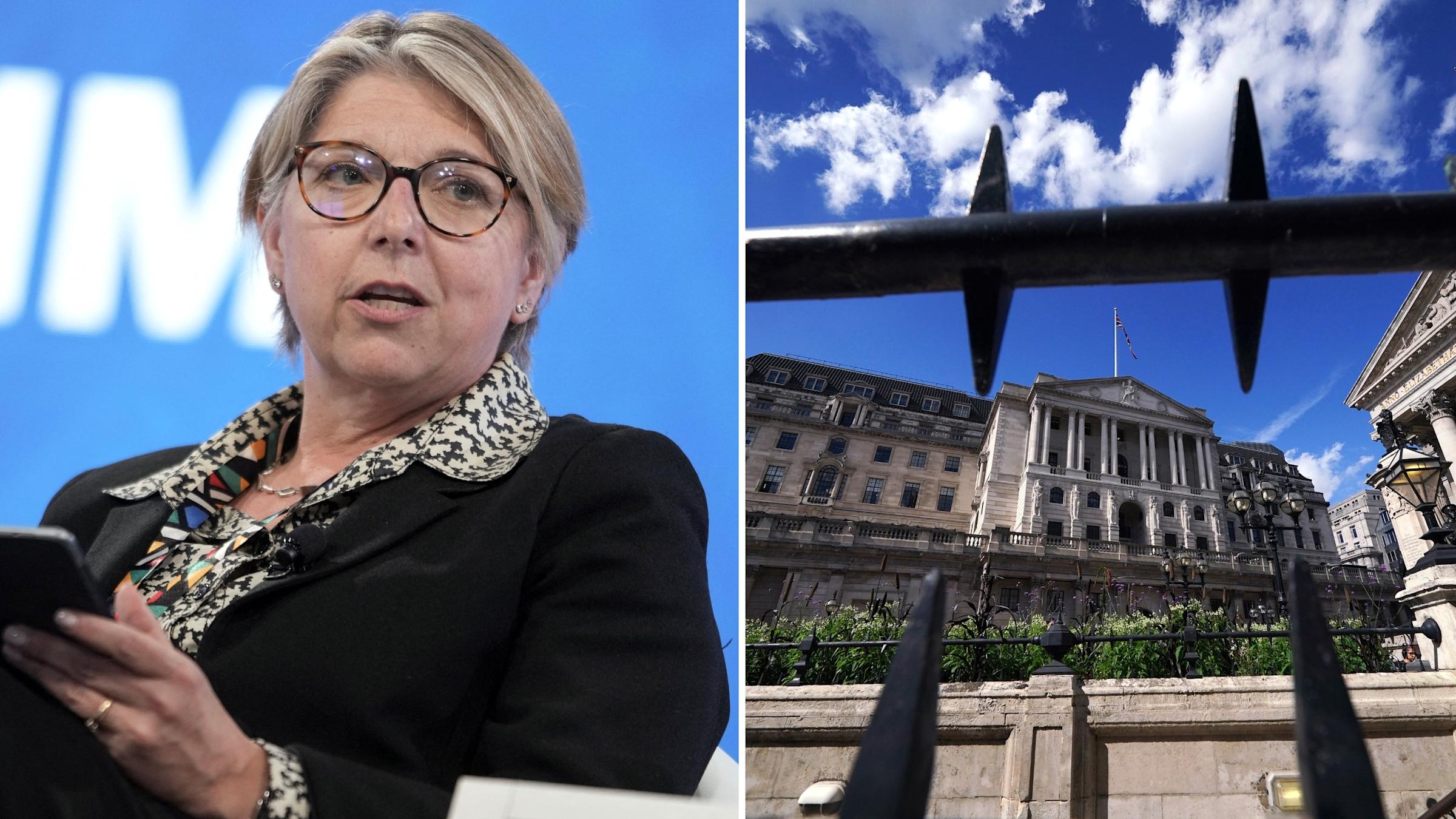
Global stock markets have surged to record highs despite the Iran War, yet Bank of England's head of financial stability, Sarah Breeden, recently warned that asset prices may not fully reflect the growing threats facing the global economy (1).

"There's a lot of risk out there and yet asset prices are at all-time highs," Breeden told the BBC. "We expect there will be an adjustment at some point."

Thanks to Jeff Bezos, you can now become a landlord for as little as $100 — and no, you don't have to deal with tenants or fix freezers. Here's how

Dave Ramsey warns nearly 50% of Americans are making 1 big Social Security mistake — here’s how to fix it ASAP

The IRS usually taxes gold as a collectible — but this little-known strategy lets you hold physical bullion tax-free. Get your free guide from Priority Gold

While Breeden declined to predict when a downturn might occur (or how severe it could be), her warning for investors is that they might be underestimating the risks of today's market. Central bank officials rarely speak so directly about potential market declines.

In this case, Breeden isn't merely flagging a single weak point in the market, but the risk of multiple pressures hitting all at once. Historically, routine corrections have led to deep downturns.

For example, during the dotcom bubble, overvalued tech stocks didn't fall on their own. The decline was compounded by tight financial conditions and the drying up of venture capital, leading to a broad pullback in investment that saw the stock market lose 10% of its value (2).

"The thing that really keeps me awake at night is the likelihood of a number of risks crystallizing at the same time," Breeden told the BBC, alluding to the fear that macroeconomic shocks, lower private credit confidence and AI could triple-whammy the market at any time.

Then, she asked the question every investor might want to consider: "Are we prepared for it?"

The S&P 500 has surged roughly 30% over the past year, hitting a string of all-time highs. The UK's FTSE 100 index followed a similar path, rising more than 20% over the same period.

Much of today's market momentum is driven by a massive wave of investment into artificial intelligence. The International Monetary Fund goes as far as to describe AI as the "defining drive of global economic conversation—and, increasingly, of economic growth itself (3)."

Tech companies have poured hundreds of billions of dollars into AI infrastructure. The scale of the spending has been intense enough that some observers have even described it as a "frenzy," whilst directly comparing it to the dotcom bubble (4).

In the 90s, investors rushed into internet startups with unproven business models, only to later watch valuations collapse when they couldn't turn a profit.

Today, AI leaders argue the comparison doesn't fully hold. For example, NVIDIA CEO Jensen Huang has pushed back on bubble concerns, pointing to real demand for computing power and long-term productivity gains, calling it "the largest infrastructure build-out in human history (5)."

And that's to say nothing of the circular nature of at least some AI investment that aggravates this dynamic. Many companies involved in the production pipeline — from NVIDIA GPUs to the companies that buy them — are invested in one another, leading to the reuse of capital among some of the biggest names in the game, according to Bloomberg (6).

Still, even optimistic forecasts rely on continued growth and investor confidence. If economic conditions deteriorate, those can go away quickly.

And AI isn't the only sector worth discussing.

Read More: Robert Kiyosaki warned of a 'Greater Depression' — with millions of Americans going poor. Was he right?

Another area drawing increased scrutiny is the rapid growth of private credit — "shadow banking (7)."

Unlike traditional banks, the nonbank financial companies that lead these funds lend directly to businesses without the same level of regulation or oversight. Over the past 15 to 20 years, the sector has grown from a niche market into a multi-trillion-dollar industry (8).

That rapid expansion has raised a key concern: The system hasn't been tested in a major downturn at this scale.

Some cracks are already starting to show. In recent months, certain funds have reported losses and limited investor withdrawals (9). One notable example is a $400 million loan impairment tied to BCRED, Blackstone's own private credit vehicle (10).

Breeden warned that this part of the financial system could become a major pressure point if conditions worsen.

"It's a private credit crunch, rather than a banking-driven credit crunch, that we're worried about," she said.

So what can investors do to hedge against the market downturn Breeden feels could happen any day now?

When risks start to stack up across the financial system, some investors look to assets that have historically held their value during periods of market stress. Gold is one of the most well-known examples.

Unlike stocks, gold has traditionally been viewed as a store of value — it retains its purchasing power well into the future. Particularly during times of market volatility.

If you're curious about adding precious metals to your broader inflation-hedging strategy, a gold IRA from Goldco lets you hold physical gold and other metals while still getting the tax advantages of an IRA.

With a minimum purchase of $10,000, Goldco offers free shipping and access to a library of educational resources to help investors understand how precious metals fit into a broader portfolio strategy. The company will also match up to 10% of qualified purchases in free silver.

If you're exploring ways to diversify beyond traditional markets, you can download your free gold and silver information guide today to see whether this approach aligns with your goals. You can also figure out how much of your portfolio can go into the precious yellow metal.

Another idea is more of an indirect hedge: Real estate, an asset that generates income.

Rental properties have long been a source of steady, passive income for institutional investors, and today, real estate accounts for nearly a quarter of the typical family office portfolio. By generating passive income, you could better protect yourself from market drops and inflation. But for many investors, the capital requirements and hands-on management involved have historically made it difficult to access.

Mogul lowers that barrier.

Through fractional ownership in blue-chip rental properties, investors can gain exposure to income-generating real estate without the responsibilities of direct ownership. That includes potential monthly rental income, property appreciation and certain tax advantages, all without the need for a large down payment or active property management.

Founded by former Goldman Sachs real estate investors, the platform focuses on what it describes as the top tier of single-family rental homes across the U.S., with each property undergoing a vetting process designed to target resilience even in weaker market conditions.

Across its offerings, Mogul reports average annual returns and cash yields that reflect the income-driven nature of residential real estate.

For investors looking to diversify beyond stocks, you can browse available properties and explore how fractional real estate fits into your strategy.

For investors with more capital to deploy, real estate opportunities can extend to larger, institutional-grade deals that are typically out of reach for individual investors.

In recent years, crowdfunding platforms have opened access to a broader demographic, but outcomes often depend on factors such as deal structure, platform incentives and the sponsor's expertise.

Lightstone DIRECT's direct-to-investor model ensures a high degree of alignment between individual investors and a vertically-integrated, institutional owner-operator — a sophisticated and streamlined option for individual investors looking to diversify into private-market real estate.

With Lightstone DIRECT, accredited individuals can access the same multifamily and industrial assets Lightstone pursues with its own capital, with minimum investments starting at $100,000.

Even with assets like gold and real estate in the mix, some investors want additional diversification, particularly in areas that have historically shown low correlation with both stock and property markets.

Fine art is one example.

In 1999, the S&P 500 peaked, and it took more than a decade to recover fully. Today, some forecasts suggest more muted returns ahead. Goldman Sachs, for instance, has projected annual returns of around 3% over the next decade, while Vanguard estimates closer to 5%.

With many traditional assets trading near historical highs, some investors are exploring alternatives that don't move in lockstep with public markets.

Platforms like Masterworks allow individuals to invest in shares of blue-chip artwork with pieces by artists like Banksy, Basquiat and Picasso.

More than 70,000 investors have joined the platform since 2019. Masterworks has sold 27 artworks so far, delivering net annualized returns like 14.6%, 17.6%, and 17.8%.

Moneywise readers can get priority access to diversify with art: Skip the waitlist here.

Note that past performance is not indicative of future returns. Investing involves risk. See important Regulation A disclosures at Masterworks.com/cd.

Robert Kiyosaki says this 1 asset will surge 400% in a year and begs investors not to miss this ‘explosion’

No time to lower your crippling car insurance rate? Here’s how to do it within minutes — you could end up paying $29/month without a single phone call

Millionaires under 43 are reshaping investing — just 25% of their portfolios are in stocks. Here’s where their money is going

Dave Ramsey says this 7-step plan ‘works every single time’ to kill debt, get rich in America — and that ‘anyone’ can do it

Join 250,000+ readers and get Moneywise’s best stories and exclusive interviews first — clear insights curated and delivered weekly. Subscribe now.

We rely only on vetted sources and credible third-party reporting. For details, see our ethics and guidelines.

BBC (1); Investopedia (2),(7); International Monetary Fund (3); The New York Times (4); Fortune (5); Bloomberg (6); U.S. Federal Reserve (8); Proffitt Goodson (9); Morningstar (10)

This article provides information only and should not be construed as advice. It is provided without warranty of any kind.
Comments
You must be logged in to comment.