yahoo Press
Phantom capacity tightens US-Mexico trucking market, Uber Freight says
Images

1 / 6

2 / 6

3 / 6

4 / 6

5 / 6
6 / 6
The above button links to Coinbase. Yahoo Finance is not a broker-dealer or investment adviser and does not offer securities or cryptocurrencies for sale or facilitate trading. Coinbase pays us for certain activity generated through this link. Prices displayed are informational.

The U.S.-Mexico trucking market is tightening in early 2026, but not in the way traditional freight indicators suggest, according to Uber Freight.

Instead of a demand-driven cycle, capacity constraints tied to security, compliance and driver qualification are reshaping how freight moves across the border — creating what one executive described as “phantom capacity.”

“We’ve basically seen in Q1 … a tightening in supply. It’s almost like a supply-driven market,” Zeid Houssami, senior vice president overseeing Uber Freight’s cross-border business, told FreightWaves in an interview.

Houssami said underlying demand has remained relatively stable, but usable capacity has shrunk due to stricter security requirements and operational concentration along key industrial corridors in Mexico.

San Francisco-based Uber Technologies (NYSE: UBER) operates three platforms: Uber (ride-hailing), Uber Freight (logistics), and Uber Eats (food and goods delivery).

While headline metrics such as spot rates and tender rejections may signal a loose market, Houssami said those indicators are increasingly misleading.

“Demand hasn’t really shifted. It’s really been more supply constraints, due to security primarily, and then also just a consolidation of volumes on specific corridors,” he said.

That dynamic is creating a growing gap between theoretical capacity and freight that can actually move reliably — particularly in cross-border lanes requiring vetted carriers and secure transit.

The result: lower tender acceptance rates and increased reliance on the spot market, even before a full pricing upcycle takes hold.

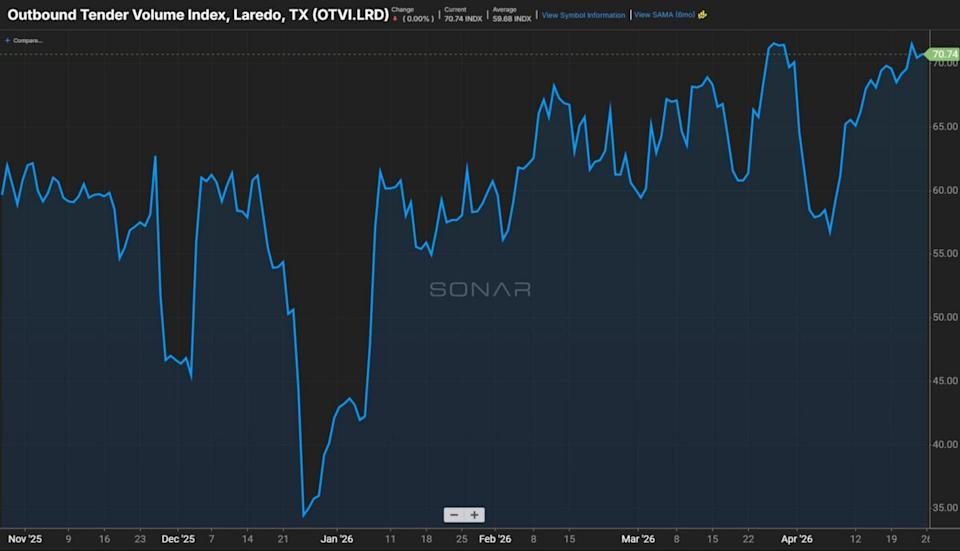
SONAR’s Outbound Tender Volume Index (OTVI.KRD) shows tender volumes remaining relatively stable to slightly elevated in early 2026, reflecting resilient cross-border demand even as broader freight markets show mixed signals.

However, rising volatility in tender acceptance — tied to compliance constraints and carrier selectivity — suggests that underlying capacity is tighter than volumes alone indicate. The divergence between steady OTVI and softer acceptance rates reinforces the “phantom capacity” narrative, where freight is available but harder to cover consistently.

One of the biggest constraints is not a lack of drivers overall, but a shortage of drivers who meet tightening compliance and security standards.

“There’s not really a driver shortage — it’s more so it’s a compliant driver shortage,” Houssami said.

This distinction is critical for cross-border freight, where security protocols, documentation requirements and carrier vetting are increasingly limiting which capacity is actually usable.

The impact is most pronounced on northbound freight into the U.S., where demand significantly outweighs southbound flows.

“Northbound demand is two to three times more than it is on the southbound side,” Houssami said.

That imbalance is forcing carriers to quickly reposition equipment back into Mexico, tightening available capacity for U.S.-bound shipments.

Facing these constraints, shippers are changing procurement strategies — not necessarily because demand is surging, but to prepare for future disruptions.

“I think it’s probably more of the latter,” Houssami said of early procurement activity, noting that shippers are acting defensively rather than reacting to a demand rebound.

Uber Freight has seen a surge in mini-bids and short-term procurement events as companies look to diversify carrier networks and secure reliable capacity ahead of potential shocks tied to tariffs, fuel costs and policy changes.

Houssami said the industry is moving away from heavy reliance on long-term contracts toward a hybrid approach that incorporates more spot market flexibility.

At the same time, geographic concentration of manufacturing in Mexico — particularly in automotive and industrial hubs — is limiting how much shippers can diversify their networks.

“It is a tough problem to solve … when the manufacturers are concentrated in a specific location,” Houssami said.

That concentration is reinforcing capacity bottlenecks along key corridors, particularly those tied to high-value, security-sensitive freight.

Looking ahead, Houssami said the biggest wildcard for cross-border freight remains the upcoming review of the U.S.-Mexico-Canada Agreement.

Uncertainty around whether the trade pact will be extended or renegotiated is already influencing shipper behavior and nearshoring investment decisions.

“I think it’s definitely slowed down nearshoring investment … everybody’s in a little bit of a holding pattern until July,” he said.

If the agreement is extended, it could provide much-needed stability for cross-border supply chains. But prolonged negotiations or uncertainty could inject additional volatility into freight markets.

In the near term, Houssami said shippers should focus on proactive planning and building more resilient carrier networks.

“I think first and foremost, planning, demand forecasting … is paramount,” he said.

He added that diversifying carrier relationships — particularly with compliant, security-ready providers — will be critical as capacity becomes more constrained and fragmented.

With compliance, security and policy increasingly shaping freight flows, the U.S.-Mexico trucking market is entering a phase where access to reliable capacity may matter more than price alone.

The post Phantom capacity tightens US-Mexico trucking market, Uber Freight says appeared first on FreightWaves.
Comments
You must be logged in to comment.