yahoo Press
California billionaire tax moves closer to November ballot: What to know
Images
1 / 10

2 / 10

3 / 10

4 / 10
5 / 10

6 / 10
7 / 10

8 / 10

9 / 10

10 / 10
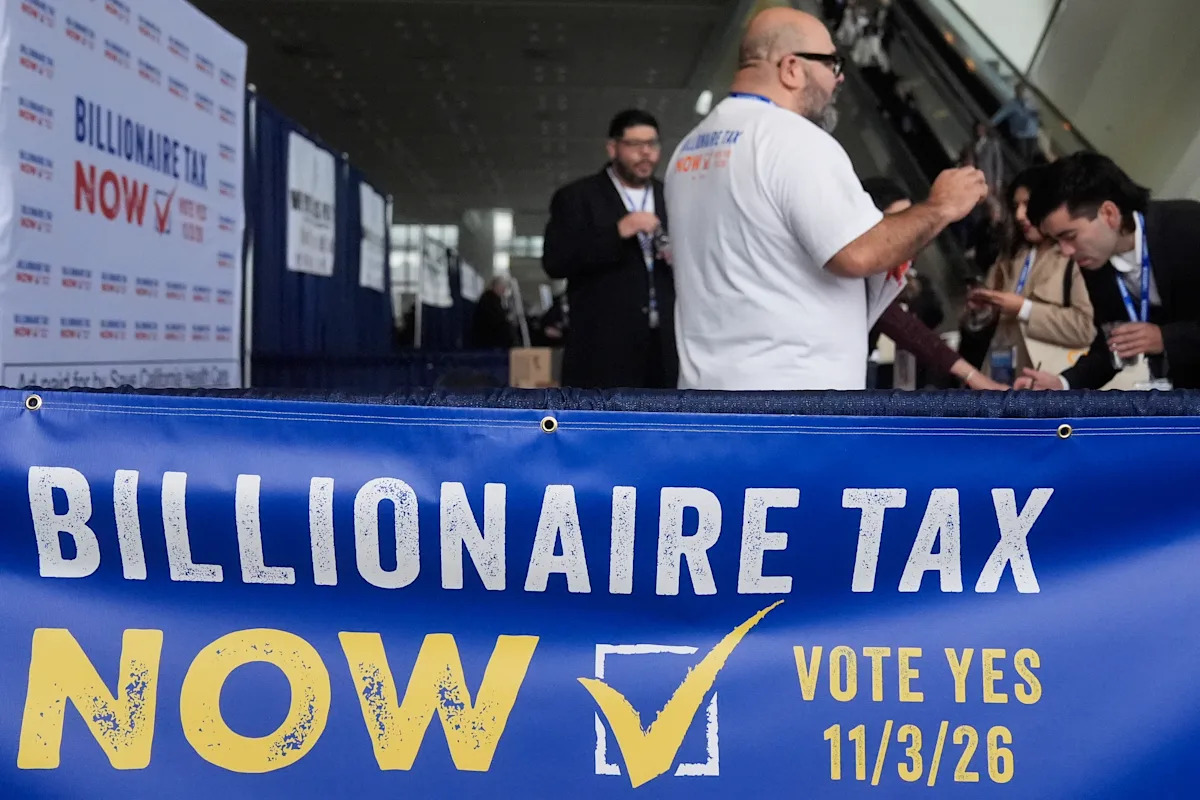
Backers of a proposed tax on California billionaires say they have collected enough signatures to bring the measure to a statewide vote this fall.

The labor union Service Employees International Union-United Healthcare Workers West (SEIU-UHW) says it is spearheading a tax on the state's ultra-wealthy to prevent hospital and clinic closures, protect healthcare jobs, and help fund K-14 public education and state food assistance programs.

Opponents say the tax would fuel an exodus of wealthy company founders and investors, spark job losses, and further weaken California's economy.

On Monday, supporters submitted more than 1.5 million signatures to election officials for the petition seeking a state vote on the billionaire tax. About 875,000 registered voters must be validated by June 24 to put the measure on the November ballot.

However, a competing initiative, called the "Transparency Act," is also gathering signatures to go up for a fall vote. It seeks to reduce waste in state spending and increase government transparency. If both measures appear on the ballot and the Transparency initiative garners more votes, it could derail the billionaire tax, according to a Los Angeles Times report.

The proposed California tax act would levy a one-time 5% tax on the net worth of billionaire residents, subject to the asset restrictions noted below. Taxpayers could choose to pay the tax in five annual installments, with a 7.5% additional fee on the unpaid balance.

Billionaires with primary residences in California as of Jan. 1, 2026, would owe the tax in 2027. That's an estimated 255 eligible taxpayers. A half-dozen or more high-profile tycoons relocated out of state as news of the proposed tax rolled out last year, so the number may be slightly lower.

Those who have reportedly relocated include Google co-founders Larry Page and Sergey Brin.

The tax proposal is not based on income — that's a loophole that allows billionaires to pay less in income taxes than the average American.

Rather, the proposed California tax is based on billionaires' assets, including equity holdings, often in their own companies. The impact on the most wealthy would vary widely.

For example, the Tax Foundation, a right-leaning tax policy nonprofit, projected that the tax would render Tony Xu, the founder of DoorDash, bankrupt, with a tax liability of $4.17 billion, unless he could challenge the initiative's asset valuation.

On the other hand, Jensen Huang of Nvidia would face a tax liability of more than twice that: $8.5 billion. And he says he's fine with that.

The California healthcare worker union, SEIU-UHW, launched the "emergency tax" initiative to reverse possible healthcare staffing issues and service reductions at healthcare facilities. The union estimates a nearly $100 billion loss of federal funding over the next five years due to the passage of the One Big Beautiful Bill Act.

Taxpayers and trusts with assets over $1 billion would be taxed on businesses, securities, collectibles, and intellectual property, but the tax would exclude real property and certain retirement accounts and pensions.

The California Billionaire Tax Act is estimated to raise about $100 billion, according to the initiative's website.

BillionaireTaxNow.org says the money would be used to:

Keep hospitals, ERs, clinics, nursing homes, and home care facilities open and staffed

"Stabilize" healthcare insurance premiums and coverage

Maintain healthcare jobs

Fund K-14 public education programs and staffing

Fund California food assistance programs

The Institute on Taxation and Economic Policy, a left-leaning think tank, supports the California billionaire tax, saying that the One Big Beautiful Bill Act "cut health care and food support in part to pay for tax cuts for the very wealthiest Americans. The legislation gives more than $1 trillion in tax savings to the richest 1% of households over the next decade."

ITEP added in the analysis that, "ultra-wealthy households have many ways to enjoy a lavish lifestyle without selling most of their holdings, and so can largely avoid the individual income tax. The billionaire tax directly remedies this injustice by taxing all wealth, whether this wealth has been realized as income or not."

The Tax Foundation believes the California billionaire tax, as drafted, contains "aggressive design choices and possible drafting errors" that could result in the proposed one-time 5% tax being "dramatically higher."

It warns that "the poorly drafted initiative" could force company founders to sell "a significant portion" of their shares and lose their controlling interests. Stock prices could plunge, impacting retirement savings and investment account balances of working Americans.

The Hoover Institution, also a right-leaning nonprofit, has said the wealth tax would render California worse off financially by as much as $25 billion, taking into account lost income tax from billionaires leaving the state. It also estimated revenues from the levy would fall short of the $100 billion projection, more likely generating just $40 billion.

Sen. Bernie Sanders (I-Vt.) has long advocated for a national wealth tax. His "Make Billionaires Pay Their Fair Share Act," co-sponsored by Rep. Ro Khanna (D-Calif.), is the latest effort, introduced in March.

The national tax would levy a 5% annual, not one-time, tax on the estimated 938 billionaires in the U.S., estimated to raise $4.4 trillion over the next 10 years. In the first year, the bill would give a $3,000 payment to "every man, woman, and child" in a household earning $150,000 or less.

No action has yet been taken on the bill.

From strategic investments to advanced planning, here's how the wealthy reduce their tax burden.

Earning a $1 million salary puts you in the 37% tax bracket. Find out why many million-dollar earners pay taxes at a lower rate and how you could use their strategies to lower your tax bill.

From capital gains strategies to charitable donations, here are some of the common tactics high earners use to shrink their tax bills.

The OBBBA launched new tax breaks this year, and 53 million filers have claimed at least one. Here are four key changes boosting refunds.

A mansion tax is an additional transfer tax on properties that sell for above a specified price. Learn how mansion taxes work and if you'll need to pay them.

Here’s a closer look at how the "Trump Gold Card" works, how much it costs, and what experts are saying about the legalities and economic impacts of this new program.
Comments
You must be logged in to comment.