huffpost Press
Trump Uttered 2 Awkward Words About Secret Service That Are Turning Heads
Images
1 / 8

2 / 8
3 / 8
4 / 8
5 / 8
6 / 8
7 / 8

8 / 8
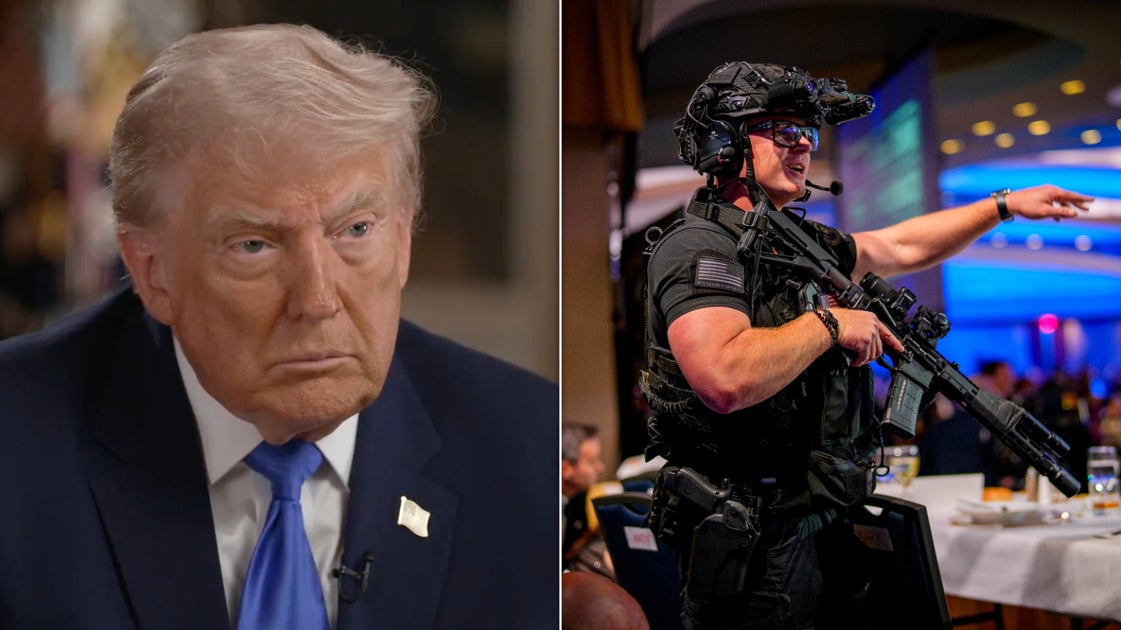
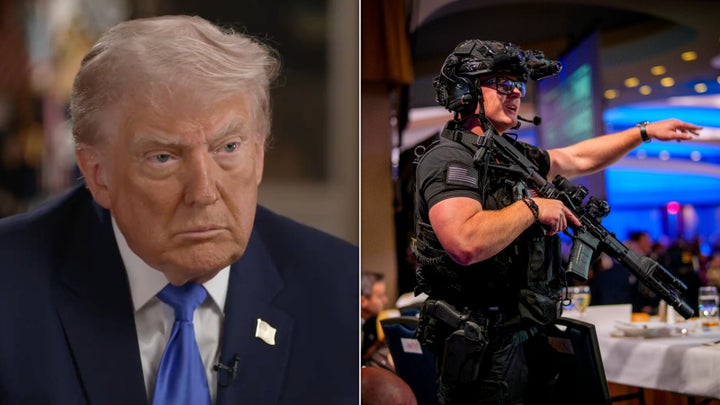
President Donald Trump uttered two words in a “60 Minutes” interview Sunday night that have turned more than a few heads: Law enforcement agents took down a White House Correspondents’ Association dinner shooter, and they were “really attractive.”

On Saturday night at a Washington, D.C., hotel, during the annual White House Correspondents’ Association dinner with the presidential administration, a man breached a security checkpoint and fired multiple shots before being apprehended.

In a “60 Minutes Overtime” interview the next day, Trump walked senior CBS News correspondent Norah O’Donnell through his perspective of the shooting.

“There were a number of people who were very, very scared,” O’Donnell said in the extended cut of the interview. “How worried were you that there were going to be injuries?”

“I wasn’t worried,” Trump said in response after a pause. “I understand life. We live in a crazy world.”

He went on to say that he was watching the back door of the ballroom because he wanted to know what was going on and if he could “be helpful.”

“I also saw a lot of very strong, physically strong, really attractive law enforcement people come through those doors,” Trump then said. “And frankly, it made me feel very safe, very, very safe. There’s nobody going to get by them. … They were very impressive, I think they were very impressive. I think the whole operation was very impressive.”

Trump often comments on physical appearance. Like, a lot. Whether he’s declaring that Sydney Sweeney is the “HOTTEST” or that Taylor Swift is “NO LONGER HOT,” he loves to comment on celebs’ looks. Members of the media are often his target, too — in 2025, he called New York Times reporter Katie Rogers “ugly,” and he called Bloomberg reporter Catherine Lucey “piggy.” And, of course, politicians aren’t immune. One of many examples: Trump said Rep. Jamie Raskin (D-Md.) had an “ugly face.”

Experts aren’t really sure why Trump felt the need to make this “really attractive” comment in light of Saturday night’s events — but they say that his feeling that way might not be surprising, even if it felt out of left field.

A month or so ago, for example, he praised Immigration and Customs Enforcement officers for their “much larger, and harder, muscles.” Madeleine Fugère, a social psychologist at Eastern Connecticut State University who studies human attraction, said there’s also an association of attractiveness and being in a position of authority.

“I couldn’t necessarily say how often it happens, but I think anecdotally there are examples of people falling in love with someone who would help save them from a dangerous situation,” Fugère said.

In his comment, Trump also addresses the law enforcement officers’ physical strength, which echoes his “larger, harder muscles” comment from March. This association is perhaps least surprising from a biological perspective.

“ There are associations between physical attractiveness and strength, most notably through what we call symmetry,” Fugère explained. “Humans are sort of programmed to develop symmetrically, and people who do develop more symmetrically are expected to have better genes. More symmetrical individuals tend to be rated as more physically attractive.”

Nancy Irwin, a Hollywood clinical psychologist, had a similar perspective.

“I quite often see that optics are everything to some people, DJT being one,” Irwin wrote in an email to HuffPost. “In psychology, there is a tacit tenet among humans that what is beautiful is good. Studies support that babies will respond with a smile and trust to a face and appearance that is attractive and proportionate, vs. to [a] disproportionate [one]. As we mature, we learn to move past this in varying degrees, but still, there is an immediate ease to trust someone who presents well.”

But there’s more to it than biological cues. Physical attractiveness is also often associated with perceiving someone as being good at something. This is known as the halo effect, which research database EBSCO defines as “a cognitive bias where an individual’s overall impression of a person, brand, or product influences their feelings and judgments about specific traits or attributes of that entity. … For example, a person might assume that an attractive individual is also intelligent or kind, demonstrating the attractiveness stereotype.”

Paul Eastwick, a professor of psychology at UC Davis and author of “Bonded by Evolution,” a book about the science behind love and connection, told HuffPost that Trump’s comment on the attractiveness of these agents “sounds like a textbook case” of that phenomenon.

“In other words, Trump’s statement illustrates the common biased assumption that physically attractive people are good at things that are not in fact related to physical attractiveness,” Eastwick wrote. “If the law enforcement agents appear ‘camera-ready,’ people like Trump might feel safer, but there’s no evidence that attractiveness is related to any sort of professional competence in the law enforcement domain (or any other domain for that matter).”

By entering your email and clicking Sign Up, you're agreeing to let us send you customized marketing messages about us and our advertising partners. You are also agreeing to our Terms of Service and Privacy Policy.
Comments
You must be logged in to comment.