huffpost Press
'Screams Triumphant Dictator': Here's What Design Experts REALLY Think Of Trump's Presidential Library
Images
1 / 10

2 / 10
3 / 10
4 / 10
5 / 10
6 / 10

7 / 10
8 / 10

9 / 10

10 / 10
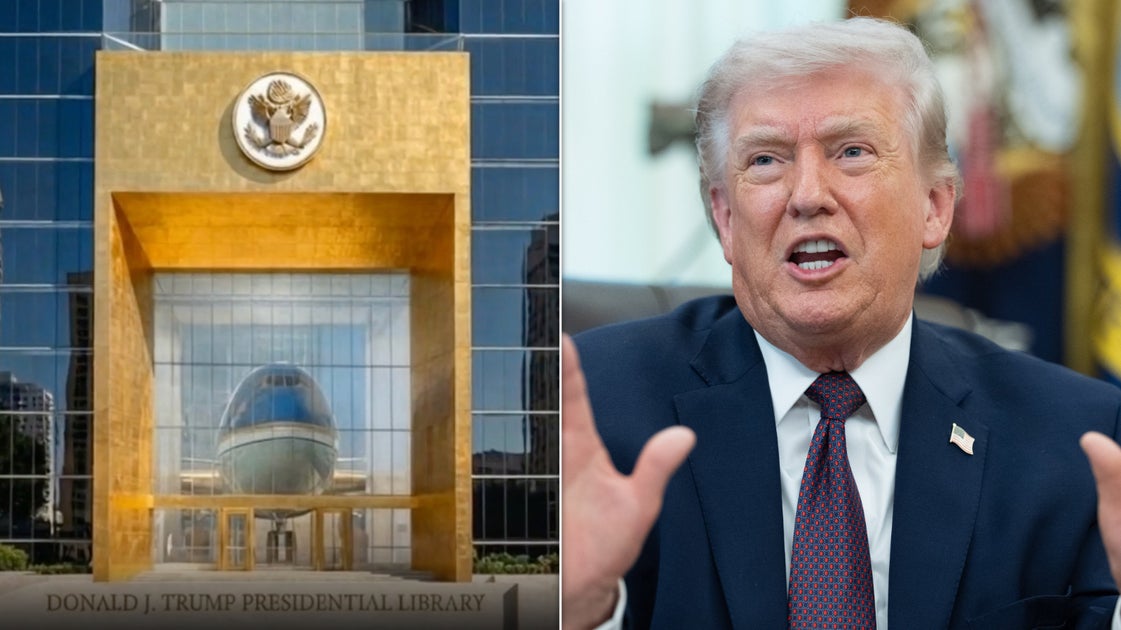
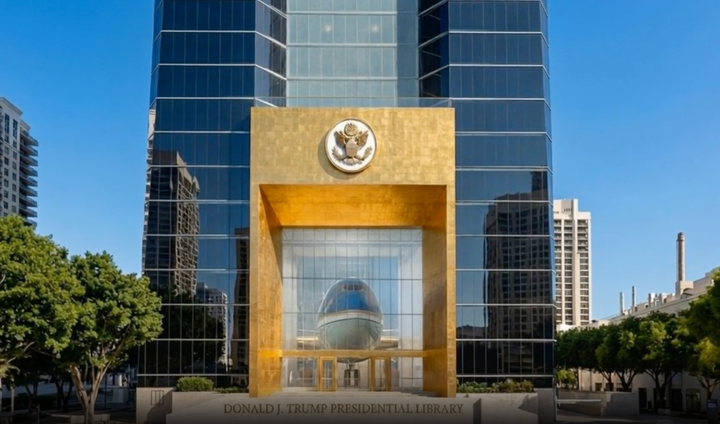
President Donald Trump is not exactly known for his sophisticated or understated taste. But a recent rendering of his presidential library in Miami has drawn particularly strong reactions from political observers and experts in design.

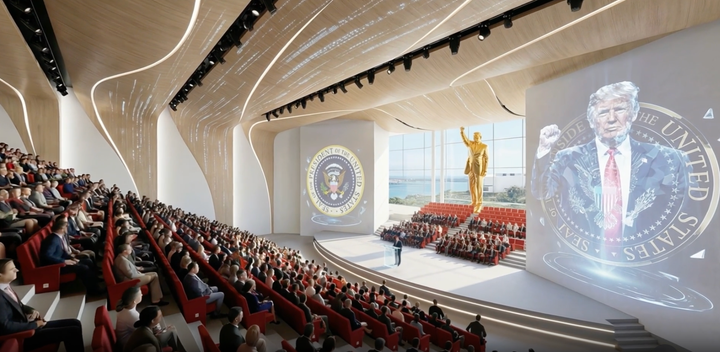
As a video shared by Eric Trump shows, the proposed design involves a towering, gold-accented skyscraper with an unmistakably opulent feel. There’s a golden escalator, an Air Force One jet, a replica of Trump’s White House ballroom plans, large screens broadcasting Trump’s face and at least two oversized golden statues of the president.

Notably absent from the “library”: books.

Rather than documents, exhibits or research facilities, the Donald J. Trump Presidential Library appears more focused on private revenue streams. The rendering highlights the building’s use as a glitzy event venue, and the president recently shared his intentions to include a hotel in the tower.

“Could be office, but it’s most likely gonna be a hotel with a beautiful building underneath,” he told reporters.

The design has quickly sparked comparisons online to everything from Biff Tannen’s Pleasure Paradise in “Back to the Future Part II” to authoritarian monuments in North Korea. Architecture writer Catherine Slessor summed it up in The Guardian as a “gaudy, self-glorifying monstrosity.”

Beyond the quippy memes, the proposal raises even more substantive questions about what a presidential library is supposed to represent and communicate to the public.

With that in mind, HuffPost asked experts in the field of design ― from architects to interior designers ― to weigh in on the rendering of Trump’s presidential library and what it signals to them.

“My reaction is that it is completely absurd,” said K. Heather Brakefield, owner and principal architect at KHB Architecture Studios. “A presidential library is supposed to preserve records, provide public access to history, and help people understand a presidency in context. This concept looks much more like a monument to personal mythology than a serious civic institution.”

She sees clear symbolism for wealth, spectacle, celebrity and self-celebration.

“Instead of communicating reflection, scholarship or public service, it communicates branding,” Brakefield said. “It turns the idea of a presidential library into a stage set centered on Trump himself rather than the historical record of his administration. That, to me, misses the point entirely.”

“If you didn’t tell me this was a presidential library, I would have thought it was an outpost of the National Air and Space Museum,” said interior designer Annie Elliott. “The life-sized replica of Air Force One is the perfect symbol for this presidency, though. Trump values shiny things and shortcuts, not history or education. I don’t see plans for a library, exhibitions or an information center. In the end, it’s just another hollow skyscraper.”

For interior designer Andrew Shoukry, the proposed “library” appears to be less a place of reflection or learning and more an example of the Trump brand.

“The use of gold, scale and spectacle signals power and permanence rather than intellectual legacy,” he said. “It leans heavily into visibility and dominance, which aligns with a broader aesthetic language that prioritizes attention over restraint or timelessness.”

As Elliott put it, “The gigantic, gold statue of Trump screams ‘triumphant dictator.’”

Architect and artist Thomas Wells Schaller emphasized the importance of physical and psychological context when it comes to design, particularly civic or public architecture.

“A U.S. president is a public servant,” he said. “As such, a presidential library ought to be a testament to that service, reaching out over time to continue to serve the public as a trusted source of knowledge and inspiration. But rather than reaching out, the design for the proposed Trump Library seems to look inward ― toward mere commercial and corporate interest.”

Instead of communicating reflection, scholarship or public service, it communicates branding.

Schaller believes Trump’s proposed structures show a lack of consideration for the rich history of civic buildings like presidential libraries.

“There’s nothing wrong with bold architecture ― or even with being intentionally out of context,” said Aaron D. Murphy, owner of ADM Architecture. “But when architects do that, there’s usually a clear rationale rooted in culture, urbanism or theory. Here, the move toward scale, gold detailing and spectacle doesn’t appear to be grounded in Miami’s context or civic identity.”

The proposed library is much more self-referential, making a personal statement rather than offering a home to history.

“Presidential libraries have traditionally balanced legacy with public trust,” Murphy said. “This proposal shifts that balance toward authorship and visibility. It’s not trying to blend in, and it’s not really trying to engage with its environment. It’s trying to dominate the conversation. It doesn’t just stand out ― it seems designed to ignore everything around it.”

He added that well-considered projects take the history of their location into account ― something he does not see reflected here.

“Miami is defined by diversity, cultural layering, color and a strong relationship between public life and space,” said interior designer Sarah Boardman. “The rendering doesn’t engage with that context, it feels imposed rather than integrated.”

Architect Jorge Salgado, who is from Miami, echoed some of those concerns, though with a degree of ambivalence.

“Do I care? Kind of, in so far as it impacts my hometown,” he said. “The scale and some of the stylistic choices raise questions. Interestingly, it is not in a classical style. Tacky, perhaps.”

A high-rise building with a luxury hotel component also breaks from the presidential library tradition in many ways.

“Traditionally, these spaces are designed to be grounded, open and community-oriented places where the public can engage with history, research and shared national memory,” Boardman said. “They often function more like a campus than a monument. This concept moves in a very different direction. It reads much closer to a vertical, branded structure, more in line with commercial developments like Trump Tower than a civic institution.”

The proposed design suggests exclusivity and hierarchy, she suggested.

“The emphasis on height, gold elements and spectacle centers identity and visibility over access and use,” Boardman said. “Rather than inviting the public in, it reinforces a boundary, signaling that the space is to be looked at, not necessarily participated in. Idolatry at its best.”

The library rendering is in line with a Trump aesthetic that has remained largely unchanged since he became a public figure.

“Over the past two decades, there’s been a clear move toward sustainability, material innovation, and performance ― things like energy efficiency, responsible sourcing and long-term adaptability have become central to how buildings are conceived,” Boardman explained. “Even highly luxurious spaces today often integrate those priorities in a way that’s both visible and functional.”

“This ’80s glam aesthetic resists that shift,” she added. “It stays rooted in a very specific visual language, high-gloss finishes, gold accents and overt displays of luxury, that prioritize immediate visual impact over evolution or performance.”

The refusal to adapt or evolve feels highly intentional.

“Overall, the aesthetic feels rooted in a traditional idea of luxury that equates richness with value,” Shoukry echoed. “What’s interesting is that contemporary design has shifted toward depth, contrast and character. So while the designs are cohesive in their messaging, they feel somewhat out of step with where design is heading culturally.”

Zooming out, Salgado warned that sidelining professional expertise in projects like this can have real consequences.

“The discipline of architecture has a rigorous body of knowledge, a history and a professional class trained specifically to understand and produce it,” he said. “When consequential decisions about civic buildings, historic urban plans and public monuments are made without serious professional engagement, when our expertise is treated more like an obstacle than a resource, the results tend to reflect that.”

While there’s plenty to say about gaudy and anachronistic aesthetics, the real debate isn’t about taste ― it’s about purpose.

“America has not always lived up to its ideals,” Schaller said. “But in the design of our public buildings, we have the unique opportunity to continue to memorialize our intention to strive. When such buildings proceed with the input of historians and design professionals, and a reverence for the public they serve, we can leave behind a truly worthwhile legacy.”

By entering your email and clicking Sign Up, you're agreeing to let us send you customized marketing messages about us and our advertising partners. You are also agreeing to our Terms of Service and Privacy Policy.
Comments
You must be logged in to comment.