bbc Press
UK transplant system, once world-leading, now lags behind
Images
1 / 10

2 / 10
3 / 10
4 / 10
5 / 10
6 / 10

7 / 10
8 / 10
9 / 10
10 / 10
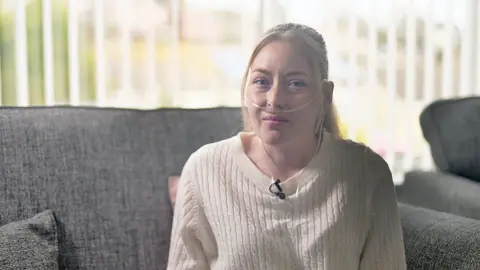
Jodie Cantle says she feels as though life is passing her by. She is attached to an oxygen cylinder at all times, waiting for a double lung transplant.

Over the past seven years, the 34-year-old has been offered new lungs on 17 different occasions, but each time the operation has been cancelled.

"I feel the world is moving on without me," she says, "and I'm just here, on hold."

The UK used to be a world leader in the field - but has fallen behind major Western nations. The number of heart and lung transplants the NHS carries out each year has not increased in three decades.

BBC File on 4 Investigates has found that technology is outdated, there is a lack of investment and senior surgeons are leaving - while patients point to issues with ongoing care.

The government told the BBC it would be writing to the NHS demanding that it "urgently implement" recommendations, first set out in 2024, to make transplant services "fit for the future".

But those working within the system say they need more resources to improve care.

Jodie is one of 450 adult patients in the UK currently waiting for a heart or lung transplant.

Born with cystic fibrosis, a genetic disorder that causes mucus to become thick and sticky, she has just 9% lung function. A transplant is her only hope for a normal life.

She makes no criticism of her transplant centre, London's Harefield Hospital, but the long wait has left her frustrated.

One potential transplant did not proceed because the hospital didn't have a theatre available. On every other occasion, she was told the lungs were not good enough to use.

"You try not to let it take over your life, but it does," says Jodie. "You always have to have your phone on hand - if they get a match for lungs, I've got to drop everything and leave immediately."

Harefield says every decision involves "multiple, complex factors and our teams consider very carefully what is right for each person".

While the number of organs donated in the UK is equal to, or better than, much of other parts of Europe per head, the NHS uses far fewer of the hearts and lungs it gets than most other countries. Just one in 10 lungs and one in seven hearts are transplanted. Some countries make use of twice as many.

Consequently, the NHS performs fewer heart transplants, and half as many lung transplants per head than many other European countries.

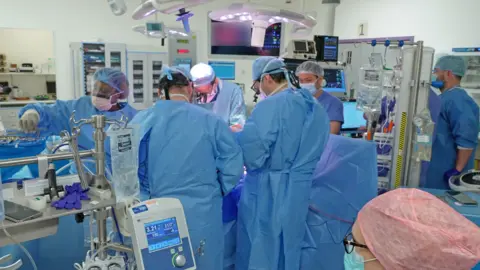
The NHS's poor performance is partly down to equipment, a dozen surgeons and experts have told the BBC.

They have spent years - often with little progress they say - asking for new technologies that are commonly used abroad.

For instance, the NHS has not invested in CT coronary angiogram machines, which allow clinicians to scan hearts to check if they are diseased.

Without detailed knowledge of the organ's condition, mistakes can occur. Surgeons have told the BBC that healthy organs can be discarded, and diseased organs can be transplanted.

Similarly, ice boxes continue to be used to transport hearts and lungs between hospitals in many instances. These can cause hardening of the transplant organs and lead to complications.

Modern alternatives to ice boxes are available that keep hearts beating and oxygenated while they are being transported. The cold-storage devices also assess a heart's viability, but they are only part-funded by the NHS.

In Glasgow, where those alternatives are used more often because of additional financial support from the Scottish government, the transplant centre says it has "substantially" improved its ability to accept donor hearts.

Even after a transplant has taken place, the UK system continues to struggle with follow-up care - its five-year survival rates lag behind the best in the world for both hearts and lungs.

Long-term support for organ recipients is vital, but patients who have spoken to File on 4 Investigates say it is not always available or is poorly administered.

Transplant patients need to continue taking medication to prevent a new organ from being rejected by the body. These can have toxic effects, raising the risk of skin cancer, kidney failure and many other health issues.

Zanib, 34, had a successful lung transplant in Manchester in January 2020, but five years later her kidneys began to fail and she was admitted to intensive care. She says the trust's renal specialists repeatedly ignored referrals from her transplant team to see her.

It was only when, while seriously ill, she brought her case to the attention of senior individuals at the hospital that Zanib received the attention she needed.

She now needs energy-sapping dialysis treatment three times a week to replace the job of her kidneys, which went into renal failure. It has impacted her employment and social life.

"The system… just doesn't work for patients like me," she says. "[We should] feel safe and supported, rather than more anxious, more vulnerable and more stressed."

Manchester University NHS Foundation Trust did not comment on Zanib's case but said "patient outcomes and safety are at the forefront of our treatment plans for all our patients".

Jess Jones, a patient advocate who has spent a decade looking into the transplant system, says the NHS must do far better at providing wraparound care that is able to deal with a patient's increased risk of complications.

"There's no point doing incredible life-saving magical operations with incredibly skilled surgeons and then not investing longer term in what's really needed to keep these people well and to have good longer-term outcomes.

"Australia, for example, has astonishing outcomes - 20% above what we do when it comes to five-year survival [rates]."

There are also striking variations between each hospital.

There are five heart and lung transplant centres in England - Newcastle, Manchester, Birmingham, Cambridge and London - and a heart transplant unit in Glasgow. People who live in Wales or Northern Ireland have to travel to one of these for surgery.

On average, a patient waits more than four and a half years in Birmingham for a heart transplant. In Cambridge, the wait is about 8 months. Birmingham says it wants to expand its service, but doesn't have the funding.

At Cambridge's Royal Papworth Hospital, which carried out the UK's first successful heart transplant in 1979, transplantation is a central focus. It doesn't have A&E or maternity services to manage, and its teams have the backing of management to conduct as many transplants as possible.

The hospital "bends over backwards to make transplants happen to ensure that we say yes to every good donor organ", Papworth's clinical lead, Dr Steve Pettit, told File on Four Investigates.

Papworth invented a technique, called Donation after Circulatory Death (DCD), for retrieving hearts from donors whose life support systems have been switched off, which now makes up about a quarter of all heart transplants in the UK. The work was, however, funded by the hospital's charity, rather than the NHS.

Another issue for the UK is a "brain drain" of experts, who see more appealing and lucrative opportunities elsewhere in the world.

Half of the six UK centres have lost their top surgeon in the past two years, and others are leaving for jobs abroad too.

Birmingham's former director of heart and lung transplants is now based in the US. Mr Jorge Mascaro says his decision to move there was motivated, in part, by frustration with the NHS's lack of investment in its transplant service and staffing.

If the situation does not change, he says, "transplantation is going to shrink and shrink progressively [in the NHS], and it may be that you're going to end up with only a couple of [hospitals] doing transplantation because the others will not be able to recruit enough staff".

As experienced surgeons leave, he says, the more junior ones lose their mentors and become increasingly "risk averse", only choosing to use the healthiest donated organs offered to them.

"It's getting worse," Mascaro told the BBC.

Issues in heart and lung transplantation were first outlined in 2024 in a report commissioned by the Conservative government. NHS England, which was tasked with implementing report recommendations, says it has worked to "improve outcomes for patients", but surgeons and campaigners believe progress has been slow.

According to Robbie Burns, a former executive director at NHS hospitals and transplant recipient, who now works as a patient representative: "There's been a lack of focus and a lack of oversight at a national level.

"I think the improvement has been extremely marginal and nowhere near the level that we need to achieve our goal of being a world-leading transplant service."

Sir Magdi Yacoub, an internationally acclaimed surgeon who helped establish the UK's once-leading reputation, told File on 4 Investigates that the NHS's issues stem from a continued lack of investment and deprioritising of services.

"We need to have more people, more money, physical resources," he says. "We have all the expertise… but we have slipped back in applying it to [patients]."

Responsibility for transplant services will soon be transferred to the Department of Health and Social Care (DHSC), following the decision to abolish NHS England.

The minister for transplantation, Dr Zubir Ahmed - who also works as a transplant surgeon in Glasgow - initially agreed to be interviewed by the BBC. When the government's press team was informed, the offer was retracted.

Instead, in a statement, the DHSC said the government had inherited a broken NHS and it recognised "the systemic issues facing cardiothoracic transplantation and the impact this is having on patients waiting for a life-saving transplant, as well as their loved ones".

A Birmingham surgeon speaking on behalf of NHS Blood and Transplant (NHSBT), which looks after services prior to transplantation, said NHSBT was aware of the problems in the system. "We're already trying to do better," Mr Aaron Ranasinghe told File on Four Investigates. "We're already doing better in terms of numbers of transplants building year on year. But we need adequate funding to follow that to allow us to reach potential."

When contacted by the BBC, the UK's transplant centres said they were continuing to develop their services and always kept patient safety and outcomes as their number one priority.

The service helps patients who need a lift home after being discharged.

Two Shropshire stroke survivors are calling for a rethink to plans aimed at cutting services.

Plans are under way for a new surgery to replace the current outdated building in Sherston.

About 200,000 donors in England have a special type of blood needed to help critically ill newborns.

It has been paid for after money was awarded to the hospital trust for improving waiting times.
Comments
You must be logged in to comment.