bbc Press
York, Southampton: UK universities flock to India - but will they succeed?
Images
1 / 10

2 / 10
3 / 10

4 / 10
5 / 10

6 / 10

7 / 10
8 / 10

9 / 10

10 / 10
On the shores of Mumbai's Powai lake - a rare pocket of serenity in the bustling metropolis of more than 20 million people - a glitzy new campus of the University of York is getting its final finishing touches.

The institute has begun recruiting students for the 2026-27 academic year, and operations are set to commence in the next few months.

"We're looking at an intake of around 270 students in the first year... and that should go up to 3,000-4,000 students each year over the coming years," Lindsay Oades, provost of the University of York in Mumbai, told the BBC.

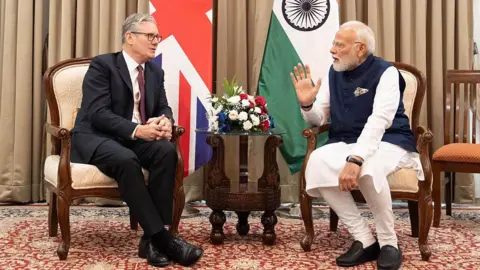
York is among nine UK universities that are setting up campuses in India following announcements last year during  Sir Keir Starmer's visit to the country. Others include the University of Aberdeen, University of Bristol, University of Liverpool, Queen's University Belfast and Coventry University.

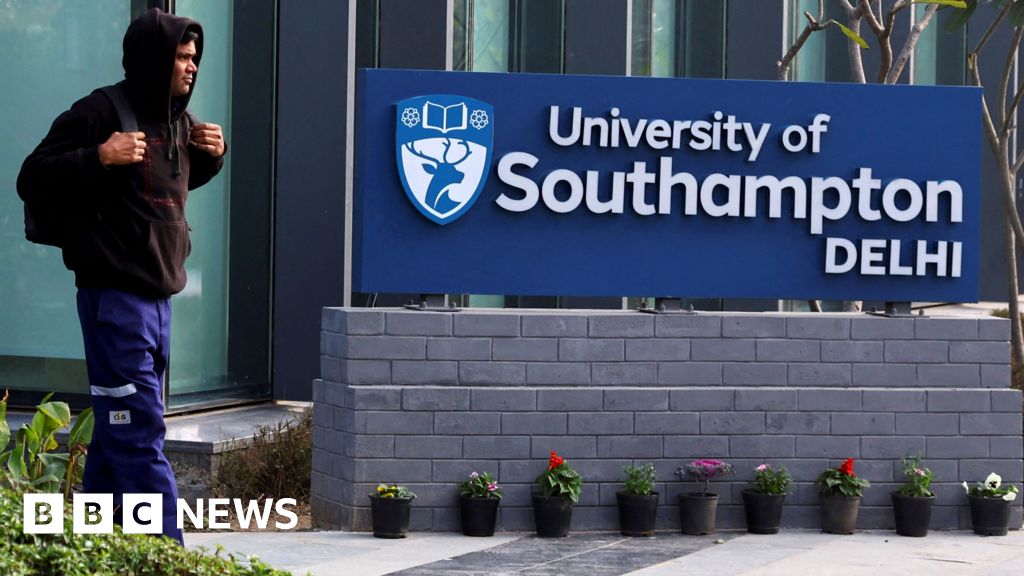
The campus of the University of Southampton has already opened a campus in the capital Delhi.

Most of these planned campuses are expected to focus primarily on business, management and engineering programmes.

In 2020, India's National Education Policy announced that foreign universities would be allowed in the country and rules were notified in 2023, creating a legal mechanism for these institutions to set up shop.

Ostensibly, the proposition appears like a win-win for UK universities facing severe fiscal pressures at home, as well as for Indian students starved of quality education locally. However, expanding on the ground will be easier said than done.

According to UK government's figures, India has 40 million university students and would need at least 70 million places in the decade to 2035, opening up an incremental market opportunity of 25-30 million seats for British universities.

Moreover there's a clear supply gap in high-quality education.

"Eleven million students complete Grade 12 [final school year in India] each year, with roughly 1.5-1.7 million falling within the top academic bracket. India's top-tier institutions admit only about 200,000 of them annually," Aritra Ghosal of OneStep Global, which helps foreign universities enter the Indian market, told the BBC.

"From an affordability standpoint, an estimated four-five million students can realistically consider degree programmes priced above £10,000 per year," said Ghosal.

That's essentially the aspirational upper middle class and not the mass market, but a large enough gap for British universities to exploit.

According to Oades, fees at York's Indian campus will be priced at around 50% of what it would cost to study at the university's campus in the UK.

While still much more expensive than many Indian private universities, there is a straight-up "quality justification" for the premium, he says, adding that universities like York follow global standards and focus on the demand for employability skills and industry partnerships.

The courses will also allow students to opt for hybrid learning between the Mumbai and York campuses, a model followed by other British universities as well.

But will this be enough?

For decades millions of Indian students have opted to study abroad, taking loans and using up family savings, mainly to migrate for better work opportunities.

Mumbai-based Ankita Kejriwal, whose son Vivaan is hoping to study finance and economics in the US next year, says most of his friends and cousins are choosing to go abroad primarily for international work exposure.

"That is the main draw. They may choose to come back in a few years, but not without working there at least for a while," says Kejriwal.

An India-delivered UK degree will not be a substitute for these students. Tighter immigration rules, however, could encourage some to opt for the foreign university experience in India.

"For those seeking brand value with lower financial and visa exposure, it may be an efficient alternative", says Ghosal.

The success of these domestic campuses will hinge on numerous factors.

Maintaining UK academic standards while operating at Indian price points will require "cost discipline and programme selectivity", says Ghosal.

Universities will have to carefully pick programmes in high-employability disciplines and collaborate with Indian industry from the outset.

Initially, enrolment is expected to be in the low hundreds. Growth will typically occur over a five-to-seven-year horizon once alumni outcomes become visible and employer acceptance for these students stabilises as enrolment decisions are increasingly outcome-driven in India, according to Ghosal.

India's regulatory environment can be difficult and universities will need to engage with authorities and systems at many different levels.

Expectedly, most UK universities, including York, have partnered with local education companies to manage regulatory complexities, establish and operate the campuses and enrol students.

But more immediate issues like infrastructure availability could still come in the way for others trying to get in.

Nearly 30,000 acres of new campus land and approximately 2.7 billion sq ft of academic infrastructure will have to be developed to meet surging demand from students for new universities, according to real estate consultancy Anarock.

"Current infrastructure remains insufficient to meet both policy ambitions and demographic momentum," Anarock said in a recent report, adding that $100bn will be required to create these academic facilities.

Given that this level of investment may not be viable, "many new entrants - particularly private players and foreign universities - may initially adopt asset-light strategies, leasing space within existing or purpose-built institutional buildings before committing capital to owned campuses", says Aashiesh Agarwaal of Anarock.

Whether that would deliver the quintessential university campus experience remains to be seen. But calibrated, not breakneck, expansion appears to be factored into the business projections.

Last year, international campuses brought in about just $1.34bn of the $43bn British universities earned as exports revenue. Their expansion in India is set to give a $67m boost to the UK's economy over an unspecified period - a modest number compared with the $5.3bn Indian students spent in studying on campus across Britain in 2024 despite plummeting enrolment.

Follow BBC News India on Instagram, YouTube, X and Facebook.

The PM also tells senior MPs the conflict was "not our war" and there must be a "lawful basis" for any UK involvement.

Bank of England governor Andrew Bailey is among those attending the emergency Cobra committee meeting.

The European nation, struggling to find skilled staff, is giving jobs to young people from India.

British politicians tend to stick together during dangerous moments abroad. In 2026? Not so much.

In 1912, Jamini Sen became the first woman Fellow of Glasgow’s Royal College, founded in 1599 and long closed to women.
Comments
You must be logged in to comment.