huffpost Press
Democrats May Be Ready To Pull This Major Lever To Stop Trump’s Iran War
Images
1 / 6

2 / 6

3 / 6

4 / 6

5 / 6

6 / 6
WASHINGTON – Democrats face a big decision about how hard to go against President Donald Trump’s war in Iran: Do they want to keep passing “war powers” resolutions that don’t stop the conflict, or do they want to go harder and potentially shut down the government?

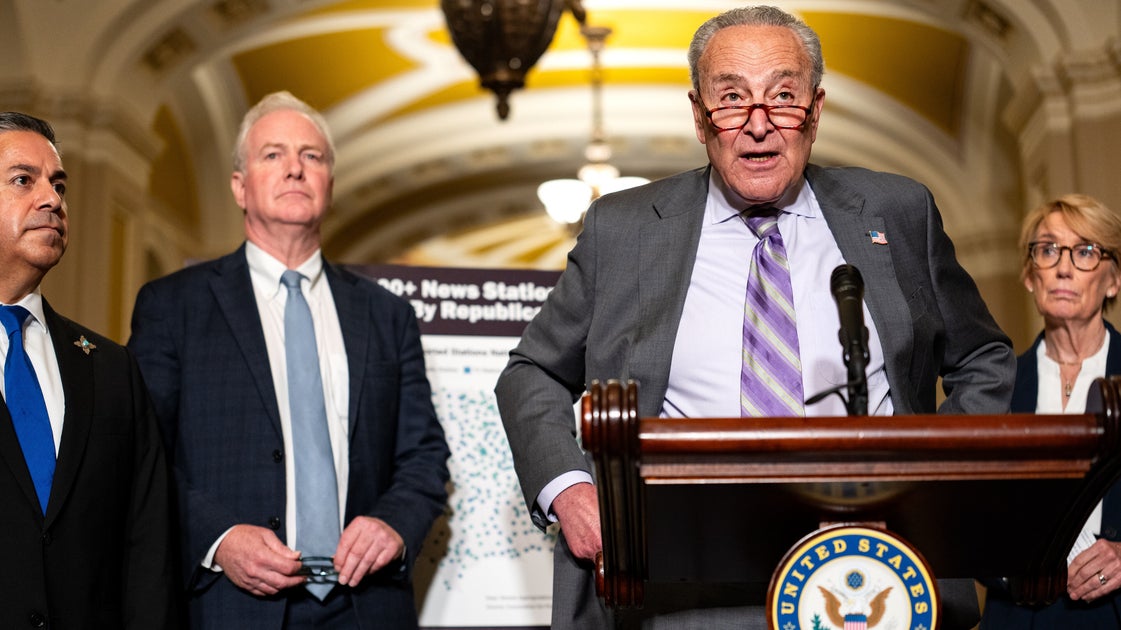
Sen. Chris Van Hollen (D-Md.), who is challenging Sen. Chuck Schumer (D-N.Y.) for the role of Senate majority leader when Democrats take control of Congress next year, has said Democrats should use a Dec. 11 government funding deadline to force Trump to end the conflict.

“I believe that voters sent a message loudly and clearly that we need to end the war in Iran and bring down costs as soon as we have it,” Van Hollen told NPR on Monday. “And we should not be voting for one penny in mid-December to continue this war.”

In other words, Van Hollen thinks Democrats should refuse to vote for a government funding bill if it omits language requiring the war’s end, essentially daring Trump to blink. A government shutdown would be likely — and potentially risky politics, since it would strain an already shaky Federal Aviation Administration during the busy holiday travel season.

Schumer has not said whether he would be willing to risk a government shutdown over the war, and Senate Democrats hold mixed views about the strategy.

“I probably would oppose continuation of funding unless steps are taken to stop the war,” Sen. Richard Blumenthal (D-Conn.) told HuffPost.

“It’s a question of whether we continue to fund a war that is escalating costs, taking lives, ruining our standing abroad, and the only power we have to stop it is the power of the purse,” Blumenthal said.

Sen. Peter Welch (D-Vt.) said shutting down the government instead of passing a “continuing resolution,” or CR, would only make things worse.

“Our goal is to end the war. Figuring out how to do it is the challenge,” Welch told HuffPost. “We have an opportunity to put language in the CR, but the goal is to end the war for two reasons. It’s a god awful, destructive war. Number two, it’s causing enormous economic harm to everyday people. A shutdown will add to the harm.”

A group of Democrats led by Sens. Tim Kaine (D-Va.) and Tammy Duckworth (D-Ill.) is drafting legislative language they hope to add to the funding bill to prohibit the Trump administration from using any money for the war, but it’s not clear if Republicans would go along. Sen. Susan Collins (R-Maine), chair of the Senate Appropriations Committee, which oversees government funding bills, doesn’t think a CR is the right venue for lawmakers to try to affect the war — even though she opposes the conflict.

“The way to bring the Iranian war to a close is through the war’s resolution act,” Collins told HuffPost on Thursday, referring to the War Powers Resolution, a 1973 law that gives Congress fast-track procedures for directing the president to cease hostilities abroad.

Collins has repeatedly voted in favor of resolutions to end the Iran war, including one that passed the House and Senate in June. The president ignored the resolution, which was technically not an actual piece of legislation and was not sent to the White House for his signature. The 1973 law doesn’t allow fast-track voting for actual war bills in the House, which is still controlled by Republicans until January.

If they can’t get support from Republicans, it’s not clear if Democrats would be able to insert antiwar language into a government funding bill or amend it with a vote on the Senate floor. Government funding itself would then become their leverage.

At the urging of their progressive base, Democrats initiated the longest shutdown in U.S. history last fall in a futile attempt to force Republicans to support an extension of Affordable Care Act subsidies. Progressive groups outside of Congress cheered the effort, but it’s not clear if the political impact would be the same heading into a new year with a Democratic-controlled Congress.

In both his bid for leadership and his push for a shutdown fight, Van Hollen is trying to channel the energy of voters who threw out record numbers of lawmakers in this month’s midterm elections. Voters were clearly unhappy with the war and the massive spike in gas prices it caused.

“The clear message from Minnesota voters is that they don’t want this war; they want it to end. And I don’t know how I could explain to them that I was funding more of the war,” Sen. Tina Smith (D-Minn.) told HuffPost.

Still, Smith wanted to talk to her colleagues about the best strategy.

“I’m eager to hear what their ideas are,” she said.

By entering your email and clicking Sign Up, you're agreeing to let us send you customized marketing messages about us and our advertising partners. You are also agreeing to our Terms of Service and Privacy Policy.
Comments
You must be logged in to comment.