buzzfeed Press
59 Shocking And Horrifying Deathbed Confessions That Maybe Should've Stayed Buried
Images
1 / 17
2 / 17

3 / 17
4 / 17

5 / 17
6 / 17

7 / 17
8 / 17
9 / 17
10 / 17
11 / 17
12 / 17
13 / 17
14 / 17
15 / 17

16 / 17
17 / 17
“I’m not your real grandfather. I kidnapped your mom when she was little.”

I'm a Senior Staff Writer based in New York City, where I've been covering classic BuzzFeed-style content since 2020.

NOTE: There are mentions of murder, infanticide, sexual abuse and assault, and suicide.

The other Quora questions we used are linked here; the other Reddit threads are here.

"He told me he was not upset that he had killed the people because he felt he was delivering justice, but he knew that it meant he was bound for hell. He then went to sleep and never woke up.

I called the state police in the state he had worked in and told them what he had said. They basically told me that they would look into it, but that most of the people and records from that time (the '70s–'90s) were gone, and they likely wouldn't find anything. I have never heard anything else about it."

"No autopsy was performed, and everyone assumed they had passed from old age. He smiled at me and said, 'It was my job to protect her.' I simply smiled and told him he was now my favorite person; moments later, he passed on. I will never forget him."

"Being that she weighed under 100 lbs, he was able to overpower and rape her. She told me that she always carried a well-sharpened knife and managed to grab it. She stated that she lost count of how many times she stabbed him, and when she was sure he was dead, she ran across a pasture back to her home. She said he was a well-liked businessperson from their community who had a family. I asked if she ever regretted not telling anyone; she looked at me and said, 'I am telling someone now.' I have never told anyone, nor have I looked up unsolved murders in the area at that time, but maybe now is the time."

"Turns out that she got pregnant at 17, while unmarried, with a boy she didn't even know well. Which would have been a big deal back then. She hid her pregnancy and gave birth in the family barn. Scared and knowing that if her family found out about any of this, she would be kicked out and labeled, she wrapped up the baby and placed it in a pond on the family farm.

I thought my heart stopped when she told me her story. Soon, she fell asleep and passed about an hour later."

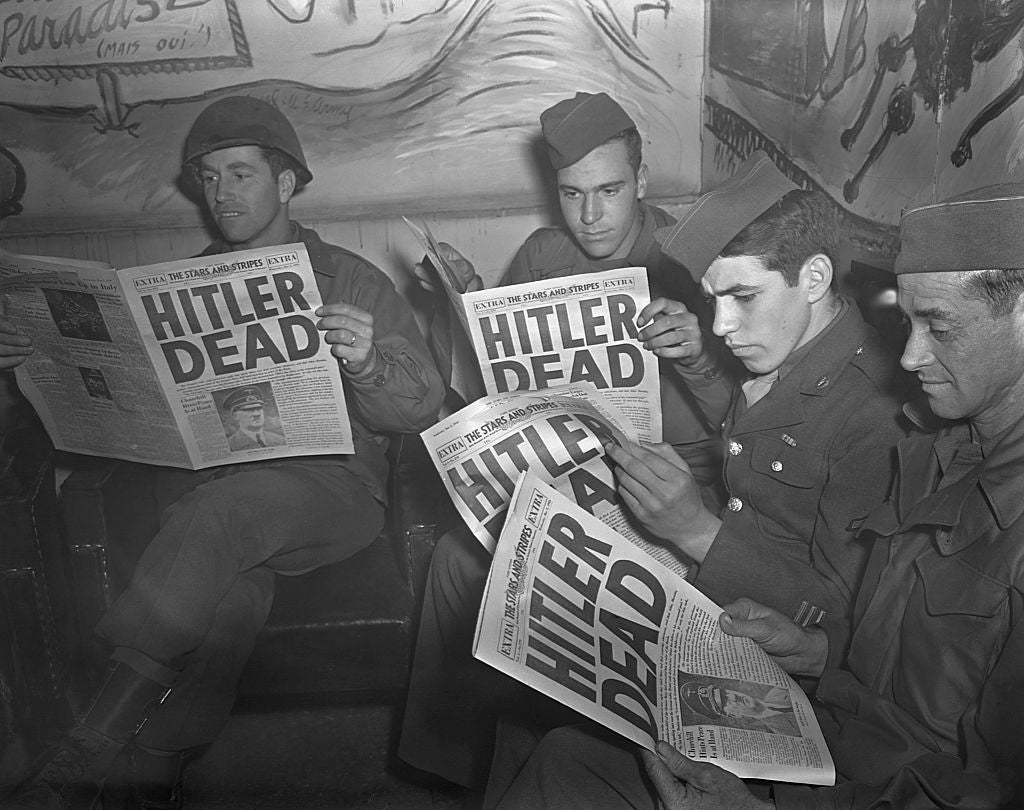
"When Hitler was dead, he said he was ordered to check the wrecked vehicles around for fuel and bring it. Then the high-ranking SS-officers carried the corpses of 'Herr und Frau Hitler' into the garden and placed them into one-foot deep holes. With the help of the collected fuel, they set them on fire. When artillery fire set in again, everybody headed for the bunker, except for him. So he watched the Führer burn. I was speechless! It was one of those moments you never forget in your life. I felt my hair stand up.

'What did you feel? What did you think in that moment?' I heard myself say.

'I thought: Look, such a great man, and he ends up in a mud hole, burning from fuel!'

I then asked him what he thought about Hitler.

'He was a visionary man!' he said, adding, 'He could have achieved so much, if there had been no war…'

He died a few days later. I never found out if he had told me the truth."

"In it, there were four ornate, hand-carved German hunting knives, plus some medals, including an Iron Cross, rings, and papers. He told us we could have the contents, then said he had risen to the rank of Standartenführer (Colonel) in the SS. He told us, through hypoxic, rattling gasps, that in 1942 he ordered and supervised the murder of over 4,000 civilians, mainly women and children, somewhere in Hungary. He was never charged with war crimes and escaped the Nuremberg war crimes trials because there were no witnesses or paperwork to tie his orders directly to the SS.

He told it without emotion, without deception, as if he were telling you where he had parked his car. He had kept that secret for 40 years and needed to release it, like a confessional, before he died. We got him into the ambulance, but he was DOA by the time we got to the ER at Beth Israel."

"I could never find any evidence of anyone having been killed during those five days in LA when the riots took place. Maybe he killed someone unrelated to the fray."

"Her children were probably 50 years old; I have no idea how this had stayed a secret for so long.

The next morning, I saw an unfamiliar older gentleman in her room. The nurse I was shadowing whispered to me that this was the childhood best friend! I don't know whether or not they were still messing around.

We told her not to tell the husband and children. If it'd been a secret this long, there was no point in telling them on her deathbed."

"'I was pulled over by a cop on one of my midnight runs, and he demanded that I open up the back of the truck to show him what I was carrying. I knew I was in big trouble if he found the booze and also in big trouble if I didn't deliver it. I made like I was reaching for the key for the padlock and shot him with my handgun. He died instantly. I hid the body and high-tailed it out of there. They never figured out who killed him. It's been over 50 years since it happened, and you're the first person I have ever told. I guess I just wanted to get it off my chest.'

I was speechless. I don't remember what I said to him, but I recall thinking later that he trusted me enough to finally tell someone he was a murderer."

"I also found out that her son was the one who'd put her away. He then moved all the way to the other side of the country just to get away from her. He never visited her and wanted nothing to do with her."

"A second patient was a woman who had been in a bad car accident and was dying. She confessed to her husband while I was in the room that she had been having an affair with two other guys — one was his brother."

"I absolutely did not stick around for the follow-up. What I did learn was that I had absolutely ZERO interest in ever working in any adult specialty. Luckily, preemies can't bury bodies. Yet."

"I also had a woman who was 100+ tell me she had been badly abused by her first husband, but was stuck in the marriage because of the culture at that time. He'd been thrown from a horse (that he'd also been very cruel to) and kicked several times. She ignored his cries for help and let him die. She said she had never told anyone about it, but she felt guilty for it for over 80 years and could still hear him screaming for help. We talked about it for a long time (I was working the night shift, and it gave me a chance to spend extra time with some patients). My experience working with people with PTSD helped me to help her see that she was acting to protect herself and others from him and responding from a place of natural fear. Before she passed, she told me I had helped her find peace with it."

"Often people have a moment of clarity/make sense for a brief episode right before they pass. I didn't take it as a threat or anything; it just freaked me out. He passed away that evening after my shift was over, so I always wondered if this was a deathbed confession of sorts."

"Some of his crimes involved children. Torture and murder of innocent civilians. I feel like it's a crime just talking about it. A lot of strangulation...He'd talk in great detail about how it felt and what the people looked like as they died. How you had to hold on even after they stop breathing.

The rumours from within the facility were that he was a guard of sorts at a prison. It was creepy...the way he spoke and the look in his eyes...I had no doubt he did those things."

"We talked to his son: he had no female family members or such (the patient was the only child of only children who had two sons), but we let him know his father's words.

The patient ended up dying. I'm sure he molested some girls somewhere in history, just none who could be identified. He tortured himself over it in his last few weeks, so I hope it wasn't a delusion."

"Another patient confessed to her daughter that her late husband, 'Bill,' was not the daughter's real father. And 'Bill' had not known either."

"I was pretty stunned and didn't actually know what to say, so I said I would say a prayer for him and the young victim. I called a friend who was a policeman and asked him who I should report this; he said he would check and call me back. I was notified the next morning that the patient had died, and when I talked to my friend again, he said just drop it. It happened over 80 years ago, and he is dead. Still, I think about this every so often."

Submissions have been edited for length/clarity.

Dial 988 in the United States to reach the National Suicide Prevention Lifeline. The 988 Lifeline is available 24/7/365. Your conversations are free and confidential. Other international suicide helplines can be found at befrienders.org. The Trevor Project, which provides help and suicide-prevention resources for LGBTQ youth, is 1-866-488-7386.

If you or someone you know is in immediate danger as a result of domestic violence, call 911. For anonymous, confidential help, you can call the 24/7 National Domestic Violence Hotline at 1-800-799-7233 (SAFE) or chat with an advocate via the website.

If you or someone you know has experienced sexual assault, you can call the National Sexual Assault Hotline at 1-800-656-HOPE (4673), which routes the caller to their nearest sexual assault service provider. You can also search for your local center here.

If you are concerned that a child is experiencing or may be in danger of abuse, you can call or text the National Child Abuse Hotline at 1-800-422-4453 (4.A.CHILD); service can be provided in over 140 languages.

The National Alliance on Mental Illness helpline is 1-800-950-6264 (NAMI) and provides information and referral services; GoodTherapy.org is an association of mental health professionals from more than 25 countries who support efforts to reduce harm in therapy.
Comments
You must be logged in to comment.