huffpost Press
Ever Wondered What 'USB' Stands For? The Answer Is Surprisingly Literal.
Images
1 / 10

2 / 10

3 / 10
4 / 10
5 / 10
6 / 10

7 / 10

8 / 10
9 / 10

10 / 10
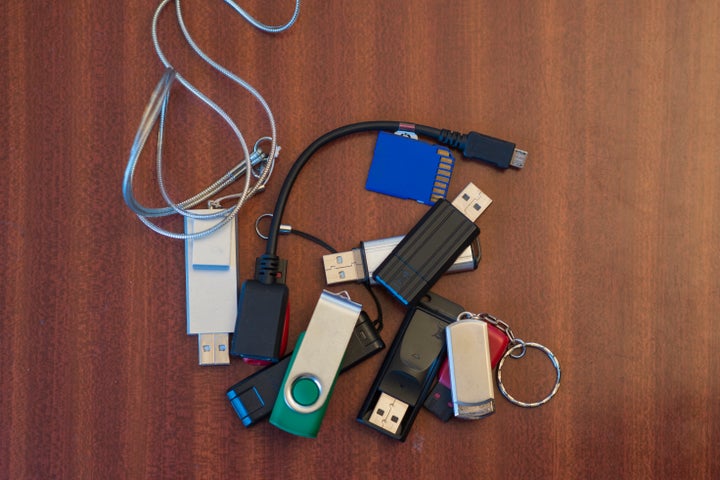
If you’re anything like me, you probably have a drawer or box at home that’s stuffed with random cables, chargers, flash drives, etc. Many of them have one notable thing in common: the letters USB.

This technology has become so ubiquitous that most people never stop to think about what the acronym actually means. Interestingly, the name in fact tells you a lot about what it was designed to do.

“USB stands for ‘Universal Serial Bus,’” Madeline Enos, a language trends expert at the learning platform Preply, told HuffPost. “‘Universal’ because it was designed to replace a bunch of incompatible connectors ― serial ports, parallel ports, proprietary ones ― with a single standard that any manufacturer could build to.”

That achievement was a pretty big deal at the time.

“Before USBs, PCs relied on a mix of proprietary, incompatible ports, one for a mouse, another for a printer, another for a keyboard, each needing a different cable,” said Noel Wolf, a cultural and linguistic expert at the language learning platform Babbel. “USB was built as a single standard any peripheral could use, regardless of manufacturer.”

The “serial” part of USB refers to the way information moves.

“‘Serial’ describes how the data travels,” Wolf said. “One bit at a time, in sequence, down a single channel, as opposed to the older ‘parallel’ ports, which sent multiple bits down multiple wires at once. Serial transmission scales better, which is why USB went from 12 megabits per second in 1996 to tens of gigabits per second now, while parallel ports were phased out.”

Finally, you get to the “bus” portion.

“‘Bus,’ an old-school computer-engineering term with nothing to do with the vehicle, refers to a shared pathway that lets multiple devices talk to a computer on the same connection,” Enos said.

That “B” shows up in other tech-related acronyms, like GPIB (General Purpose Interface Bus) and HP-IB (Hewlett-Packard Interface Bus) ― which both refer to a particular short-range digital communications standard.

“‘Bus,’ in electrical engineering, means a shared pathway carrying data or power between components,” Wolf said. “The term predates USB by decades and is used across electronics generally.”

And that “bus” term in the tech world comes from a time many centuries before electricity.

“There’s an interesting linguistic detail in ‘bus’ worth noting,” Wolf said, adding that its origins go all the way back to the Latin “omnibus,” meaning “for all,” which itself derives from “omnis,” meaning “all” or “every.”

“That’s the same root behind ‘omnibus’ still used in French, Spanish, Italian and Portuguese for certain types of public transport,” she said.

From the word “omnibus,” we get the transit term “bus,” as well as the electrical engineering term “busbar.” And it was from the latter that the “bus” in USB ultimately got its name.

“So ‘Universal Serial Bus’ contains a slight redundancy ― ‘universal’ and ‘bus’ both trace back to the same idea of something serving everyone,” Wolf said.

The meaning of the term makes even more sense when you consider the problem USB was created to solve.

“Development started in the mid-’90s when seven companies (Compaq, DEC, IBM, Intel, Microsoft, NEC and Nortel) set out to fix a major headache of the tech of that era: Almost everything needed its own port and its own cable standard,” Enos explained.

“USB dates back to 1994, when a working group of seven companies began developing the standard, with the first USB 1.0 specification published in January 1996,” Wolf said.

Intel engineer Ajay Bhatt is widely credited as a key inventor and driving force behind the creation of USB.

“Apparently Bhatt was inspired by his wife to help create the USB,” Enos said. “As the story goes, his wife was trying to print school materials for their daughter and hit a wall ― the printer just wouldn’t connect to the computer. Every manufacturer used its own connector, so getting one device to talk to another meant hunting down the right cable or buying new hardware to match.”

“Watching that frustration is what helped push Bhatt to work with others to build one common, universal system instead,” she continued.

It took time for the new system to catch on, however.

“Adoption was slow at first,” Wolf noted. “It picked up once Apple’s iMac was developed with USB-only ports in 1998 and Windows 98 supported it natively.”

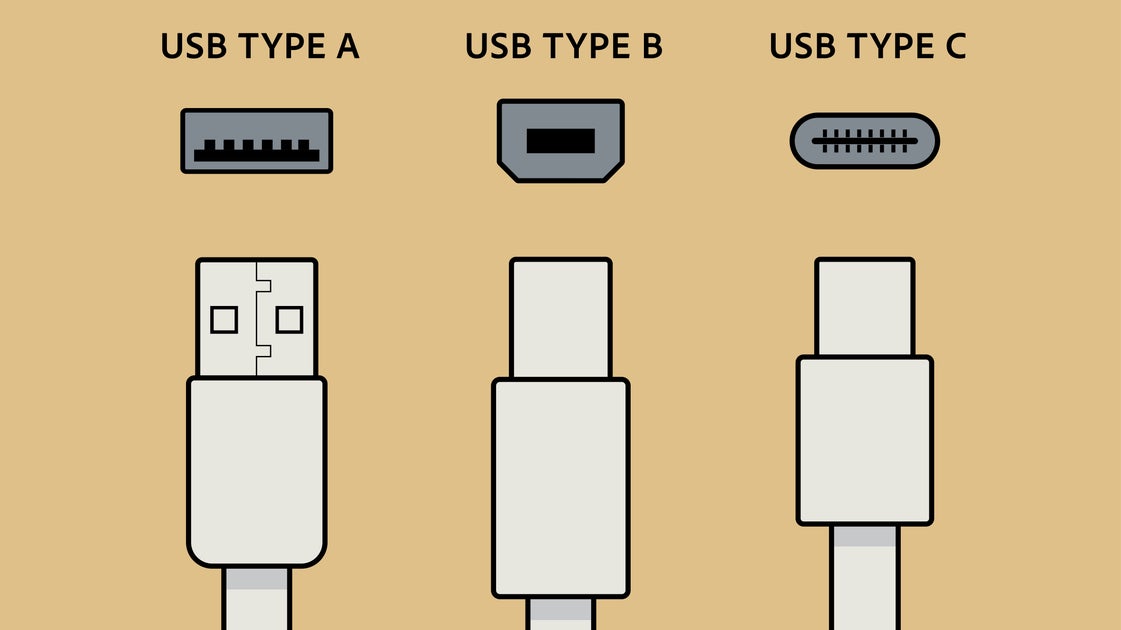
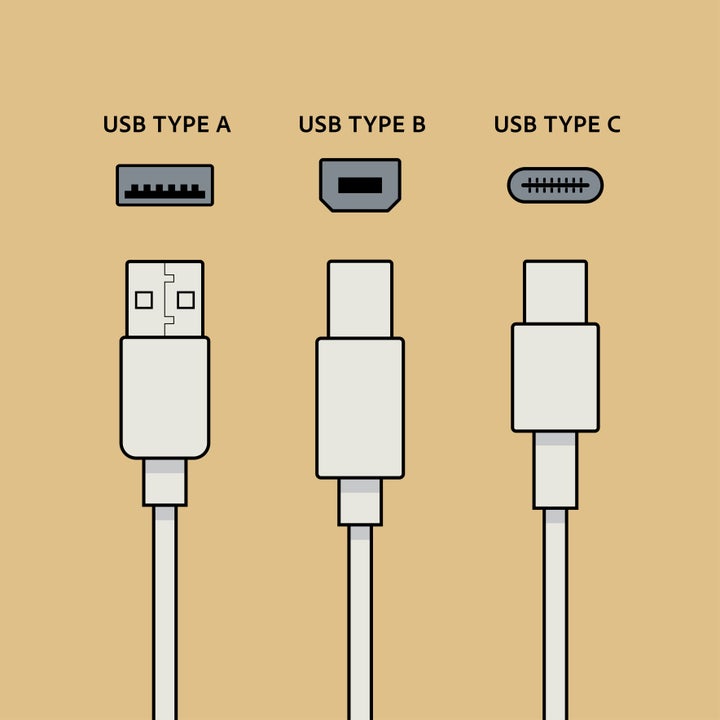
In the decades since, USB has gone through plenty of upgrades, and we’ve seen those letters attached to a few different plug shapes. The latest, increasingly common type is USB-C. In this case, the “C” simply refers to the connector type, coming after the older rectangular USB-A plug and the boxier USB-B plug often found on printers.

As you’ve likely noticed, a big selling point for USB-C is that it’s reversible, so there’s no more flipping the plug multiple times to get it in the right way.

USB-C also seems to be bringing this tech closer than ever to the stated original goal of the term USB. Due to regulations in the European Union, USB-C charging ports have been required for many handheld devices since December 2024, including phones, tablets, e-readers, digital cameras, speakers, keyboards and mice.

Driven at least in part by these requirements, many tech companies like Apple have moved toward USB-C as the global standard as well. Meanwhile, the term “USB” has proven pretty universal in more ways than one.

“There’s a nice irony in how literal ‘universal’ turned out to be,” Wolf said. “Most tech terms get adapted once they cross into other languages, but ‘USB’ is one of the rare ones that didn’t. French, German, Spanish, Japanese and most others just kept the letters U-S-B as they are rather than translating them or coming up with a local term ― they only change how the letters are pronounced.”

“Japanese sounds it out in katakana as yūesubī, saying the English letter names with a Japanese accent,” she added. “French speakers say the same three letters the French way. So the word built to mean ‘works with anything’ ended up being one of the few pieces of tech vocabulary that didn’t need translating either.”

By entering your email and clicking Sign Up, you're agreeing to let us send you customized marketing messages about us and our advertising partners. You are also agreeing to our Terms of Service and Privacy Policy.
Comments
You must be logged in to comment.