aljazeera Press
Spanish unions call general strike over housing before snap election
Images

1 / 6

2 / 6

3 / 6
4 / 6

5 / 6

6 / 6
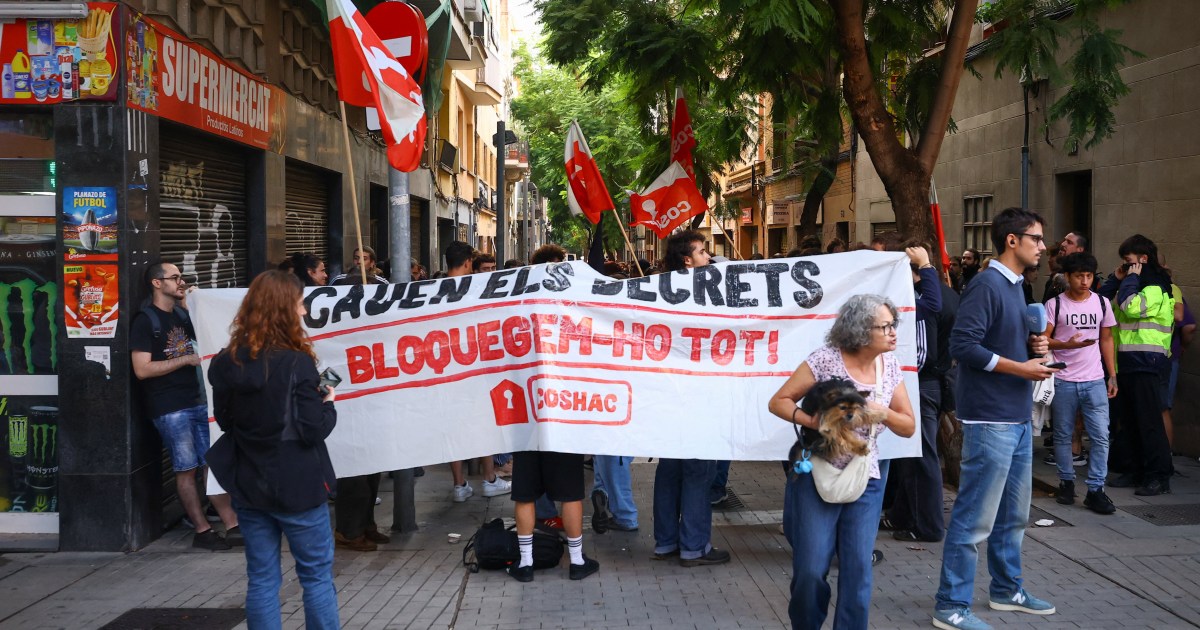
The general strike is the first to be jointly backed by Spain’s two largest unions in 14 years. Save Share Trade unions in Spain have announced a nationwide general strike over housing issues for November 11, a few weeks before a snap election in which rising rents and evictions have become major campaign topics. The country’s two largest unions, the Workers’ General Union (UGT) and Workers’ Commissions (CCOO), said the planned date still needs to be ratified by other unions in a meeting later on Wednesday. It will be the first general strike jointly backed by Spain’s two largest unions in 14 years. “We cannot ignore the fact that housing is where most of our wages go. What is the point of raising the minimum wage if housing costs are rising three, four or five times faster?” Madrid Tenants’ Union spokesperson Valeria Racu said. Spain has a deficit of about 750,000 homes, which is set to grow to more than a million by 2028, according to the Bank of Spain. The average rental price of 1,176 euros ($1,315) is equivalent to about 98.7 percent of a young person’s average monthly salary in Spain, Youth Council of Spain figures show. The strike was announced following weeks of demonstrations set off by the eviction in Madrid of 87-year-old Maria del Carmen Abascal, known across Spain as Maricarmen, who became the symbol of a mounting housing crisis. An international investment fund bought her building and raised her rent by more than 200 percent to roughly $1,880 a month, a move aimed at pushing out the long-term tenant to make way for lucrative tourist apartments. Maricarmen, who had been hospitalised since being carried out on a stretcher from the apartment where she had lived for seven decades, died on Wednesday. Prime Minister Pedro Sanchez sent his condolences in a post on X. “All my love to Maricarmen’s family and loved ones,” he wrote. “A hug as well to all of us who feel this loss as our own today.” Following her eviction on September 23, the Madrid Tenants Union organised protests and encampments in Madrid’s central Puerta del Sol square, drawing tens of thousands of demonstrators before spreading to dozens of other cities. In addition to protests, the failure last week by Spain’s government to pass emergency measures aimed at tackling the crisis prompted Sanchez to call an early election for November 29. Sanchez’s main rival, conservative Popular Party (PP) leader Alberto Nunez Feijoo, is seeking a chance at forming a government, while far-right Vox leader Santiago Abascal is positioning his party as a potential kingmaker. The 54-year-old prime minister, who has been in power since 2018, goes into the election with opinion polls consistently putting him behind Feijoo. The conservative leader suffered a major setback when the party finished first in the 2023 general election without securing enough support from other parties to form a government. Polls suggest Feijoo will not win an outright majority, meaning he will need support from Vox to govern.
Comments
You must be logged in to comment.