huffpost Press
Susan Collins Faced An FBI Investigation Over Dark Money. It’s Still Flowing To Her Reelection Campaign.
Images
1 / 7

2 / 7

3 / 7
4 / 7
5 / 7
6 / 7

7 / 7
This article is part of HuffPost’s biweekly politics newsletter. Click here to subscribe.

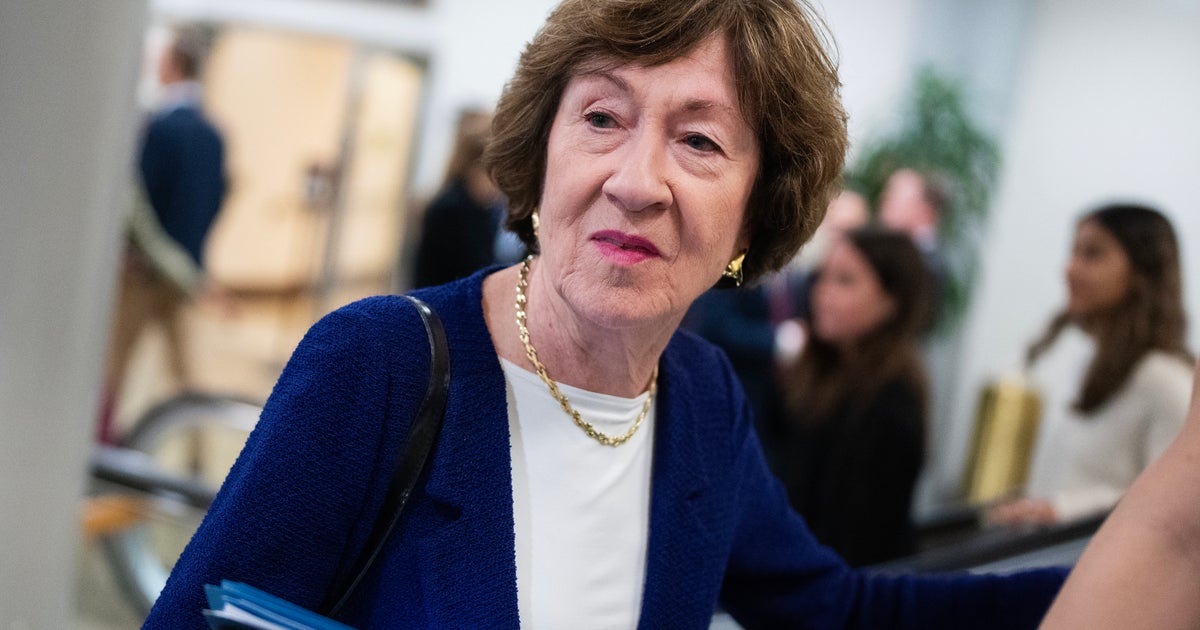
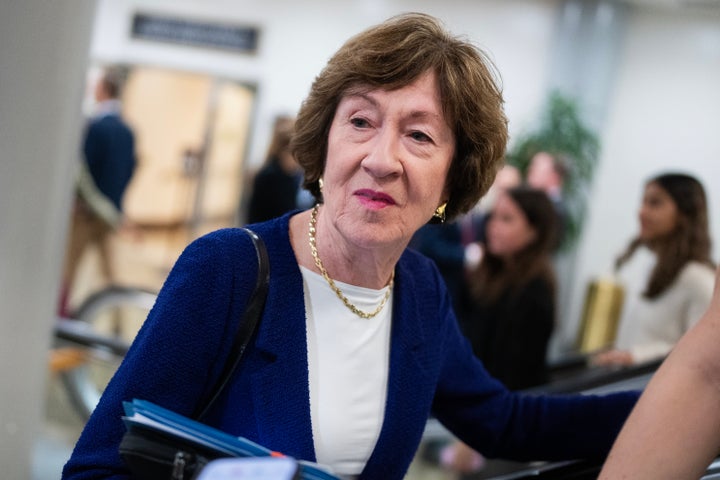
Before President Donald Trump effectively disbanded it, the FBI’s anti-corruption unit investigated Sen. Susan Collins (R-Maine) in a potential pay-to-play scheme involving a government contractor who went to jail for concealing a $150,000 donation to help her 2020 campaign by passing it through a nonprofit.

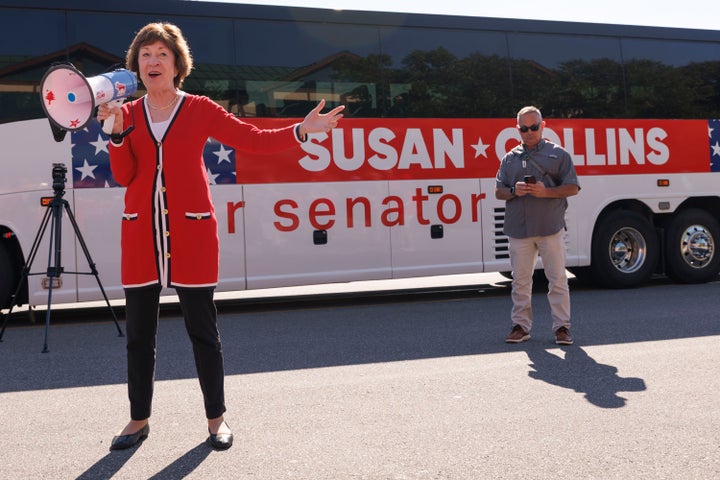
This public revelation by the nonprofit news site ProPublica led to furious denials of any wrongdoing by Collins as she faces her toughest reelection race yet. But the same kind of dark-money contributions that led to the now-scuttled investigation haven’t dried up. Two super PACs backing her current reelection campaign, including one run by Scott Reed, the operative at the center of the ProPublica story, have received $7.4 million in undisclosed contributions from nonprofits that appear to exist solely to hide donors’ identities.

The dark-money contributions to Pine Tree Results PAC and Stronger Maine are “definitely” similar in appearance to the $150,000 donation made by the Society of Young Women Scientists and Engineers LLC to the 1820 PAC back in 2020, Saurav Ghosh, a lawyer with the Campaign Legal Center, told HuffPost.

“When you see millions funneled through an entity going to different committees but no transparency about where the money originated from, that’s dangerous from a corruption perspective because that could very well be a situation like what we see with Susan Collins and Navatek,” Ghosh said.

The Society of Young Women Scientists and Engineers LLC turned out to be just a front to hide the identity of Martin Kao, then the CEO of Navatek, a Hawaii-based shipbuilding company. Collins had already helped Navatek win multi-million-dollar government contracts and would help them secure even larger contracts after the donation. The Campaign Legal Center flagged the donation to the FEC back in 2020 as a potential straw donation, which is illegal under federal campaign finance law. Kao ultimately went to jail for using the nonprofit as a straw donor to hide his contribution to Collins’ reelection.

The ProPublica investigation further revealed the porous borders between candidate campaigns and the supposedly independent super PACs and dark money groups backing them. After Kao suggested he’d like to contribute more than the direct contributions he made to Collins’ campaign, Reed solicited him to give to 1820 PAC. After Kao made his shell donation — but before public records could reveal it — a staffer for Reed’s consultancy sought Kao’s phone number so Collins could thank him for his dark-money donation.

“This is a perfect illustration that dark money is only dark for the general public,” Ghosh said. “It is not dark to the folks that are orchestrating the scheme.”

But Kao was clumsy. The Society of Young Women Scientists and Engineers LLC was registered under his wife’s name, which reporters found easily. The $7.4 million in unknown contributions helping Collins now, however, is masked behind an intricate web of conservative dark money groups that appear to exist solely to hide the true identity of their donors. A spokesperson for Collins did not respond to a request for comment.

Pine Tree Results PAC, run by Reed and funded by Collins through a joint fundraising committee, is the biggest recipient of these dark-money donations. The super PAC has received $3 million from Stronger America, Inc., $1.25 million from the Lexington Fund, $500,000 from Condorcet Initiative Corp. and $250,000 each from Ardleigh Impact Corp. and Leon Rachel Corp.

Reed previously ran the 1820 PAC and personally solicited the $150,000 contribution from Kao in 2020 after Kao contributed to Collins’ campaign and said he wanted to contribute more as he lobbied her office for help winning federal contracts, according to ProPublica. Reed did not respond to a request for comment.

Condorcet Initiative Corp., Ardleigh Impact Corp. and Leon Rachel Corp. are all run by political operative Staci Goede. The former treasurer of the Republican State Leadership Committee, Goede runs a network of dark-money nonprofits that appear to do little more than serve as pass-throughs for political donations to super PACs and other politically engaged nonprofits. Goede did not respond to a request for comment.

The Campaign Legal Center filed a complaint with the FEC alleging that Ardleigh Impact Corp. acted as an illegal straw donor for more than $2.5 million in contributions to super PACs in the 2024 election.

“There is no publicly available information indicating that Ardleigh conducted any activity from which it could have generated sufficient funds to make $2,575,000 in contributions during the three-month period between its formation and this torrent of election spending,” the complaint alleged. “As such, there is reason to believe Ardleigh was not the true source of the funds contributed in its name, and was instead established and used as a ‘straw donor’ by one or more unknown persons seeking to make $2.575 million in federal political contributions while concealing the true contributors’ identities.”

The complaint, however, has gone unanswered. The FEC does not have enough members to conduct business after Trump fired a Democratic commissioner in 2025 and two Republican commissioners retired.

The Lexington Fund, meanwhile, is part of the dark-money network run by conservative legal activist Leonard Leo. Formed in 2023, this nonprofit receives some funding from Leo’s Marble Freedom Trust and Concord Fund, but otherwise discloses no other funding.

Leo, who lives in Maine and hosted a fundraiser for Collins at his home in 2019, is the instrumental figure behind the right-wing takeover of the courts. He created the list of Supreme Court nominees for Donald Trump in the 2016 election, and his network helped shepherd Justices Neil Gorsuch, Brett Kavanaugh and Amy Coney Barrett through the Senate and onto the court. Collins was the deciding vote for Kavanaugh in 2018, though her vote against Coney Barrett in 2020 was a key part of her surprising reelection win that year.

Stronger America, Inc. is a political nonprofit that appears to solely back Collins’ reelection campaign. Paul Cooksey, a longtime GOP operative and former Senate committee counsel, runs it, and it has spent more than $11 million on advertising to boost Collins, according to the New York Times. Collins attended a fundraiser for the nonprofit in 2026 at a D.C. townhouse owned by Oracle, the data giant owned by billionaire Republican donor Larry Ellison, the Times reported.

Currently, Stronger America, Inc. is running Facebook and Instagram ads touting Collins’ support for local industries and her ability to bring home federal spending through her position as chair of the Senate Appropriations Committee.

The group, formed in 2022, has a curious background, having donated $1.25 million to a left-wing nonprofit called Progressives for Democracy in America in 2024. Its first contribution in 2022 was actually from Everytown for Gun Safety, a gun-control nonprofit largely financed by former New York City Mayor Michael Bloomberg. Everytown for Gun Safety did not respond to a request for comment.

Alan Minsky, the head of Progressives for Democracy in America, told HuffPost that he was unaware of the source of the contribution and that his group had only raised money in 2024 for ads supporting progressive Democratic Reps. Summer Lee (Pa.) and Jamaal Bowman (N.Y.) as they faced primary challenges from moderates. Lee won her primary and general elections while Bowman lost his primary.

“They must have believed and deceived the people I was working with that they were sincere supporters of Summer Lee and believed that she would lose the general,” said Minsky, a long-time left-wing activist and journalist.

Stronger America, Inc. is also connected to a super PAC called Stronger Maine. This super PAC, also run by Cooksey, received $1.4 million from Stronger America, Inc., $500,000 from Common Sense Leadership Fund, a super PAC created by the political arm of the Heritage Foundation, and $250,000 from American Advancement, Inc. Representatives for both Stronger America, Inc. and Stronger Maine did not respond to a request for comment.

American Advancement, Inc. is part of a network of dark-money groups run by Ohio lobbyist Tom Norris. Norris’ network has faced multiple legal complaints and investigations. An FEC investigation into Norris’ nonprofit’s involvement in Republican Ohio state Rep. Larry Householder’s 2018 bid to be speaker found that it likely acted as a straw donor for undisclosed individuals or entities. Federal courts ruled that the FEC could publicly disclose the real identities behind those donors, but the agency declined. Householder was convicted on corruption charges in 2023 related to a different set of dark-money contributions from the utility company FirstEnergy that were funneled through a nonprofit to hide their source.

The Missouri Ethics Commission also found that nonprofits associated with Norris broke the law by acting as illegal conduits for unnamed donors supporting former GOP Gov. Eric Greitens’ 2016 campaign.

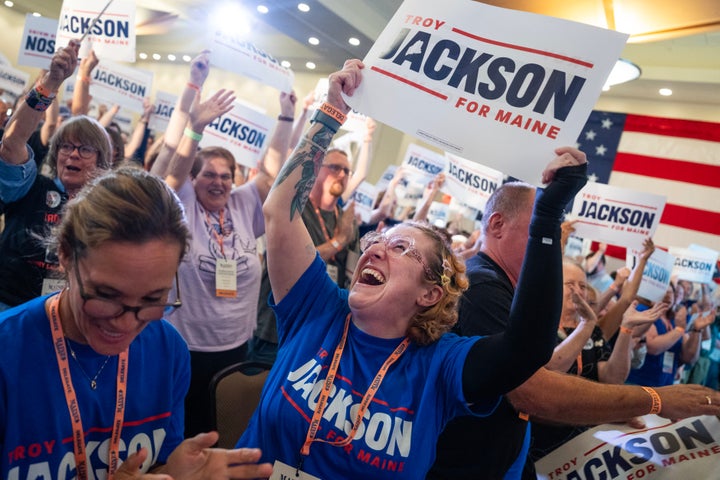
Collins isn’t alone in receiving dark-money support. Nearly every candidate in a competitive race is buoyed by some dark-money spending — including Collins’ opponent, Democrat Troy Jackson. WinSenate, the main pro-Jackson super PAC, is entirely funded by SMP, a super PAC connected to Sen. Chuck Schumer (D-N.Y.), which, in turn, receives a large percentage of its donations from the dark-money nonprofit Majority Forward.

Dark-money spending hit a record of $1.9 billion in the 2024 election, according to the Brennan Center for Justice. And it is likely to top $1 billion in 2026.

Unlike Kao’s donation, the source of nearly all of this spending is unknown to the public. But as the ProPublica reporting showed, lawmakers know it helps elect them.

“It’s quite disturbing that we’re asked to participate in a democratic process, but we as voters are deprived of this very important information,” Ghosh said. “It is genuinely a big problem that we don’t know who’s behind $2 billion in spending.”

By entering your email and clicking Sign Up, you're agreeing to let us send you customized marketing messages about us and our advertising partners. You are also agreeing to our Terms of Service and Privacy Policy.
Comments
You must be logged in to comment.