huffpost Press
Trump Has Given Workers A Pay Cut With His War In Iran
Images
1 / 6

2 / 6

3 / 6
4 / 6
5 / 6

6 / 6
President Donald Trump and Republicans are heading into the midterm elections with a big problem on their hands: War-induced inflation has erased workers’ wage gains from the past year.

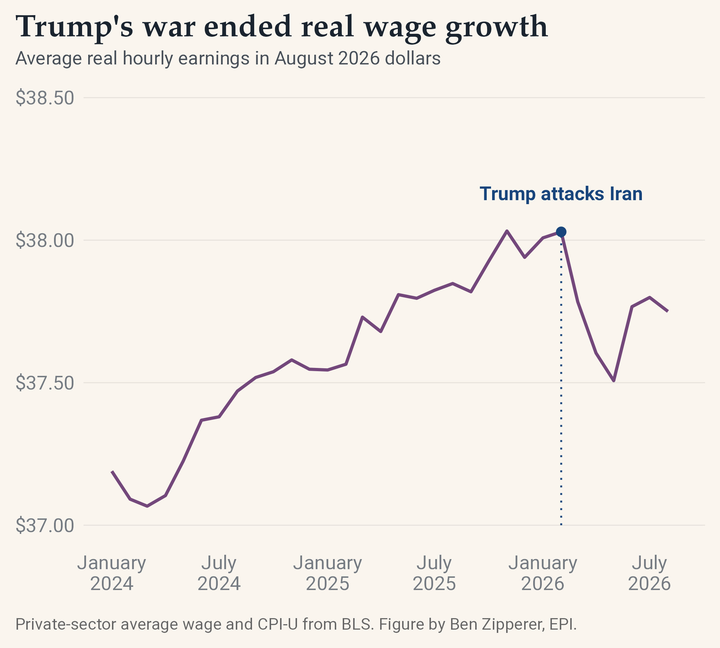
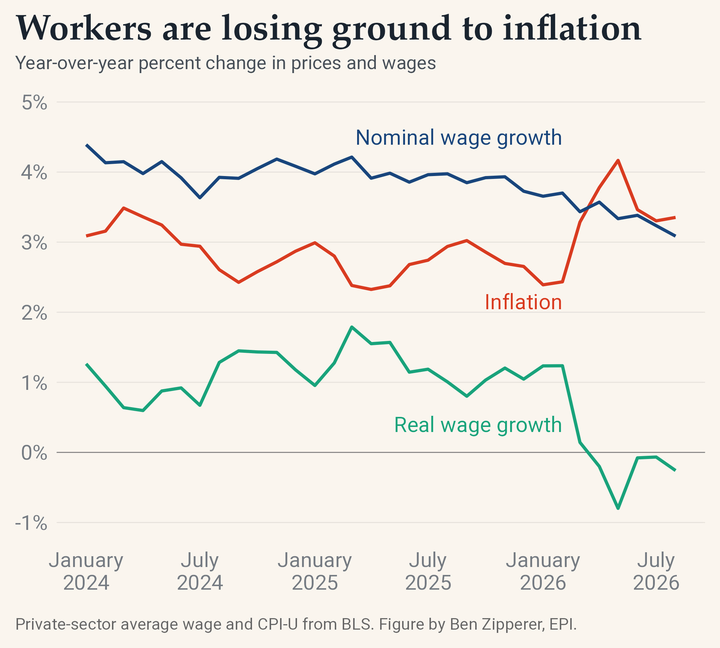
The most recent economic data shows real wages — pay that’s been adjusted for the cost of living — fell again in August as energy prices surged. Real wages have decreased in four of the past five months and now stand 0.3% below where they were in August 2025, according to the Bureau of Labor Statistics.

Although the decrease might seem modest, it amounts to a pay cut for workers ― and helps explain why people are so down on the economy.

Falling real wages is not what Trump and leaders in the House and Senate promised voters under unified Republican control. But the president’s war of choice in Iran has sent gasoline and diesel prices to painful new heights, pushing up the cost of food, energy and transportation.

The danger for Republicans isn’t just that people’s grocery and utility bills are higher — it’s that their paychecks aren’t growing at a commensurate rate.

“Nominal wage growth has been slowing, and I don’t think that’s been adequately noted,” said Dean Baker, an economist at the Center for Economic and Policy Research, a progressive think tank.

The overall economy is still strong, and the unemployment rate remains low. But workers do not have the leverage they enjoyed during the pandemic recovery, when they were switching jobs at a higher rate and squeezing more raises out of employers. The job market has turned into a “low-hire, low-fire” environment, where workers aren’t getting laid off in great numbers, but employers aren’t having to boost pay to retain them, either.

“I think that has a cost to wage growth,” said Elise Gould, an economist at the Economic Policy Institute, a left-leaning think tank. “And the other side of that, obviously, is inflation.”

“Your ability to provide for yourself and your family is pretty much top of people’s minds,” she added. “Where prices really hit them is whether or not the income they have is sufficient to pay those higher prices. Right now, it’s not.”

This graph, courtesy of the Economic Policy Institute, shows how real wages went for a tumble after Trump launched his war in Iran:

The inflation rate jumped by 0.4% last month, with higher gas prices accounting for about a third of the increase since July, according to BLS. The cost of food, housing, airline tickets and used cars all went up. The overall inflation rate of 3.4% remains well above the Fed’s 2% target.

Gas prices now average $4.47 a gallon, up nearly 40% from a year ago, according to AAA. Meanwhile, diesel fuel recently hit an all-time record of $6.45 a gallon, which is helping to push up prices throughout the consumer economy, since diesel helps power the farm equipment that produces food and the trucks that deliver just about everything.

As Trump has struggled to find a nonhumiliating way out of the conflict in Iran, he has alternated between calling the affordability issue “fake” and insisting fuel prices will “drop like a rock” once it’s over. He has now resorted to saying that gas prices will fall after the midterms, just as he’s promised voters will receive $5,000 checks if Republicans hang onto the House and Senate.

Rep. James Walkinshaw, a Democrat who represents a suburban Virginia district, said he believes voters are making the connection between rising prices and lagging wages. He noted that the Trump administration is trying to freeze pay for federal employees, thousands of whom live in Walkinshaw’s district.

“What I hear from them, which is different than in the past, is a pay freeze is a pay cut. Right?” Walkinshaw told HuffPost on Capitol Hill on Thursday. “Because the gas to get to my federal job is more expensive. The groceries are more expensive. So people are connecting those dots in a way that I don’t recall.”

As many Americans feel they’re slipping behind, Democrats would do well to tie the sticker shock of gas prices to their stagnating wages, said Celinda Lake, a Democratic pollster. Speaking to a group of progressives at the Capitol on Thursday, Lake said she had just run three focus groups with voters in Michigan and was surprised to see how often their paychecks came up in the discussions.

“People were raising [the issue of] wages constantly,” she said. “My favorite person in the focus group said, ‘Everything is going up except my wages.’”

Lake said Democrats and Republicans seem to be running close to even on the economy, but that Democrats have a sizable advantage on the question of who would be better at increasing paychecks. She said voters want to see politicians who will increase the minimum wage and go after corporations for price gouging.

“The real advantage for Democrats comes when you combine wages and prices,” she said. “People totally believe that you have to get the prices down and the wages up. You cannot just rely on one half of the equation.”

Trump continues to blame former President Joe Biden for voters’ sticker shock at the grocery store, even though it’s been 20 months since Biden left office. The schtick is apparently wearing thin, according to a recent Politico poll, in which 43% said Trump is “mainly or fully responsible” for the state of the economy, compared to just 28% who said Biden is.

“You could blame [Biden] for the economy that he handed off, but so far as prices have gone up since then … how is Biden responsible for that?” Baker said. “It’s kind of crazy.”

Overall, the higher fuel prices have cost the typical U.S. household more than $800 since the war began, according to researchers at Brown University. It’s no wonder that the cost of living reliably tops voters’ concerns in recent polls.

With so much talk of inflation, Republicans have tried to emphasize other issues with just over six weeks to go before voters head to the polls. At their unusual midterm convention last week, they talked a lot about their 2025 tax cuts, the benefits of which went primarily to the wealthy, and the slowing flow of migrants over the southern border.

This week Trump acknowledged the reality of higher gas prices but gave no indication he understands the squeeze everyday workers are feeling.

“It’s a very inexpensive price to pay for what we’ve done,” he insisted Wednesday.

By entering your email and clicking Sign Up, you're agreeing to let us send you customized marketing messages about us and our advertising partners. You are also agreeing to our Terms of Service and Privacy Policy.
Comments
You must be logged in to comment.