yahoo Press
Agility Unveils Humanoid Built to Work With People
Images
1 / 4
2 / 4

3 / 4

4 / 4
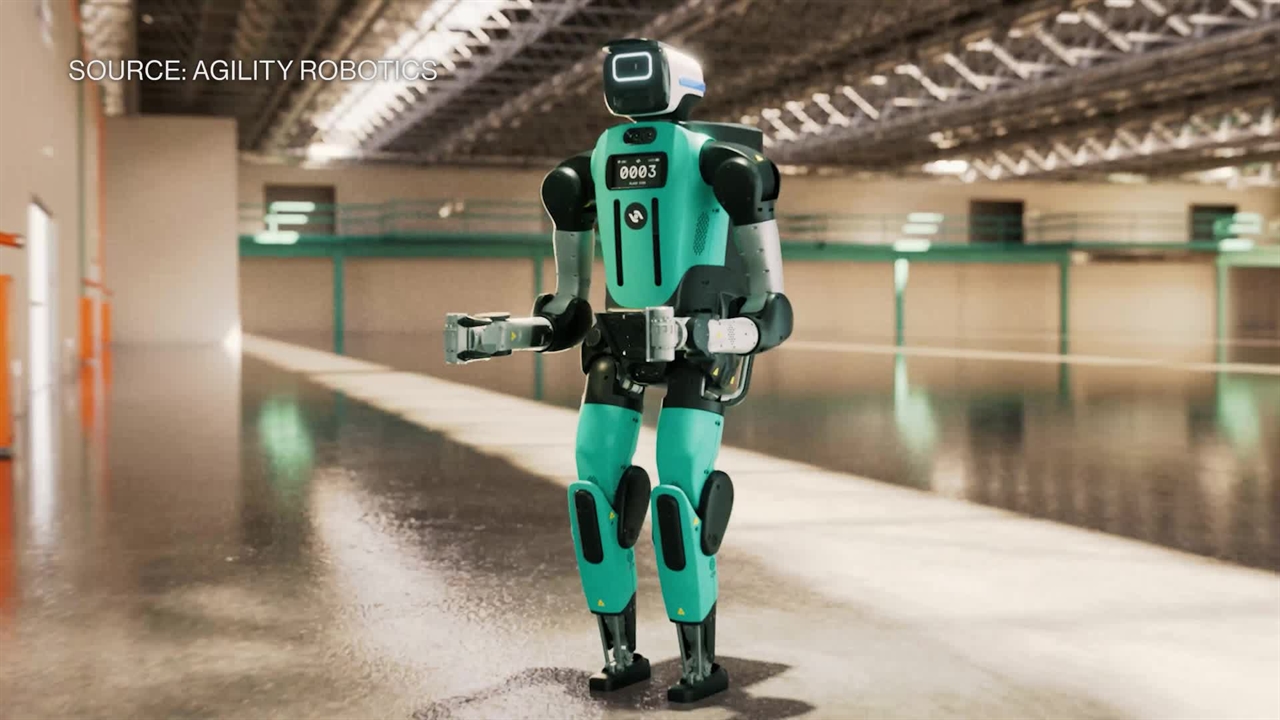
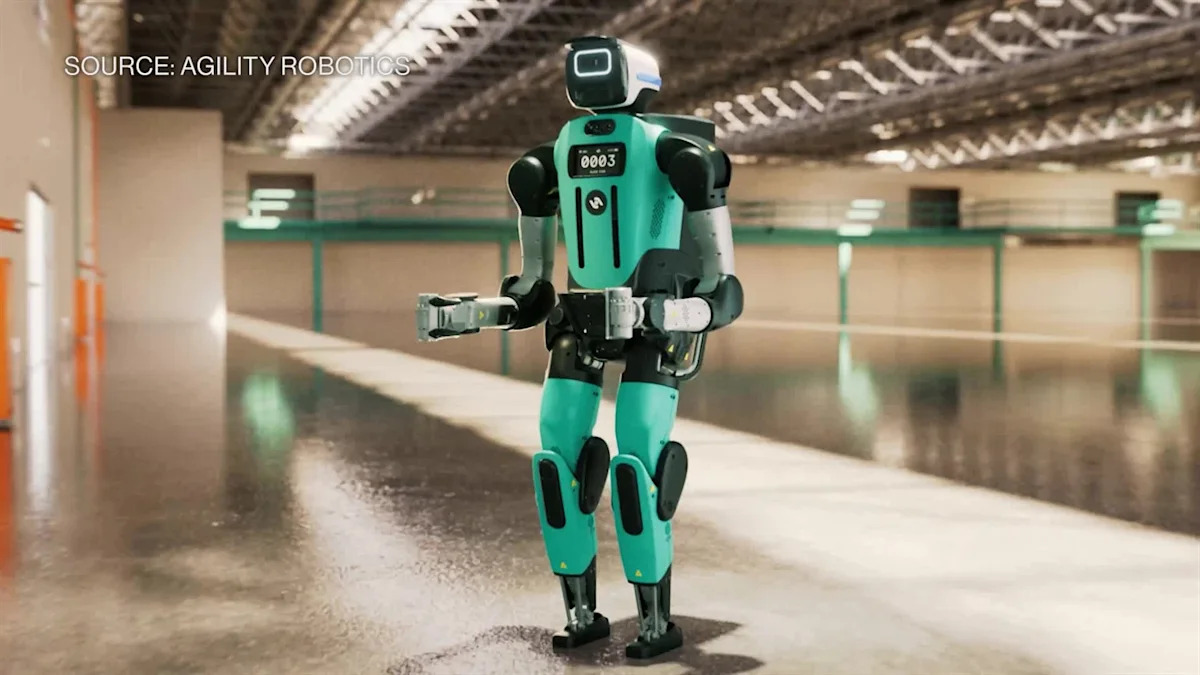
Agility Robotics unveiled Digit 5, a new humanoid designed to safely work alongside people without the physical barriers required by earlier models. Agility Robotics CEO Peggy Johnson joins Bloomberg Tech's Ed Ludlow to discuss how the robot can take on more complex warehouse and manufacturing tasks as Agility looks to expand deployments beyond the nine customer facilities it operates in today, and how AI can accelerate the timeline for Digit 5 to learn new skills.

Peggy, tell me about Digit 5. What is new on this generation of of humanoid platform?

So Digit 5 is the first humanoid to be able to work in close proximity to other humans. That means the physical safety barriers that have kept them separated from humans up until now is coming down and agility has uh solved for that problem and it will allow humanoids to come outside of that work cell and operate throughout a facility.

Peggy, how has agility solved for that? When when I am reporting on and and investigating the the the progress of the field, humanoid robotics, a lot of the work is actually on the software side, right? Making sure that uh there's a grounding in real world physics so that the the humanoid of any type can be in close proximity to uh its human colleagues or counterparts. Like what where did you focus the work with with Digit 5?

It actually was a little bit of both. So the hardware itself had to be improved. Digit has 360 degree vision. It needs to be able to see all around so that it can uh monitor, observe for humans and when humans become uh within a certain barrier or a certain radius, uh it will bring itself safely down to the ground until the human passes. Uh there was also a fair amount of software as you might imagine that was AI enabled in order to detect uh humans on the robot. So this is this has to be done instantaneously. Humans are quick and they will be able to um uh pass safely and then once gone, the robot will stand up again and resume its work.

We we are talking about a world where a humanoid robot can work in close proximity with with human co-workers. But what are the kind of case studies for that? Where will we see Digit 5 deployed?

Well, right now, Digit is deployed inside a physical safety barrier like much automation you might see in these facilities. That limits it generally to a single task. But if Digit comes outside of the safety barrier, it can now take on full workflows inside these facilities from uh unloading a pallet down in the receiving area to then tending machines, kitting, sequencing, quality control, and then packing things up on the other end and sending it out for shipping. So an entire workflow can now be achieved because the robot can move from station to station and take on different tasks.

Peggy, for all the conversation around AI taking jobs, displacing jobs, in physical AI, that there does seem in the data to be an opportunity to address labor deficits in all kinds of industries. You know, how much is that agility's pitch with Digit 5, prior, future generations of of your humanoids that you can go into markets where there just aren't enough human workers.

That's exactly the gap we're trying to fill. Um in 2025, there were over 400,000 manufacturing jobs that were going unfilled and by 2033, that's it's going to be close to 1.9 million jobs. That's four and a half times increase that people just aren't stepping into. We have a retiring workforce. Uh we have younger people who want digital jobs and not these manual, dirty, repetitive, um very mind-numbing kind of work. And that means it's perfect for humanoid robots. And then the humans are available for higher, more complex work in these facilities, including robot managers. We'll need those as well as more and more robots are introduced.

Peggy, where is and what is what is the the the health of the supply chain for Digit 5? What is it like trying to bring a new generation of humanoid online when you think about sourcing the components, where it's manufactured?

So, from the start, we have manufactured in the United States in Salem, Oregon, and we have intentionally kept an eye on our supply chain to largely be US and allied focused. So we have minimized that problem of having risk in the supply chain going forward. Clearly things like Lidar and rare Earth models will need to continue to have a supply for and I know the um US government is working on those supply chains to ensure uh that new industries like robotics will continue to have access to those and we appreciate their effort on that.

When you bring a new generation of humanoid to market, or you start production of that humanoid and then deploying it um in in different environments. What what's the kind of ramp like? You know, uh we're kind of used to seeing humanoid robots at all of the the annual shows, kind of on display, um doing funny things, neat tricks, but I think like a lot of people are trying to get a sense of how real this is. The role of a humanoid in in the industrial base of of America and other jurisdictions.

Yeah, dancing robots are lots of fun to watch, um but generally they don't get paid to work. So when we began looking for use cases, we said where is the need the greatest? And it turns out it's in these um, uh, you know, unskilled areas uh that are hard to find humans for. The entry really is in these facilities like logistics, manufacturing, uh and we started with simple material handling, moving plastic or metal bins they call totes, um from one place to another. There's a lot of need for that still today in facilities and that's where the entry point seemed most realistic and it had huge demand because it was hard to fill roles that involve that kind of task. From there, we'll continue to teach Digit 5 new skills and as it comes out of the physical safety barrier and is allowed to walk around these facilities, uh we'll keep adding to its abilities and functionality over time.

Peggy, Agility is headed to the public markets, um, via a reverse merger with with a spack or a D-spack. what what was the thinking around doing that? Um, what why does agility need to to be a public company and and go through that mechanism?

Sure, we looked at all of our options available to us and um, you know, whether that was staying private and continuing to fund raise or going versus a standard uh IPO or choosing the route we're going to through the spack, which is the most efficient, quickest way to market, and we have orders pending. We have over $300 million of orders for multi-year commitments for Digit 5, and we wanted to ensure we were able to deliver on those as well as continue to work with the number of customers in our pipeline. So it was really about acceleration, speed to market. But it also does give us the ability to define the category. being first out the door, the first pure play humanoid to go public, uh we can show other companies what will be needed, the high safety bar, reliability, uh the ability to plug into existing um IT systems in these facilities, the enterprise hardening of the robots is uh where we'll get to set some of the standards going forward.

Well, the first pure play uh humanoid robotics public company, maybe in the United States. Uh Elon Musk might have something to say about that with with Tesla and Optimus. But how closely did you watch what happened in China and in Asian capital markets with Unitree, for example? You know, it it it's on a regular basis, we're kind of comparing and contrasting the progress on humanoids here in the states versus China in terms of like the scale of output, where they're deployed. What what what do you take from that?

Well, what we take is we want to be able to deliver what our customers need. We haven't seen this to tell you the truth across the industry. We have a robot that can lift 50 pounds over and over again. Uh we have hands that can be replaced with different kinds of tools, uh swappable end effectors and a battery that allows for three shifts of work with one robot. It's got a 10 to one run-to-charge ratio, which means it can run for 90 minutes and very quickly in nine minutes uh have the battery recharge. So it was listening to our customers, understanding the needs and deploying that functionality in Digit 5, which allows us to get paid to work. We really haven't seen that deployed anywhere else yet.

What's agility going to focus on for the next one to two years? You'll go public via the spack, but in terms of the technology, scaling. What's the big priority for you, Peggy?

The big priority is with AI, continuing to teach Digit 5 new skills and listening to our customers what they need, how we can fill in any gaps in their workflow in these facilities. So, with AI now, uh teaching Digit new skills can go much more quickly than in the past when an engineer had to program every movement of the robot. So, we'll you'll see a lot more functionality, capability from Digit 5 in the uh next few years to come.
Comments
You must be logged in to comment.