yahoo Press
Markets News, Sep. 14, 2026: Chip Stocks Drop, Software Jumps as Indexes Close Lower; Oil Prices Rise, 10-Year Yield Hits 5%
Images
1 / 4
2 / 4

3 / 4

4 / 4
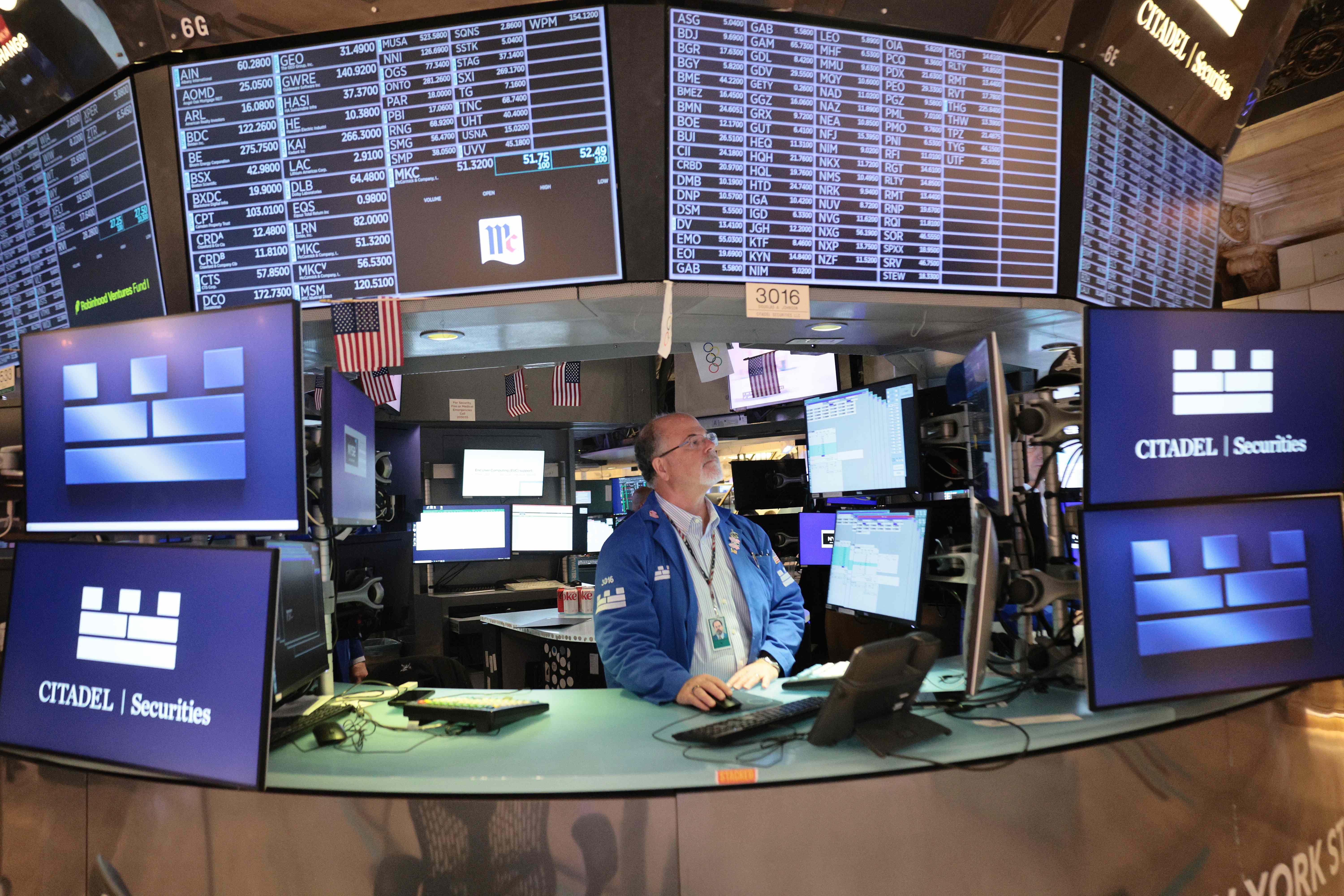
Major U.S. stock indexes closed lower, and Treasury yields rose, with chipmaker shares among the biggest decliners following a safety warning by some of the biggest names in AI.

The tech-focused Nasdaq Composite, benchmark S&P 500, and blue-chip Dow Jones Industrial Average closed Monday down a respective 0.6%, 0.5%, and 0.3%. They pared sharper intraday declines, with the Nasdaq dropping more than 1% in morning trading. The three major indexes on Friday snapped four-session losing streaks as oil prices pulled back but closed lower for the week.

Stocks tied to AI sold off as industry leaders suggested a rethinking of spending priorities in the business, which has powered profit and revenue growth across the tech sector. Anthropic CEO Dario Amodei wrote in an essay over the weekend that "we must slow the pace at which we improve the capabilities of AI models"; other AI leaders, including SpaceX (SPCX) CEO Elon Musk, expressed similar sentiments. The Roundhill Memory ETF (DRAM) and broader iShares Semiconductor ETF (SOXX) closed down roughly 7% and 5.5%, respectively.

Marvell Technology (MRVL) and Intel (INTC) dropped about 7.5% and 5.5%, respectively, while Nvidia (NVDA) fell nearly 3.5%. Oracle (ORCL) said co-founder Larry Ellison canceled his recently disclosed plan to sell up to 50 million shares. Its shares declined roughly 3.5% amid the broader tech selloff.

President Donald Trump refused to tap the brakes, citing concerns about global competition for the future of AI. "There is a SICK conspiracy going on against AI and Data Centers, and the only one that is happy about it is China," Trump wrote on Truth Social. "WHOEVER WINS AI, WINS! We are leading China, and all others, and will continue to do so."

Software was a bright spot, with the iShares Expanded Tech-Software Sector ETF (IGV) about 5% higher. Cybersecurity stocks CrowdStrike Holdings (CRWD) and Palo Alto Networks (PANW) jumped a respective 14% and 13% to pace the S&P 500 and Nasdaq 100. Salesforce (CRM) was up 4.5%, helping the Dow minimize declines.

Investors are awaiting the Federal Open Market Committee's interest-rate decision on Wednesday afternoon. After the Consumer Price Index reading for August matched economists' expectations on Friday, traders now see a 93% likelihood that the Federal Reserve will raise rates this week, according to the CME Group's FedWatch tool.

The 10-year Treasury yield—which serves as a benchmark for a wide range of interest rates, including those for mortgages, corporate bonds, and other loans—rose above 5.01% Monday morning, its highest intraday level since October 2023. The yield recently was near 4.99%, up more than one basis point from Friday's close.

"While the Fed's rationale for staying on the sidelines hasn't collapsed, it has weakened," wrote Chris Larkin, E*TRADE from Morgan Stanley's Managing Director, Trading and Investing. "But the stock market ended last week with a bounce even though the odds of a rate hike increased, which could mean investors aren't as worried about the impact of higher rates as some market watchers believe. Energy prices continue to be the primary wild card, so news out of the Middle East will likely have a big influence on day-to-day sentiment."

Oil prices surged after Saudi Arabia closed a key pipeline that bypasses the Strait of Hormuz because of drone attacks. They later retraced their advances, with U.S. benchmark West Texas Intermediate prices up 1.3% to $101.35 a barrel in late-afternoon trading. Brent crude futures, the international benchmark, advanced 1.4% to $106.10.

Bitcoin was trading around $79,100, up from overnight lows of $76,400. The U.S. dollar index, which tracks the value of the greenback against a basket of foreign currencies, rose 0.4% to 99.47. Gold futures declined 1.8% to $4,330 an ounce.

Go beyond the day's market moves with Investopedia's Value Add, where you'll find sharp analysis, investing ideas, and practical guidance on what today's biggest financial stories could mean for your money. Explore Value Add and subscribe on Substack.

SEPTEMBER 14, 2026 AT 07:13 PM GMT

Bank of America Stock Falls After CEO Moynihan Says Q3 Investment Banking Fees Down 10%

Bank of America shareholders did not like a piece of news from CEO Brian Moynihan's speech at a conference today.

Shares of Bank of America (BAC) are dropping about 6% in the final hour of trading Monday after Moynihan said that third-quarter investment banking fees are down roughly 10% year-over-year.

Speaking at the Barclays Global Financial Services Conference, Moynihan said, per an AlphaSense transcript, that "if you look this quarter, what we're seeing is the market generally in investment banking is down 10% or so in the Dealogic fees type of things."

During its third quarter last year, Bank of America topped $2 billion in investment banking fees. "I'd say $1.6 billion to $1.8 billion in fees will be kind of the number," Moynihan said.

Bank of America shares are up about 8% since the start of the year.

SEPTEMBER 14, 2026 AT 06:40 PM GMT

Roblox Stock Surges as Analysts React Positively to Developers Conference

Analysts like what they heard from the Roblox Developers Conference Friday.

Shares of Roblox (RBLX) are soaring 11% Monday after several analysts reacted positively after the video game developer unveiled several new features aimed at enhancing user engagement at its conference.

Analysts from BofA Securities, Wells Fargo, and Wedbush raised their price targets on the stock, while JPMorgan analysts wrote that "we come away incrementally positive on RBLX's path toward expanding distribution, content diversification, engagement & algo optimizations, AI strategy, and monetization opportunity."

Deutsche Bank analysts noted that "[Daily Active Users] have returned to growth, [Concurrent User] declines have narrowed and Steal an Egg has emerged as a new viral hit." The analysts, who maintained their "hold" rating and $38 price target on the stock, added that "we think the combination should support the stock near term, although we think it's too early to conclude that Roblox has fully 'comped the comp' or that the discovery changes can generate hits more consistently."

Despite today's sharp gains, Roblox shares are down 37% this year.

SEPTEMBER 14, 2026 AT 04:14 PM GMT

What Bond Yields Do After A Hiking Cycle Starts

Markets are bracing for a widely expected rate hike on Wednesday.

Traders are positioned for the Federal Reserve to raise interest rates by a quarter of a percentage point to a range of 3.75% to 4%, which would be the first rate hike since July 2023. Many Fed watchers expect the move to start a hiking cycle that could weigh on stocks in the near term and, according to one major bank, push bond yields higher over the coming 12 months.

Surging bond yields can make government debt more attractive than stocks and other risk assets, which can weigh on U.S. equities. And because mortgage rates tend to closely track the 10-year, higher yields can make homebuying a more expensive proposition.

History shows that most hiking cycles tend to move 10-year U.S. Treasury yields by an average of about 1.14 percentage points one year after the start of a cycle, according to a Deutsche Bank report published on Monday.

The good news: If this hiking cycle ends up being a "baby cycle"—the bank's economists expect this one will be less aggressive than in past years—bond yields could rise less dramatically, per Jim Reid, Deutsche Bank's global head of macro research.

That the starting point is already high, with bond traders driving 10-year yields to as high as 5% early Monday, could contribute a more modest impact on yields, according to Deutsche Bank—or a rise of seven-tenths of a percentage point, Reid said.

But history says not to expect yields to drop. The only time yields fell over the course of the first year after the start of a rate hike cycle was in 2004, according to the Deutsche report.

"So it's not usually a positive for rates when the Fed hikes but there are some reasons why this cycle might be better than many other for yields," Reid said.

-Crystal Kim

SEPTEMBER 14, 2026 AT 03:36 PM GMT

Some Experts Say Stocks Still Look Cheap—Even With the S&P 500 Near Its Record High

The S&P 500 isn't far off its record high. But some experts say fast-growing profits mean many stocks still look cheap.

The S&P 500's price-to-earnings (P/E) ratio, which compares the profitability of the benchmark index's constituents to their stock gains, has fallen 11% since the start of the year, suggesting profit growth at America's largest companies has outpaced their stock gains lately, analysts from LPL Financial observed in a recent note. That could mean stocks have gotten "cheaper," and still have substantial room to rise, the analysts wrote. (Stocks fell last week; read Investopedia's full daily markets coverage here.)

Worries about the market's biggest companies spending heavily on AI infrastructure could be one of the reasons investors have been holding back, according to the report; AI spending was among Monday's top stories in markets, with industry leaders' comments about slowing model development raising concerns about a pullback in hardware expenditures. Analysts at Wolfe Research also pointed to rising oil prices, Treasury yields sitting at multi-year highs, and the likelihood of interest rates being raised at this week's Fed meeting.

LPL said the second-quarter earnings season has been a "blowout," with the S&P 500 on track to post year-over-year earnings growth of over 30%. (Only a few companies in the index are yet to report.) FactSet analysts recently found that about 87% of S&P 500 companies beat earnings per share estimates in their second-quarter results.

Read the full article here.

-Aaron McDade

SEPTEMBER 14, 2026 AT 03:15 PM GMT

Information Technology Leads S&P 500 Sectors Lower

Technology shares are having a rough Monday. So are those in several other sectors.

The S&P 500 Information Technology Sector is 2% lower in late-morning trading, the worst performer of the 11 industries tracked. Corning (GLW) is down 12% to lead the sector lower.

Also having a tough go in early trading are the Industrials, Materials, and Utilities sectors, which are down a respective 1.9%, 1.1%, and 1.1%.

Just three sectors are in the green: Communication Services (up 1.7%), Consumer Staples (1.4%), and Health Care (1.2%).

SEPTEMBER 14, 2026 AT 02:16 PM GMT

A Big Crypto Vote Is Coming This Week. Here's What You Need to Know

A sweeping crypto bill will get a big test this week.

The Senate is set to hold a cloture vote on the Clarity Act on Tuesday. If the bill gets at least 60 votes, it will move to a floor vote by the full chamber; if not, it's likely to sit on the legislative back burner for the rest of the year, extending the industry's wait for regulatory direction the legislation could provide. The latest draft of the act, among other things, classifies digital assets, defines regulatory jurisdiction over them, and treats crypto exchanges and brokers as financial institutions under the Bank Secrecy Act, requiring them to adhere to anti-money laundering programs and customer due diligence checks.

Traders who once saw the act as a likely catalyst for crypto prices are less certain now. Crypto markets wavered last week, with bitcoin sitting around $78,000 Monday—roughly the midpoint of the highs and lows seen this year. On prediction markets, bettors currently see it as unlikely that the industry will get the rules of the road it's long sought before the end of 2026.

Industry leaders now appear unfazed about a possible negative outcome. Federal agencies are at the ready to pen guidelines of their own to address gaps in digital assets regulation.

Read the full article here.

-Crystal Kim

SEPTEMBER 14, 2026 AT 01:41 PM GMT

AI Trade Stumbles as CEOs Talk Model Slowdown

Most of the AI trade is hitting the brakes this morning.

Shares of hardware makers like Nvidia (NVDA), Marvell (MRVL), Advanced Micro Devices (AMD) and Intel (INTC) are falling early Monday after several prominent AI leaders over the weekend called to slow development of new models. While that may or may not happen, investors fretted that it could mean a pullback in spending on chips.

Shares of some tech companies seen as potentially benefiting from a development pause rose. That included cybersecurity and software firms that investors have feared could be disrupted by AI products. Palo Alto Networks (PANW), CrowdStrike (CRWD), Salesforce (CRM), and Adobe (ADBE) were all gaining recently.

Stocks broadly retreated after the open, with the tech-focused Nasdaq Composite leading the major U.S. indexes lower.

Dario Amodei, CEO of Claude maker Anthropic, over the weekend called on his company and its rivals to slow development to think more seriously about the models' safety implications. His post followed comments from a former OpenAI and Anthropic employee last week who posted on social media about his decision to resign over worries that the latest AI models are not being developed safely.

"Not building the technology deprives humanity of benefits or simply places AI in the hands of authoritarian powers, while building it too fast is reckless," Amodei wrote.

SpaceX (SPCX) CEO Elon Musk said on social media that Amodei's post is correct, while OpenAI CEO Sam Altman in an interview with Fortune over the weekend said the ChatGPT maker may not go public this year due to safety concerns. Altman also outlined OpenAI's views on regulation of AI and ways AI development could spin out of control in Sunday night social media posts.

Cybersecurity stocks have been boosted in recent months by recent developments with AI models, as a few high-profile hacking incidents have spurred hopes that companies will prioritize spending to protect their data.

-Aaron McDade

SEPTEMBER 14, 2026 AT 01:08 PM GMT

The Housing Market Desperately Needs Lower Mortgage Rates. Instead, They're Heading Higher

High mortgage rates are delaying homebuying dreams, and few experts see a light at the end of the tunnel.

Late last week, mortgage rates rose to 7.14% intraday, their highest since May 2025, according to Zillow. Existing-home sales slipped 2% from July to August to their slowest pace since June 2025, according to the National Association of Realtors. It wasn't a coincidence.

"Mortgage rates and home sales move in opposite directions, so it's not surprising to see a mild dip in home buying activity due to high mortgage rates," NAR Chief Economist Lawrence Yun said in a statement.

The outlook dimmed last week as the war in Iran intensified, oil prices rose, and data showed inflation running stubbornly high.

Read the full article here.

-Diccon Hyatt

SEPTEMBER 14, 2026 AT 12:43 PM GMT

Oracle Founder Larry Ellison Drops $7.5B Share Sale Plan

Oracle (ORCL) shares are lower this morning after a weekend in which a plan was announced and then quickly canceled for founder Larry Ellison to sell a sizable chunk of shares.

After the closing bell Friday, Oracle said in an SEC filing that Ellison had entered into a new Rule 10b5-1 plan back in June to sell up to 50 million of his Oracle shares. At Friday's closing price of $150, that would be worth about $7.5 billion.

On Saturday, the company put out a press release to say that the plan was canceled without Ellison selling any shares, and noting that he "has no other plans to sell any of his Oracle stock."

Oracle shares, which have lost about half their value over the past year, were down 5% in recent premarket trading, tracking the broader move lower for AI stocks.

-Aaron McDade

SEPTEMBER 14, 2026 AT 12:23 PM GMT

Why Rising Bond Yields Aren't Throttling The Economy, For Now

Borrowing costs are nearing multi-year highs for consumers and businesses alike, but that doesn't mean the economy is in for pain yet, some analysts say.

Data centers are a big reason why, according to Ajay Rajadhyaksha, Barclays' global chairman of research. Their buildout continues to drive construction jobs, from plumbers to steelworkers, whose steady paychecks mean they aren't being forced to cut back on spending at restaurants or retailers.

The construction sector typically suffers when rates rise, since building houses becomes more expensive. But the giant tech firms building data centers are far more immune to rising borrowing costs, helping keep construction jobs afloat.

"This is why the traditional rate transmission mechanism has not worked," Rajadhyaksha wrote in a note to clients. "The dog did not bark because someone else was feeding it."

Read the full article here.

-Polo Rocha

SEPTEMBER 14, 2026 AT 11:22 AM GMT

What to Expect in Markets This Week: Fed Interest-Rate Decision; U.S. Retail Sales Data; Salesforce Conference

A barrage of economic data has tempered investors' hopes for steady interest rates. Now the Fed will make its move—or not.

The Federal Open Market Committee will convene Tuesday and share its rate decision Wednesday afternoon. The committee will deliberate after the release of August job and inflation data, which reverberated through the stock market as investors mulled what the indicators may mean for interest rates.

Expectations for a rate hike rose when employment data depicted the labor market as relatively healthy: employers added more jobs than expected in August, and economists revised July and June job numbers upward. (To cool the economy, the Fed can lift the federal funds rate, which can raise rates throughout the economy and curb spending, though it can also slow hiring.)

Fed watchers became more confident in their assessment when price data confirmed that inflation remains above the central bank's 2% target. Wholesale inflation—as measured by the Producer Price Index—came in hotter than expected and the Consumer Price Index rose 3.4% year-over-year in August, matching the rate recorded in July and economists' predictions.

Read the full article here.

-Sarina Trangle

SEPTEMBER 14, 2026 AT 10:54 AM GMT

Nasdaq Futures Plunge; Chip Stocks Sell Off as AI Leaders Call for Slowdown

Futures contracts tied to the Dow Jones Industrial Average pointed 0.2% lower.

S&P 500 futures declined 0.7%.

Nasdaq 100 futures plunged 1.6%.

Read the original article on Investopedia
Comments
You must be logged in to comment.