huffpost Press
A New Taylor Swift Just Dropped — From Australia
Images
1 / 9

2 / 9

3 / 9
4 / 9

5 / 9
6 / 9

7 / 9

8 / 9

9 / 9
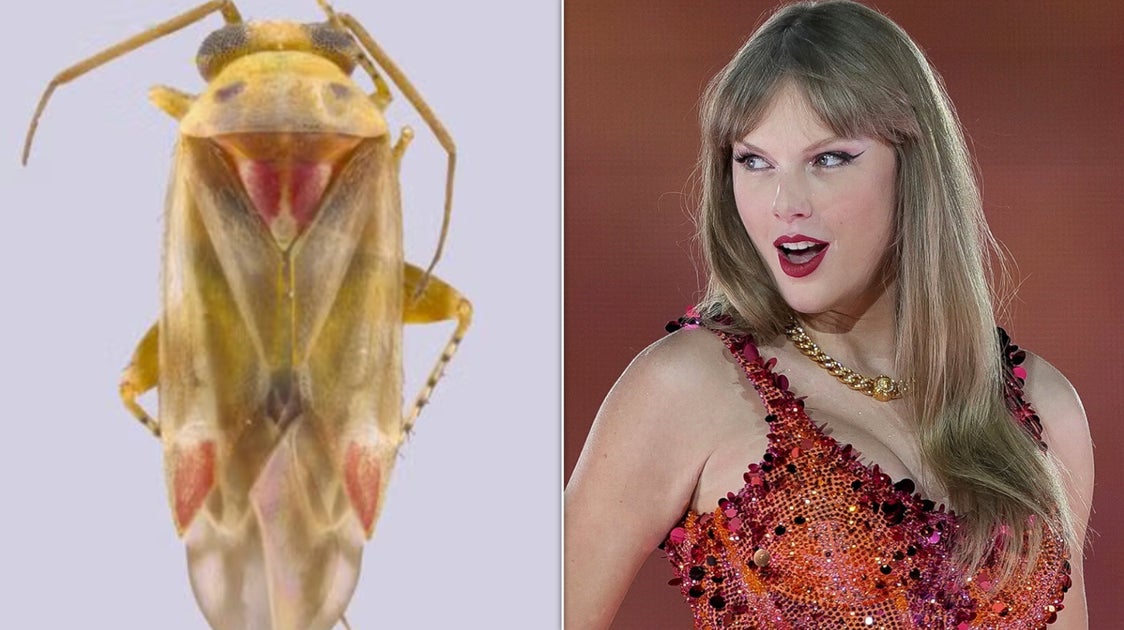
Hopefully, Taylor Swift won’t be bugged by this news, but a doctoral student in entomology at UC Riverside has just named a new genus of plant-feeding insects from Australia after the singer.

Sarah Schroeder just co-authored a paper in the journal Insect Systematics and Evolution where she describes 12 new species of insects, including a genus she named Swiftiephylus after Swift herself.

The Swiftiephylus genus contains four species that all have latin names inspired by Swift and her albums: Swiftiephylus taylorae, Swiftiephylus amator, Swiftiephylus intrepidus, and Swiftiephylus poetorum.

Schroeder noted that the bugs have a slight resemblance to her favorite celeb.

“Taylor Swift’s iconic look is her blonde hair and red lips. These insects are pale yellow with accents of red throughout,” Schroeder said in a UC Riverside press release. “In the paper I refer to them as blonde.”

HuffPost reached out to Swift, who hasn’t commented on the buggy new honor. However, Schroeder hopes the reflected glory from the singer onto the bugs will “bring attention to the diversity of insects that has yet to be discovered.”

Although Schroeder and her co-author, UC Riverside entomology professor Christiane Weirauch, are credited with naming the species, they were actually collected between 1995 and 2004.

Schroeder hopes the Swift names can raise awareness of the importance of taxonomy.

“If we don’t describe species, we don’t know they exist and can’t conserve them,” she said. “Honoring Taylor through naming these species after her is a way to honor conservation science and bring attention to all the unknown diversity.”

It doesn’t look as though the Taylor Swift bugs will reflect badly on the singer: They aren’t known to be pests to humans or animals, nor to harm the host plants where they spend the majority of their lives.

The Australian bugs aren’t the first insects to be named after Swift.

Back in 2022, a brown and orange millipede was discovered in a Tennessee forest and named Nannaria swiftae by the Swift-loving scientist who IDed it.

By entering your email and clicking Sign Up, you're agreeing to let us send you customized marketing messages about us and our advertising partners. You are also agreeing to our Terms of Service and Privacy Policy.
Comments
You must be logged in to comment.