yahoo Press
Opinion - The Christian nationalism takeover of Congress
Images
1 / 6
2 / 6

3 / 6

4 / 6

5 / 6

6 / 6
It's not unusual for a member of Congress to write a book. Many have, and most of them are of little interest. I know, after reading too many of them.

What is unusual is for a member of Congress to write a book that makes the New York Times Bestseller list. But that's the case with "No Prophets." The new book by Jared Huffman (D-Calif.) debuted in the Times this week as No. 6 of all best-selling hardcovers. No book could be more powerful or more timely.

"No Prophets" not only exposes how Christian nationalism is a serious threat to our democracy, it also reveals how, under the leadership of Speaker Mike Johnson (R-La.), Christian nationalists have, in effect, taken over control of the House of Representatives.

Huffman is quick to point out that Christian nationalism is far different from the old Moral Majority of Jerry Falwell. By mobilizing evangelical voters, Falwell worked within the democratic system to promote what he called "pro-life, pro-traditional family" policies. Today's Christian nationalists are not out to improve democracy — they're out to destroy it. Their stated goals are to establish the United States as a Christian nation, make Christianity the official state religion, tear down the wall of separation of church and state, and make the Bible, not the Constitution, our fundamental national document in order to achieve what Johnson calls "biblically-sanctioned government."

Christian nationalism is, according to Huffman, "America's most dangerous political movement." And what's stunning is the extent to which it has already infiltrated the Congress. As Huffman describes the scene, "The Capitol complex teems with Christian nationalist power players, faith leaders, religious networks, advocacy groups, and a steady wave of religious programs converging with a common purpose: to embed right-wing Christian influence in government and manifest biblical dogma into policy." It's what he calls a "shadow theocracy" inside the Capitol.

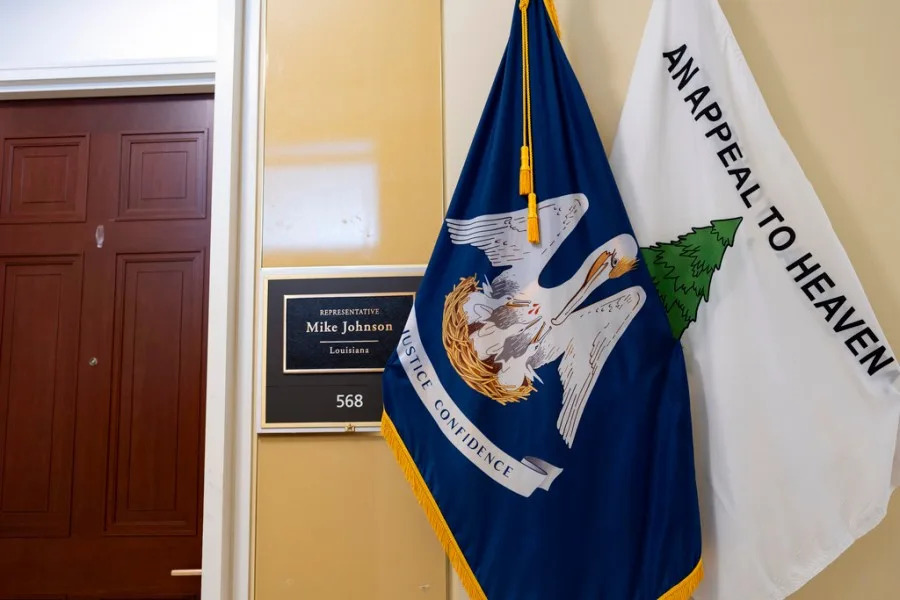
The signs are everywhere: The Christian nationalist "Appeal to Heaven" flag displayed in front of many congressional offices; ministers that roam the corridors and drop in regularly to pray with members; daily prayer breakfasts for Christians only; lobbyists who intercept members and hand them invitations to the next Bible study. All under the direction of Johnson, who reopened a tiny prayer chapel near his office where he told reporters he goes to "seek the Lord's guidance for what we do each day" and who, in his first TV interview as Speaker, told Fox News host Sean Hannity: "Well, go pick up a Bible off your shelf and read it. That's my worldview." One would only wish he'd also read the Constitution.

The most important contribution of Huffman's book is making the connection between Christian nationalism and Jan. 6. The attack on the Capitol was not just a political rally, Huffman argues — it was a fundamentalist religious revival. Christian nationalists were among its key organizers. Christian nationalists were bussed to Washington and led the march on the Capitol. Before invading the Capitol, many blew the shofar, carried huge wooden crosses, openly prayed with their hands aloft, and waved the "Appeal to Heaven" flag. One Capitol Hill police officer testified about being confronted with rioters carrying a sign reading "Jesus is my Savior, Trump is my president." One year later, the Smithsonian labeled its online exhibit of photos and videos of Jan. 6 "Uncivil Religion."

There is no doubt Christian nationalism was a driving force behind the Jan. 6 riot at the Capitol. The Select Committee to Investigate the January 6th Attack on the United States Capitol even appointed a special task force to examine the role of religion on Jan. 6. As Committee Chairman Bennie Thompson (D-Miss.) admitted to Huffman, they found that "right-wing Christian extremists actually had a lot to do with it." And yet, the committee's final 845-page report makes no mention of anything related to religion or Christian nationalism. Why? As Huffman reveals for the first time, Select Committee Vice-Chair Liz Cheney (R-Wyo.), for whatever reason, vetoed it. So one opportunity to expose the dark, violent side of Christian nationalism was lost forever.

Fortunately, there is some pushback. In 2018, Huffman and Rep. Jamie Raskin (D-Md.) launched the "Freethought Caucus," a group of lawmakers dedicated to defending church-state separation. It started out with a handful of members, but today its ranks have swelled to 33 members — more than the Republicans' Freedom Caucus.

Huffman describes the mission of the Freethought Caucus as "defending religious freedom, resisting theocracy, and advancing our nation's core values, including civil rights, pluralism, rule of law, academic freedom, and the defense of science." With those all-American goals, every representative should be a member.

Bill Press is host of The Bill Press Pod. He is the author of "From the Left: A Life in the Crossfire."

Copyright 2026 Nexstar Media, Inc. All rights reserved. This material may not be published, broadcast, rewritten, or redistributed.For the latest news, weather, sports, and streaming video, head to The Hill.
Comments
You must be logged in to comment.