huffpost Press
Body Language Experts Spot SO MANY ‘Creepy’ Things In New Elizabeth Holmes Trailer
Images
1 / 8

2 / 8
3 / 8

4 / 8

5 / 8

6 / 8

7 / 8

8 / 8
Comedian Nathan Fielder gave people a genuine shock on Sunday night when he dropped the trailer for “You Can See Everything,” his new documentary with filmmaker Lance Oppenheim about convicted fraudster Elizabeth Holmes. The teaser followed a surprise screening of the film at the Telluride Film Festival earlier that evening.

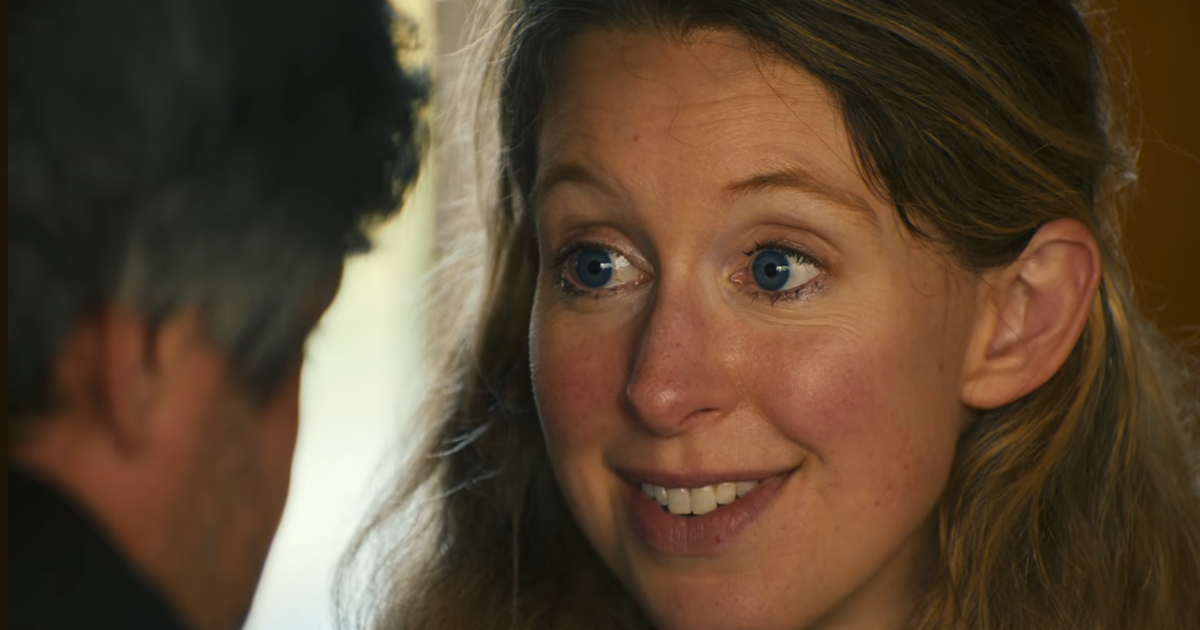
The nearly 80-second clip is an exercise in discomfort as we see the disgraced Theranos founder insist to Fielder with wide, unblinking eyes that she has no reason to lie to him.

“I’m not that person,” she says over unsettling music. “I can promise you that. I don’t have anything to deceive you on. Of course, I’m not deceiving you. I’m engaging with you as a human being. Why would I deceive you? There’s no reason for me to do that.”

When Fielder asks if she’s “being real right now,” she responds, “I’m always being real.”

A wider shot then reveals she’s been using her foot to rock her baby’s bouncer the entire time.

As with most things involving Elizabeth Holmes, the footage immediately grabbed the internet’s attention and invited analysis. Of course, the trailer is edited, and the full film is not yet available to watch. But HuffPost asked body language experts to share what they observed from the short but impactful trailer.

“The smile is particularly telling,” said Wood, who has done research on smiling. “A true, honest smile tends to move on the face, almost like a wave. There’s a spontaneity to it that goes along with what you’re saying and even changes as you speak. So we know it’s a fake, plastered-on smile.”

Brown raised the concept of “duper’s delight” ― an unconscious expression of satisfaction that sometimes flickers across the faces of people who believe they’re successfully deceiving someone.

“She’s smiling through this whole thing,” she said. “It could be a version of duper’s delight right there, like she’s having a good time with it.”

Meanwhile, Dudley described her facial presentation as “affect regulation,” as she exhibits a deliberate, tight control over her emotional expression in this very intense moment.

“She’s absolutely controlling her facial expression,” Dudley said. “Her whole emotional presentation is maintained through tight, screwed-down regulation. She is intensely trying to hold on to it, regulating her affect so that you really don’t see any affect.”

This kind of overly controlled expression can have a negative effect as well.

“If somebody were looking at you like that and so up close, I’d be saying, ’Back away,” Dudley said. “It’s so creepy.”

Beyond the visual, the experts also analyzed Holmes’s language patterns and voice ― the latter of which has been a topic of much discussion over the years.

“The lowered, softer, almost whisper-like voice is an effect to create the illusion of sincerity and intimacy,” Wood said. “Also in the rhetorical analysis, she’s making statements that typically you don’t see in people that are being honest and forthright with you ― for example, ‘Why would I lie to you? I have no reason to lie to you.’”

She pointed to Holmes’ response when Fielder questions her honesty.

“If you’re being honest with someone and they doubt your honesty, typically your face would reveal that you’re upset or disturbed by that, but her facial affect stays: wide eyes, raised eyebrows, plastered-on smile ― it doesn’t change. Something just feels wrong.”

“Whenever people answer a question with a question, that’s a huge red flag,” Brown echoed.

She also pointed to Holmes’ statement of “I can promise you that.”

“Anybody who starts promising things, you’ve got to be careful,” Brown said. “And she won’t directly answer yes or no questions. She uses a lot of words, but studies done at the University of Texas show that truthful people do and say the minimum that they need to do and say to get their point across. She’s saying a lot. She’s trying to be really convincing.”

Perhaps the most striking visual in the documentary is the wide shot reveal that Holmes was rocking her baby throughout the intense exchange.

“That makes it even crazier,” Dudley said. “Imagine the control that you would have to have to never look away, say stuff like ‘I’m always being real’ in this creepy way, and at the same time rock a baby. And she was not broadsided or blindsided. She agreed to this conversation.”

Of course, we still have plenty to learn about this project, and the documentary footage is curated and edited. But audiences should know more soon enough. “You Can See Everything” hits theaters on Oct. 16.

By entering your email and clicking Sign Up, you're agreeing to let us send you customized marketing messages about us and our advertising partners. You are also agreeing to our Terms of Service and Privacy Policy.
Comments
You must be logged in to comment.