huffpost Press
His Adoption Was Part Of A Controversial Experiment. Now He’s Turned His Trauma Into A Chilling Novel.
Images

1 / 10

2 / 10

3 / 10
4 / 10
5 / 10

6 / 10
7 / 10
8 / 10

9 / 10

10 / 10
After years as both an actor and a screenwriter, Cliff Dorfman is ready to set the stage for the next phase of his Hollywood career with his most personal project to date.

Dorfman, 58, rose to prominence in the 1990s with supporting roles on “Beverly Hills, 90210,” among other shows. After shifting his focus to screenwriting, he wrote 14 episodes of HBO’s “Entourage” and co-wrote the screenplay for the 2011 feature film “Warrior,” starring Tom Hardy.

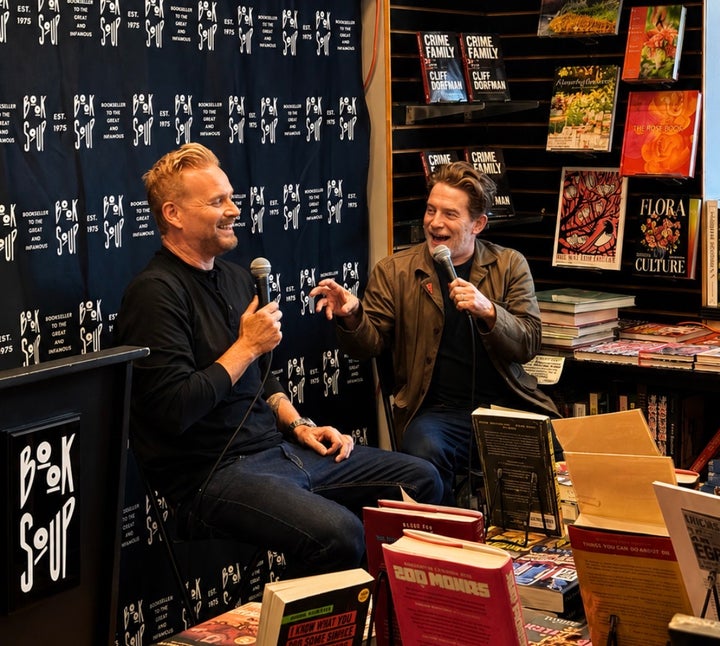
Despite those accomplishments, Dorfman says, he never had a chance to “understand my own story — and to survive it” until he wrote “Crime Family,” his debut novel. Published in July, the 287-page thriller follows Chase Forman, a Hollywood writer who returns to his native Long Island, New York, to assist his family as his adoptive father’s health and mental acuity decline.

Though Chase has spent most of his adulthood distancing himself from the Formans, he soon discovers that his family is part of an organized crime empire, with his adoptive mother, Helene, personally overseeing an international money-laundering operation. What follows is a gripping bicoastal chase as Chase and his family members become fugitives on the run from the FBI.

Along the way, a dark secret pertaining to Chase’s childhood begins to unravel, as he learns he was adopted through Louise Wise Services, which worked with child psychiatrist Dr. Peter Neubauer on a highly controversial experiment in the 1950s and ’60s that explored the behaviors of Jewish twins and triplets separated at birth without their families’ consent.

Neubauer, who died in 2008, and the since-shuttered Louise Wise Services are featured prominently in the 2018 documentary “Three Identical Strangers.” After Dorfman viewed that film, he was able to confirm that he’d been adopted through Louise Wise Services in 1968, while Neubauer’s study was ongoing.

That discovery, Dorfman says, “shattered everything I knew about my place in the world.” While “Crime Family” has parallels to Dorfman’s real life, the author insists his book was never intended as a memoir, but rather a literary exploration of the challenges ― and occasional benefits ― of life as an outsider, as well as a testament to the power of chosen family.

Like Chase, Dorfman maintains only loose ties to his adoptive family these days, noting, “It was not a fun upbringing … we have a choice to either perpetuate the cycle of abuse or break it, and my choice was to break it.”

Dorfman also downplays the suggestion that “Crime Family” is his way of getting “revenge,” noting that his story is meant for those “who have gone through, or are going through, any sort of similar situation” that involves generational trauma.

“I was able to take truths from my life and plug them into this big, glossy, shiny backdrop,” he said. “I like to use ‘The Sopranos’ as an example. Not everyone understands what it’s like to be in the mafia, right? But everyone can understand what it’s like to have a fucked-up relationship with their mom, and that’s what [series creator] David Chase was writing about.”

So far, “Crime Family” has already won the praise of “American Psycho” author Bret Easton Ellis and “Arrow” star Stephen Amell, while actor Seth Green of “Austin Powers” fame hosted Dorfman’s Los Angeles book launch.

That early reception, Dorfman says, has encouraged him to continue Chase’s story with a “Crime Family” prequel and a sequel. Still, he hasn’t turned his back on show business altogether, noting that he’s in early talks to turn the book into a five-season television series. Other future plans include a thriller titled “Johnny Pilates,” which he describes as a murder mystery set in a ruthlessly competitive Pilates studio in Beverly Hills, California.

“No one curls up with a good script ... you get to plug in directly, have direct conversations with your readers,” he said, when asked how his experience in the publishing world has compared to his screenwriting endeavors.

He went on to note: “When I started writing, I was angry, bitter and hurt, and now I’m sitting here and I feel free. I went through the arc I wanted my characters to go through.”

By entering your email and clicking Sign Up, you're agreeing to let us send you customized marketing messages about us and our advertising partners. You are also agreeing to our Terms of Service and Privacy Policy.
Comments
You must be logged in to comment.