huffpost Press
Everyone Is Noticing The Same Thing About This Clip Of Pete Buttigieg
Images
1 / 11

2 / 11
3 / 11
4 / 11
5 / 11
6 / 11
7 / 11
8 / 11
9 / 11
10 / 11

11 / 11
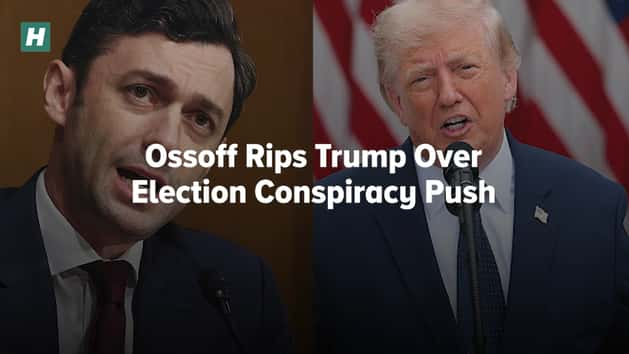
Although Sen. Jon Ossoff (D-Ga.) insists he has “zero interest” in a 2028 White House run and is focused on his 2026 Senate race, his national star power keeps rising.

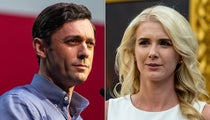
Driving that buzz are viral attacks on President Donald Trump, including a sharp rally callout of Trump’s travels with aide Natalie Harp ― a line that reportedly rattled the White House and fueled online speculation about the pair’s close relationship.

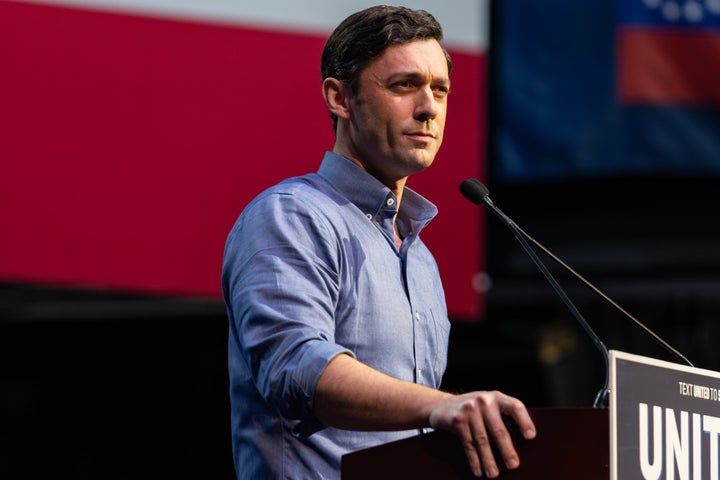
It helps that the visuals his team puts out on social media scream “presidential candidate.” As Politico’s Jonathan Martin said on “Morning Joe” last month, Ossoff, a former documentary and investigative filmmaker, has “mastered” the art of crafting viral, social-first video moments. A big part of that strategy is what’s being called the “Ossoff Angle”—a cinematic, slightly low-angle framing that leans into his tall, lanky build to project quiet authority.

MS Now host Chris Hayes and New York Times opinion columnist Ezra Klein have also discussed how Ossoff is capitalizing on a specific “visual grammar” to build an “almost mythic, Obama-like political brand.”

Ossoff says that Trump doesn’t want to do his job but wants to “travel with Natalie” pic.twitter.com/aDLMKFeMmR

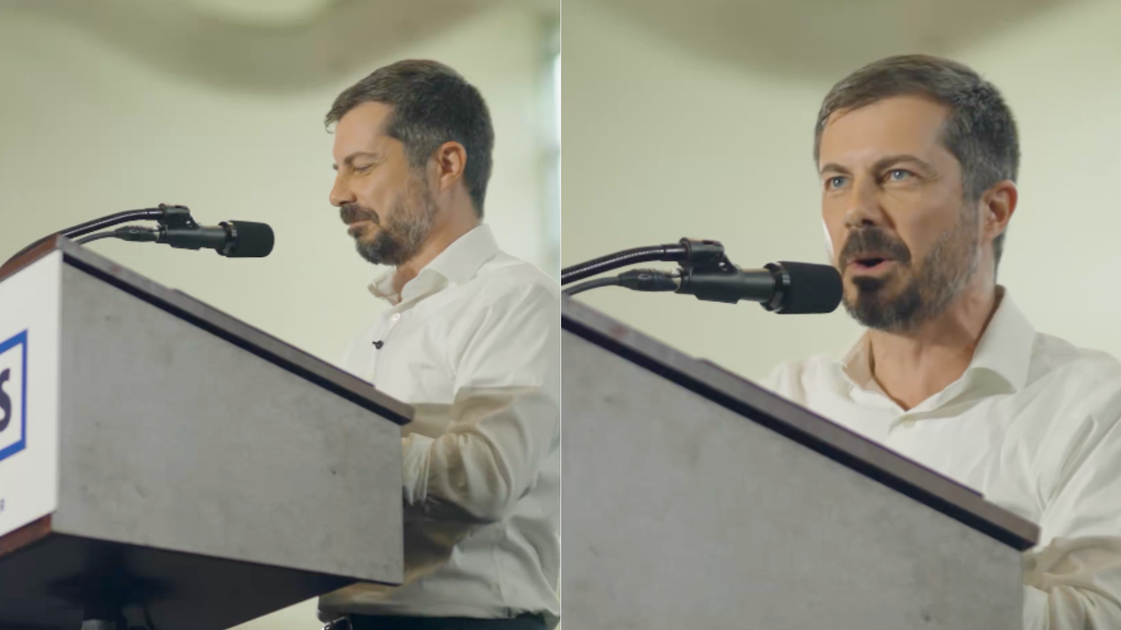
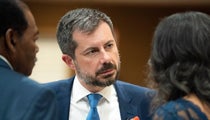
It’s such a striking visual language that other politicians are borrowing it. This week, a clip went viral showing former Secretary of Transportation Pete Buttigieg ― another early frontrunner for the Democratic presidential nomination two years from now ― using the “Ossoff Angle” during a speech.

“Note angle of shot,” Politico’s Adam Wren wrote while sharing the clip on X Tuesday.

“By 2028 every candidate is going to be doing the Ossoff shot it’s going to be the Scorsese tracking shot of campaign politics,” tweeted Aidan McLaughlin, a Washington correspondent for Vanity Fair.

Note angle of shot: pic.twitter.com/UReCL4deY8

But something was off when Buttigieg did it.

“Too much podium,” Politco’s Will Steakin wrote on X.

Too much podium https://t.co/iOphOqpwEu pic.twitter.com/x68LICi6sp

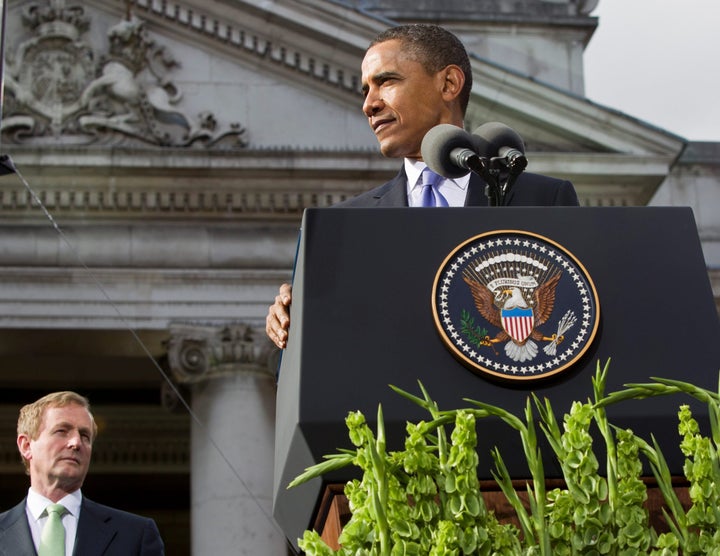
Others online said it was more of a copy of a copy. President Barack Obama’s team was using the same “heroic angle” while both of these dudes were still in diapers. (We’re joking, but not by much. Ossoff, 39, and Buttigieg, 44, could be the first millennial president. At 65, Obama is a Baby Boomer, though technically more part of the micro-generation known as Generation Jones.)

The “Ossoff/Obama angle” may seem like small potatoes, but in today’s attention economy, where a viral moment can meaningfully shape a politician’s public image and electability, things like posture, framing and a camera angle can matter.

“A low-angle shot of a politician, like we see with Ossoff, can make a person look more powerful, more dominant,” said Ann E. Burnette, a professor of communication studies who teaches political communication at Texas State University.

In a crowded field of political competitors, a classic “heroic” shot can lend a speaker a quiet air of authority and gravitas before they even say a word, Burnette said.

In Ossoff’s case, the “heroic” angle works, but it’s not the only thing that’s doing some heavy lifting in the clip above, according to Rob D. Willis, a specialist who works with C-suite executives and senior leaders to create compelling narratives.

“He also makes use of dramatic lighting ― black background, hard side light, side crop and a lectern which is pretty much out of shot,” Willis told HuffPost via email.

“Even without the angle ― and we do associate the low angle with leadership ― it’s a pretty good image,” he said.

While Ossoff looked stately and tall from the angle, shooting from below made Buttigieg look relatively small. Buttigieg ― who polls slightly ahead of Ossoff in most primary polls ― is said to be 5 feet 9 inches, but his height actually wasn’t the problem.

“What’s different is the lectern, which appears HUGE for Buttigieg. There’s a difference in lighting, too,” Willis said. “If Buttigieg wanted to fix his shot, he’d focus on the lighting and the cropping.”

Obviously, the “heroic angle” isn’t proprietary to Ossoff or Obama. Former U.K. prime ministers Margaret Thatcher and Tony Blair, as well as President John F. Kennedy, have all benefited from it, too, Willis said.

“It comes from the inevitable practicality of filming at a political rally ― you’re trapped in a journalists’ pen looking up,” he said. “Because these pictures have become iconic, we associate the low angle with leadership.”

Today, such optics are often cultivated and posted by a politician’s team. There’s a whole industry of consultants and researchers devoted to visual political communication — the use of images, video and design to convey political messages and shape public opinion.

The “heroic” angle is all part of that, said Daniel Schnur, a lecturer in political science at Berkeley’s Institute of Governmental Studies and the national director of communications for the 2000 presidential campaign of the late Sen. John McCain (R-Ariz.).

“Campaign advisers have always tried to shoot their candidates from below to make them appear taller, and therefore stronger and more authoritative in the eyes of the voters,” Schnur said.

It’s not even unique to politics, he said. Movie directors do the same thing for Tom Cruise and Daniel Radcliffe.

Schnur recalled how during the 1988 presidential campaign, advisers to Democratic nominee Michael Dukakis panicked over optics. At 5 feet 8 inches, Dukakis presented a stark visual contrast to his 6-foot-2 Republican opponent, George H.W. Bush.

“Their teams negotiated for a pitcher’s mound behind his podium so he would look taller, and also negotiated an agreement that Bush’s campaign would not talk about it publicly,” Schnur said.

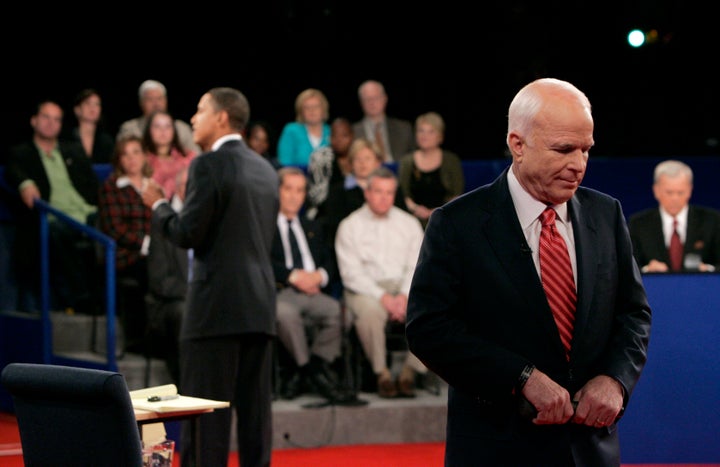
Visuals can make or break a political campaign. There are plenty of examples where a single, unfortunate photograph or video clip totally derailed a politician’s image and became a symbol of ridicule, Burnette said. She pointed to Dukakis riding in a tank in 1988, and McCain seemingly wandering the stage during his 2008 debate with Obama.

“Rather than projecting the messages of confidence that Dukakis and McCain hoped, these images ended up framing these candidates negatively,” said Burnette.

Political stagecraft ― the art of using visuals, settings, body language and media choreography to shape how voters perceive a leader or candidate ― was key for Obama, and both Ossoff and Buttigieg no doubt are taking notes from him.

As Politico reported, while Obama was in office, some members of his staff were even tasked with studying images of past presidents to see how they used the various White House rooms for different announcements, and how effective different podiums could be during speeches.

Obama would speak from three distinct types of podiums, depending on the gravity of his remarks. (President George W. Bush’s staff was just as particular about podiums, they noted.) Two specific podiums used by Obama were highlighted in the piece.

“There’s the ‘toast lectern’ ― a piece of wood on top of a metal pole ― which is used for informal events, such as a statement from the South Driveway or Camp David,” reporter Carol E. Lee wrote. “‘Blue Goose’ is the traditional podium used for big speeches. It’s bulky, formal and doesn’t allow for much adjustment. When the Queen of England was reduced to a talking hat during a meeting with President George H.W. Bush, Her Majesty was speaking from ‘Blue Goose.’”

David Litt, a former Obama speechwriter, isn’t an expert in visual language, but he sees the Obama influence, especially in Ossoff’s presentation.

“I think that, in general, Ossoff is looking at Obama as a model of a young figure who represents both generational change, but also a level of seriousness after a prevailing politics of unseriousness,” he told HuffPost. “I think visually he’s trying to project that, and he’s trying to project it with his words, too.”

More broadly, Litt said Democrats are waking up to the importance of projecting strength — particularly after Trump’s success with strongman politics and the relative lack of that quality in Republican frontrunners like Vice President JD Vance and Secretary of State Marco Rubio.

“Projecting strength not because Democrats are bullies, but because they have principles,” Litt said. “They have a backbone. They’re responsible. They stand up to bullies.”

“People associate the party with fairness and standing up for civil rights and sort of caring about marginalized groups, and all of those things are good, but I think part of what we saw in 2024 is that if people don’t feel that their president is strong enough, then they may not care about those other things,” Litt added.

He also said that this was a moment for Democrats to reclaim the mantle of strength, with a little help from a well-lit podium (Mayor Pete’s recent viral mishap notwithstanding).

By entering your email and clicking Sign Up, you're agreeing to let us send you customized marketing messages about us and our advertising partners. You are also agreeing to our Terms of Service and Privacy Policy.
Comments
You must be logged in to comment.