yahoo Press
Stock market today: Dow, S&P 500, Nasdaq surge as traders pare rate-hike bets, bond yields ease
Images
1 / 9
2 / 9

3 / 9

4 / 9

5 / 9

6 / 9

7 / 9

8 / 9

9 / 9
The above button links to Coinbase. Yahoo Finance is not a broker-dealer or investment adviser and does not offer securities or cryptocurrencies for sale or facilitate trading. Coinbase pays us for certain activity generated through this link. Prices displayed are informational.

US stocks surged on Thursday as optimistic comments from Federal Reserve governor Christopher Waller that pricing pressures showed signs of improving led traders to pare back rate-hike expectations.

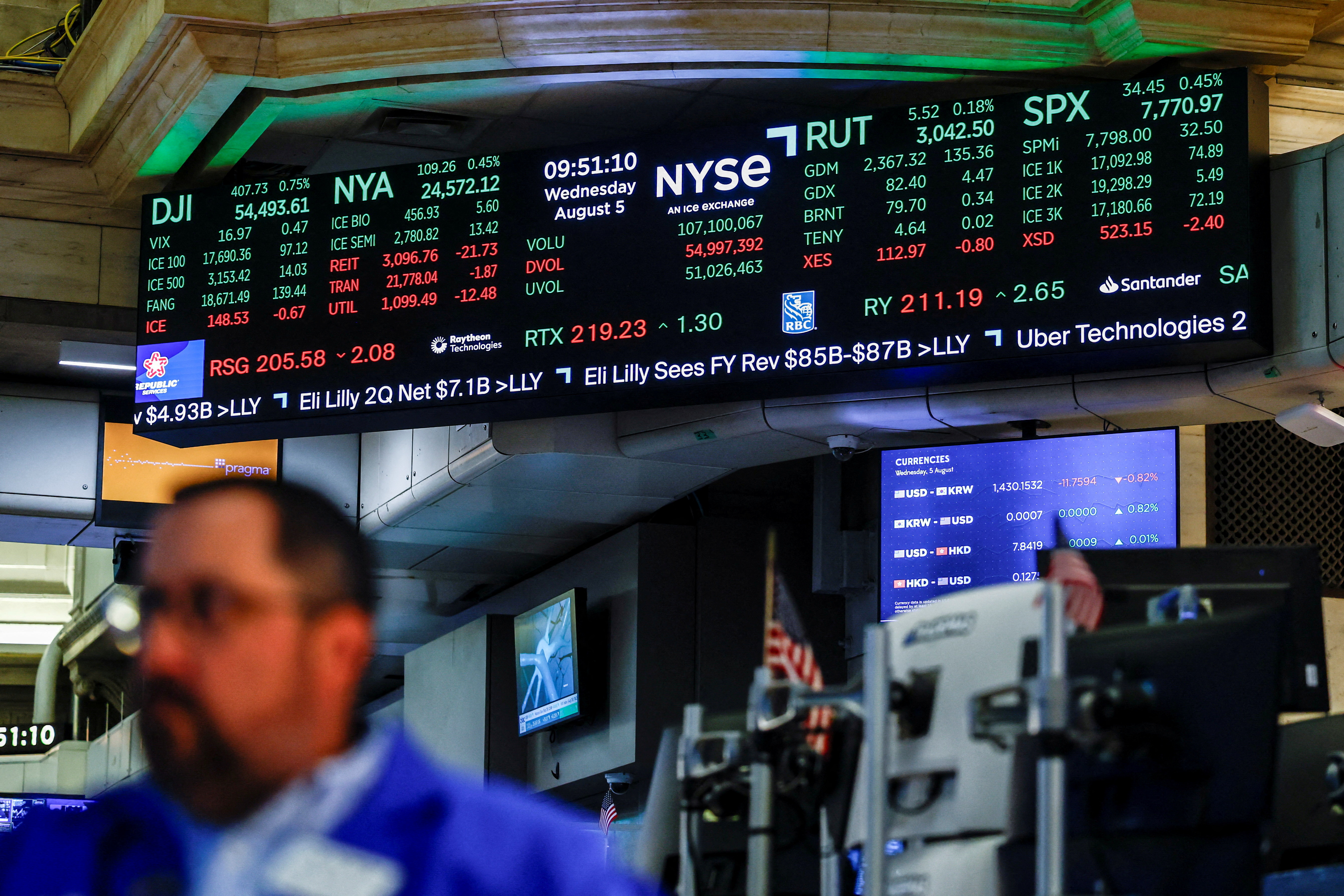
The Dow Jones Industrial Average (^DJI) climbed 1.2%, while the S&P 500 (^GSPC) rose 1%. The tech-heavy Nasdaq Composite (^IXIC) jumped nearly 1.4% as the yield on 10-year Treasurys (^TNX) declined 5 basis points to 4.74%.

Nvidia (NVDA) stock rose 1% after the AI leader announced it would acquire open AI platform Hugging Face for roughly $13 billion in a deal that's expected to close in 2027.

Stocks gained momentum after the Fed's Waller said he saw promising signs of "disinflation," suggesting he may vote to keep interest rates unchanged at the next Fed meeting. That led bond traders to rapidly scale back their bets that the Fed will raise rates in September to a tossup, from a 63% chance the day before.

Brent (BZ=F) crude oil futures remained above $95 per barrel on Thursday after President Trump said the US carried out a "very heavy attack" against Iran but also stated that the attack wouldn't take "too long."

While the reinflamed war in the Middle East has kept the spotlight on inflation, more attention is turning to the labor market, as a lineup of economic data releases sets the stage for Friday's jobs report.

On Thursday morning, outplacement firm Challenger, Gray & Christmas reported a slower pace of layoff announcements in August in the latest sign of a "low hire, low fire" labor market. That data was coupled with Bureau of Labor Statistics figures on how many Americans filed unemployment benefit applications last week, which showed jobless claims ticked up to 206,000, above estimates.

On the earnings front, Lululemon Athletica (LULU) and DocuSign (DOCU) are among the notable names reporting quarterly results after the bell. Broadcom (AVGO) stock slipped after the chipmaker's earnings beat wasn't enough to lift the shares.

Fed Governor Waller shared an optimistic view on Thursday, indicating that he is moving toward a vote to keep rates steady at the Fed's upcoming September meeting, given recent "encouraging" core inflation readings.

Though he acknowledged that inflation has remained significantly above the Fed's 2% target over the past five and a half years, Waller said at a Reuters event early Thursday that more recent readings show some promise of "disinflation."

"Three-month inflation has fallen steadily from 4.76% in February. That is a considerable improvement, and the speed of this downward trajectory is encouraging," Waller said while acknowledging some potential upside risks, including prices for energy, AI-related technology goods, and more tariff increases.

"If this continues in the data due over the next two weeks, I would be inclined to support holding the target for the federal funds rate at its current setting," Waller added.

His comments come as a welcome contrast for markets after Fed Chairman Kevin Warsh's speech last week at Jackson Hole, where he suggested that broad financial conditions do not appear restrictive.

Odds for a rate hike at the FOMC's Sept. 15-16 meeting fell sharply after Waller spoke. Traders are now pricing in a 50.3% chance of a hike, down 13 percentage points from Wednesday, according to the CME's FedWatch tool.

The US services sector expanded in August by the most in six months, according to data released Friday by the Institute of Supply Management.

The ISM's topline services index rose to 55.4 — the highest reading since February — from the previous month's 54.1 reading. Economists predicted that the reading would remain flat month over month.

Readings above 50 indicate expansion, while those below 50 indicate contraction.

The ISM's new orders gauge also accelerated to its fastest pace of growth since early 2023 at 60.9, compared to the previous month's 57.2. Prices paid also continued to accelerate, per the ISM, with the index reading at 72.6 against July's 70.3.

Employment continued to contract, though at a slower place that previous, recorded at 47.8 against the previous month's 47.4. Economists had been looking for a reading of 48.3.

Bitcoin (BTC-USD) jumped 4% on Thursday as Treasury yields eased, the dollar weakened, and investors' concerns over a potential Fed rate hike faded.

The move higher in crypto was sparked by Fed Governor Christopher Waller's hint on Thursday that he could vote to keep interest rates unchanged if inflation continues to ease.

This marks the second time in recent days that bitcoin has reclaimed the $80,000 level. Last week, bitcoin briefly climbed above the threshold but subsequently fell following Fed Chairman Kevin Warsh's hawkish comments at Jackson Hole, which sparked a sell-off in bonds.

September has historically been a weak month for bitcoin, though the world's largest cryptocurrency has managed to buck that trend over the past three years.

The token is coming off a strong 25% gain in August.

Initial jobless claims ticked up for the week ending Aug. 29 in a sign that the labor market continues to cool but remains broadly stable.

Applications for unemployment benefits rose by 2,000 from the previous week to 206,000, according to the Bureau of Labor Statistics, coming in above economists' expectations of 205,000 jobless claims.

The four-week moving average for jobless claims increased slightly to 207,250.

Continuing claims, a measure of the population that remains out of work, for the week ending Aug. 22, also increased by 8,000 to 1.78 million.

"This is a labor market that is cooling, not cracking," ADP chief economist Nela Richardson told Yahoo Finance after ADP released its private sector employment data on Wednesday.

The initial jobless claims data comes ahead of a key government labor market report on Friday that's expected to show more of the same in the US's "low hire, low fire" macro environment.

The US stock market opened Thursday in positive territory as bond yields fell and investors considered comments from Federal Reserve Governor Christopher Waller suggesting that pricing pressures were showing signs of improvement.

The Dow Jones Industrial Average (^DJI) climbed 0.7%, and the S&P 500 (^GSPC) rose 0.7% and 0.6%. The tech sector is back in focus this morning as the Nasdaq Composite (^IXIC) climbed 1%.

On Wednesday, all three major indexes finished in the green, shaking off what had been three days of trading in negative territory. At Thursday's open, the Dow Jones Industrial Average, S&P 500, and Nasdaq were off by 0.6%, 0.7%, and 0.2%, respectively, from their August peaks.

Shares for AI leader Nvidia (NVDA) rose by more 1% after the company announced it would acquire open AI platform Hugging Face for roughly $13 billion in a deal that's expected to close in 2027.

Oil prices resumed their rise on Thursday. Contracts on Brent crude (BZ=F) and US benchmark WTI crude (CL=F) both briefly touched their highest prices seen in more than a month earlier Thursday morning.

Investors have also turned their focus to the Japanese yen, which is on pace for its best day against the US dollar (JPY=X) since Aug 3, just days after Japan and the US jointly intervened by buying the currency on July 31.

US companies announced just under 53,000 job cuts last month, making it the slowest August for layoffs since 2022, according to data from outplacement firm Challenger, Gray & Christmas.

Consumer products companies, including Procter & Gamble (PG) and Estée Lauder (EL), were behind more than 10,000 of the cuts. Food producers followed, with nearly 8,000 layoffs, a third of which came from Tyson Foods in response to a historic cattle shortage.

Although job cut announcements rose from July, total layoffs so far this year are down 41% compared to 2025 and dropped 15% excluding government jobs.

"This is the quietest August since 2022, but is generally on average for the month since the mid-2010s. What we'd like to see with low layoffs is an increase in hiring activity," Andy Challenger, chief revenue officer for Challenger, Gray & Christmas, said in a statement. "While companies are making plans to hire more workers than last year, according to our numbers, it doesn't appear those positions are being filled quickly."

Read more.

Broadcom (AVGO) stock trimmed losses after tumbling as much as 4% in after-hours trading on Wednesday.

The AI chip and networking giant saw revenue growth amid booming AI demand, but the company's results were not enough to send the stock higher. Shares sank immediately after the results, then trimmed losses.

"I can understand the selling pressure," Cody Acree, StoneX financial equity research analyst, told Yahoo Finance. The analyst, who has a Buy rating on the stock, noted the chipmaker's fiscal Q3 revenue and earnings beat was "not enough to keep investors happy."

"The magnitude is not quite enough from a top and bottom line standpoint on the beat and raise when you have a company that is this levered to AI," said Acree.

Read more.

The bond market is on shaky ground again. US Treasury Secretary Scott Bessent is trying to keep one of America's biggest foreign debt buyers from making it worse.

Long-term US yields are near multi-decade highs, pushing up mortgage and corporate borrowing costs and threatening stocks. Bessent already doubled long-term Treasury buybacks last month, but the US 30-year yield (^TYX) has climbed back toward its highest level since 2007.

Now another potential pressure point is emerging from Japan, the largest foreign holder of US government debt, with about $1.1 trillion of Treasurys.

Japan spent decades with interest rates near zero. Now, its 10-year government bond yields around 3% for the first time since 1996. Japanese savers and institutions can suddenly get paid at home, giving them less reason to send money overseas into Treasurys and other foreign bonds.

That creates one problem for Washington: A weaker yen can prompt Japan to buy its currency with dollars. Raising those dollars can mean selling Treasurys, putting even more bonds into a market already struggling with high yields.

Read more.

Economic data: Challenger job cuts, year-on-year, August (-46.1% previously); Imports, month-on-month, July (+1.4% expected, -1.8% previously); Exports, month-on-month, July (-0.8% expected, -0.9% previously); Nonfarm productivity, second-quarter final reading (+1.4% expected, +1.4% previously); Initial jobless claims, week ended Aug. 29 (205,000 expected, 203,000 previously); Continuing claims, week ended Aug. 22 (1.79 million expected, 1.778 million previously); S&P Global US services PMI, August final reading (56.8 expected, 56.8 previously); S&P Global US composite PMI, August final reading (56 previously); ISM services index, August (54.1 expected, 54.1 previously); ISM services, prices paid, August (69.5 expected, 70.3 previously); ISM services, new orders, August (57 expected, 57.2 previously); ISM services, employment, August (49 expected, 47.4 previously)

Earnings calendar: Ciena (CIEN), Copart (CPRT), Zscaler (ZS), Samsara (IOT), Guidewire Software (GWRE), Lululemon Athletica (LULU), DocuSign (DOCU), Planet Labs (PL), Victoria's Secret (VSXY), The Campbell's Company (CPB)

Catch up on some top stories from overnight:

Snowflake stock soars as surging AI demand boosts earnings

Broadcom stock sinks as chipmaker fails 'to keep investors happy'

Google spared from ad-business breakup, but judge orders changes

Goldman Sachs warns investors to expect lower returns over the next year

Costco shuts down key service without notice

G20 wraps without consensus amid bond market sell-off

Bloomberg reports:

Oil steadied after a three-day rally as President Donald Trump said renewed attacks on Iran would be short-lived while reiterating his claim that the US controls the Strait of Hormuz.

West Texas Intermediate traded near $91 a barrel after surging 9% over the past three sessions. Brent settled below $96 on Wednesday. Asked how long the US bombing campaign could continue, Trump said "I don't think too long," although the president added that "we're prepared to do another one."

The renewed US strikes followed weeks of relative calm, with Iran retaliating by firing drones and missiles on American bases across the Middle East, in line with a pattern used throughout the six-month war. While some oil exports had been exiting the Persian Gulf on tankers with their transponders switched off, the latest hostilities raised the prospect of deeper disruptions.

"The latest escalation should keep support under the market, however, keep in mind both the US and Iran are looking for off-ramps here," said Dennis Kissler, senior vice president for trading at BOK Financial Securities Inc. "More peace talks could deflate prices quickly."

Read more.
Comments
You must be logged in to comment.