yahoo Press
NextEra, Santee Cooper Point to Real Dollar Savings From AI Deployments
Images
1 / 4
2 / 4

3 / 4

4 / 4
The above button links to Coinbase. Yahoo Finance is not a broker-dealer or investment adviser and does not offer securities or cryptocurrencies for sale or facilitate trading. Coinbase pays us for certain activity generated through this link. Prices displayed are informational.

NextEra Energy says an artificial intelligence (AI)–driven dispatch and outage-scheduling tool has saved its customers more than $20 million so far this year. Santee Cooper expects a custom AI weather-forecasting model to help it avoid spot-market purchases that can cost $100,000 an hour during extreme weather. Both utilities say the tools moved from concept to production in a matter of weeks, not years.The two companies detailed their AI deployments during a Sept. 2 virtual media roundtable hosted by Google Cloud, alongside Raiford Smith, the company's global director of power and energy industry. The session focused on Gemini Enterprise, Google Cloud's platform for building and deploying AI agents, and framed both utilities as evidence that AI in the sector has moved beyond generic chatbots and into tools built for specific, high-stakes operational decisions."Utilities are being asked to deliver greater reliability, lower costs, and a grid ready for what comes next," said Rich Argentieri, president of NextEra Analytics. Tami Wilson, vice president and chief financial officer of Santee Cooper, described the shift in similar terms, saying her utility is moving away from "legacy, clunky, cumbersome processes" toward AI-driven financial and load forecasting to save time and money.

Argentieri walked through NextEra's Grid Composer platform, which the company built on the Gemini Enterprise Agent Platform and rolled out across Florida Power and Light's (FPL's) generating fleet. The platform pulls together real-time telemetry, load data, and generation profiles—what Argentieri estimated at roughly half a trillion data points a day—into a single model that compares manual dispatch decisions against an AI-optimized alternative.NextEra built the first version of the tool in less than 12 weeks, according to Argentieri. Since then, he said, the optimized dispatch and outage scheduling it enables have produced "over $20 million of savings to our customers" so far this year. NextEra has since made the underlying tools available to other utilities through a Google Cloud marketplace product it calls Optos, with Optos Composer—the version built for market and asset optimization—unifying generation, fuel, maintenance, trading, reserves, and storage decisions that Argentieri said have traditionally been managed by separate, siloed teams."All of those teams very much traditionally siloed. And not only the people, but all the data and the processes that go into that," Argentieri said, describing generation, transmission, and trading functions that rarely shared data before. Bringing those functions onto a single platform, he said, has let the company avoid "suboptimal decisions" and given teams visibility into how choices in one area affect costs elsewhere in the system.Argentieri also pointed to field applications. FPL technicians—he estimated 85% to 90% of the company's workforce—now use voice-activated tools to pull torque specifications or work-order guidance on site, and can photograph a part to have it matched automatically in the company's parts catalog. He credited those tools, along with AI-assisted troubleshooting, with improving both technician efficiency and safety, including in wind turbine maintenance, where he noted the physical exertion of climbing a turbine has been compared to running a 5K. Newer technicians in particular, he said, have benefited from AI support during the learning curve. NextEra has also applied AI to driver-safety recommendations for its crews.

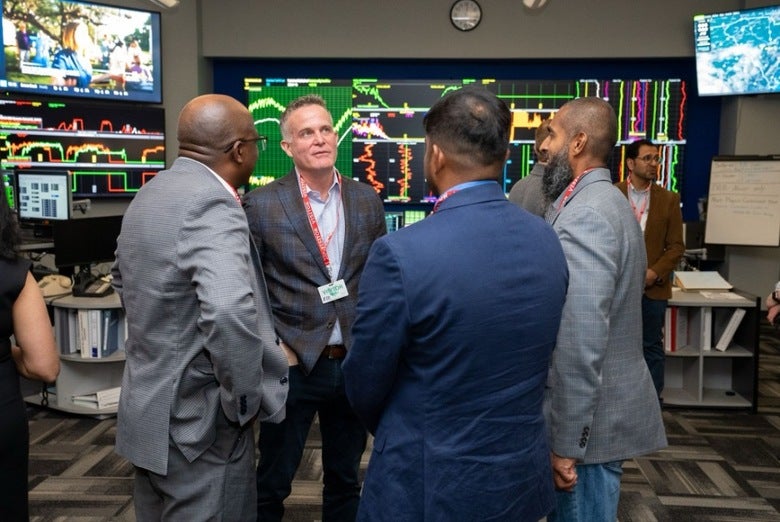
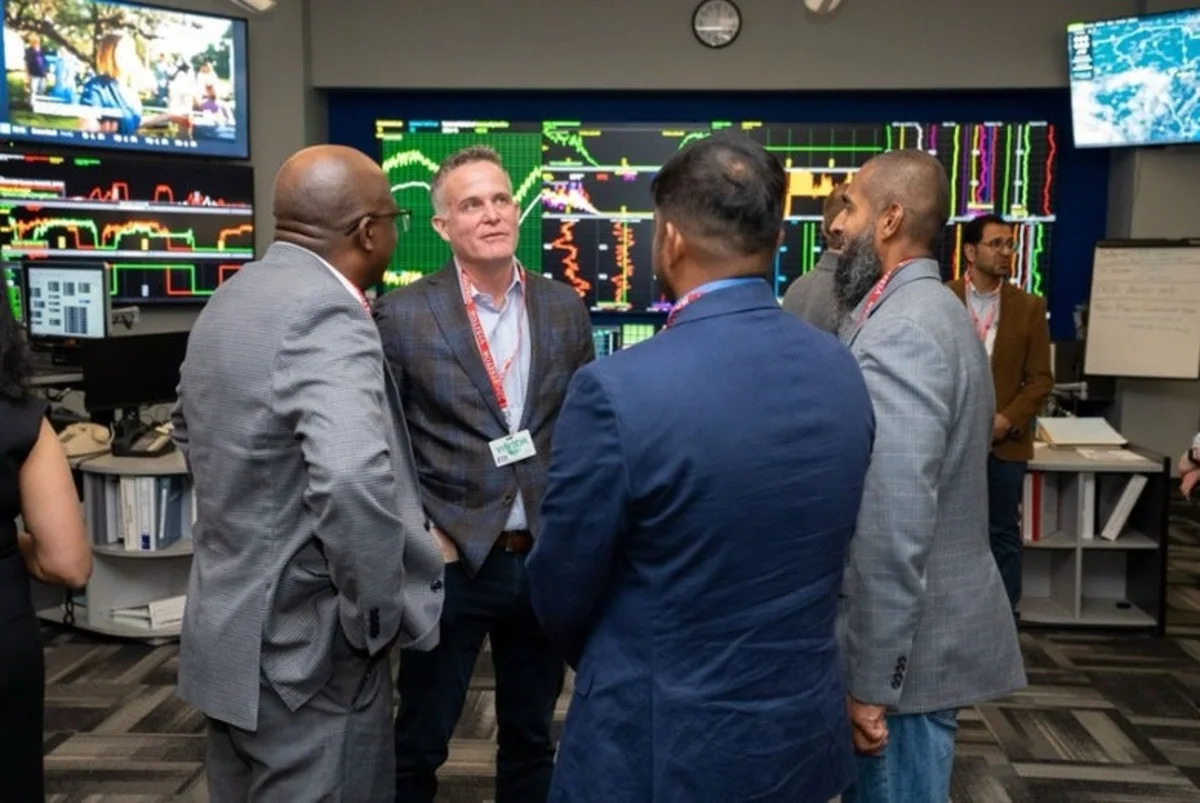
Wilson said Santee Cooper's push into AI-driven forecasting is aimed squarely at the financial exposure created by weather forecasting errors. The utility, which serves more than 2 million people across South Carolina, relies on weather forecasts to plan how much power to line up each day (Figure 1)—and Wilson said those forecasts are often wrong.[caption id="attachment_270363" align="aligncenter" width="780"]

1. Google Cloud's power and energy team visits Santee Cooper's control room to discuss how Gemini Enterprise and WeatherNext can support utility planning and operations. From left: Dr. Wayne Madhlangobe of Santee Cooper; Jamie McDaniel, Tariq Islam, and Ashwin Mishra of Google Cloud. Courtesy: Google Cloud[/caption]"If we overestimate how much electricity we will need, we spend money on fuel and operations we don't need. If we underestimate our power needs, we are forced to buy electricity on the spot market, often at high prices," Wilson said. "On the coldest winter day, one degree of temperature variance can cost up to $100,000 per hour on the spot market." She said a single degree of forecast error can swing the utility's power needs by roughly 100 megawatts an hour—enough to power tens of thousands of homes.To address that, Santee Cooper is working with Google to build a custom forecasting model based on the company's WeatherNext platform, tailored to account for local geography—including the microclimates created by two large lakes the utility manages for its hydro units. Wilson said she expects the model to meaningfully improve forecast accuracy and help the utility avoid costly market spikes, with savings that would flow directly to customers given Santee Cooper's status as a public power utility.On the financial side, Wilson said her team's forecasting group has historically managed more than 150 reports in Excel, a process she described as "extremely painful"—any change in assumptions could take weeks to run back through the models. Santee Cooper hasn't yet tested its new Gemini Enterprise Agent Platform–based tool in production, but Wilson said the utility expects it to cut those runtimes by about 75%, giving the finance team faster access to scenario data as it works through a $10 billion grid-expansion plan. The utility is also distributing several hundred Gemini Enterprise licenses to employees across departments to support natural-language queries against its internal systems.

Both utilities emphasized that their AI rollouts are paired with formal governance structures. Wilson outlined a three-part framework she said should apply broadly across the industry: governance, training, and change management. Santee Cooper is standing up a cross-functional Innovation Council to oversee its AI strategy and is requiring employees using Gemini Enterprise to complete training on both the technology and how to handle confidential data appropriately."We're not going to use this to replace jobs by any stretch," Wilson said, describing a "human in the loop" approach and a "creator-editor approval model" for generative AI outputs that she compared to the utility's existing internal financial controls.Smith, addressing an audience question later in the session, connected the utilities' efficiency gains to Google's own data center operations, noting the company's custom tensor processing units and pointing to more than a sixfold improvement in computing power per unit of electricity across Google's data centers over the past five years. He described the relationship between AI and the grid as "a whole virtuous cycle of AI for energy and energy for AI," arguing that efficiency gains in AI infrastructure feed back into tools, such as security-constrained optimized power flow modeling, that utilities can use to manage their own systems.Smith closed the discussion with an anecdote from earlier in his career, recalling a longtime head of engineering, Barry Feldman, who had spent nearly 50 years at the company and told Smith he was "having so much fun" once natural-language tools let him prototype ideas himself rather than relying on specialized technical staff to translate his expert judgment into code. "Now he could talk to it, he could type it, he could do natural language, and he could interact with it in a way that allows him to go prototype and build stuff and do things that he couldn't do before," Smith said.—Aaron Larson is POWER's executive editor.
Comments
You must be logged in to comment.