huffpost Press
MAGA Government Officials Don’t Seem To Know That They Are The Government
Images
1 / 8

2 / 8
3 / 8
4 / 8

5 / 8

6 / 8

7 / 8

8 / 8
Several senior Trump administration officials and allies have spent the past week telling the public not to trust the federal government — the same government they run.

It’s not a new message, according to political experts. This kind of “government is the enemy” rhetoric from sitting officials stretches back more than 80 years, weaponized to unify a political base against a common target, even if they’re part of that target themselves.

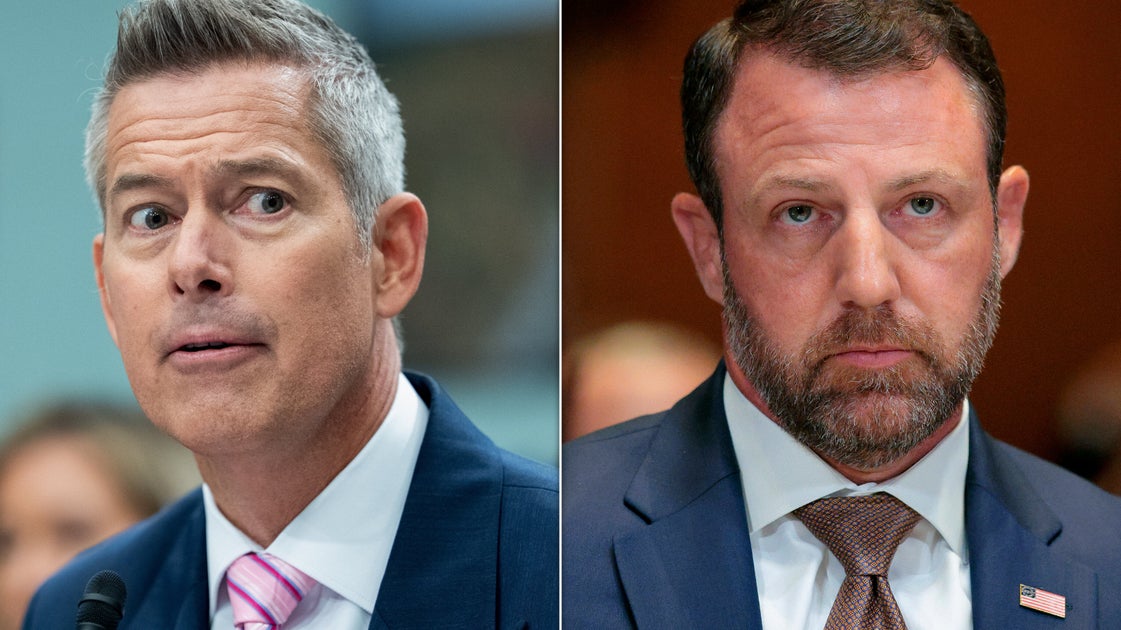
Transportation Secretary Sean Duffy and his wife, Fox News host Rachel Campos-Duffy, both said on Tuesday’s episode of “The Katie Miller Podcast” that they didn’t trust the government.

“I have a hard time believing in the government anymore,” Duffy said.

“I think as citizens, it’s our job to be suspicious of the government,” Campos-Duffy said. “We’re Americans; that’s what we do; we don’t trust the government.”

Miller, who was the communications director for former Vice President Mike Pence from 2020 to 2021 and is married to Stephen Miller, the White House deputy chief of staff for policy, added, “I’m still distrustful of the government, even though we’re in the government.”

On the same day, Homeland Security Secretary Markwayne Mullin spoke at a Manhattan news conference and condemned New York City Mayor Zohran Mamdani and Gov. Kathy Hochul (D-N.Y.) for their planned government-run grocery stores.

“It means this great small business owner should not own this business, that the government should,” Mullin said.

“It means they’re coming for you,” he added, referring to the government.

“I have nothing to do with the prosecution of the war across the globe,” said House Speaker Mike Johnson (R-La.) in a video shared on X on Tuesday as he slammed CNN reporter Manu Raju’s questions about the war in Iran.

“Should the House speaker be held responsible for the duration of a military conflict around the globe?” Johnson asked. In March, Johnson defended President Donald Trump’s military strikes on Iran, calling it a “limited operation.”

Neither the White House nor the Department of Transportation responded to HuffPost’s requests for comment. The Department of Homeland Security referred HuffPost to the secretary’s comments.

“You can’t burn down the house and expect to occupy it,” Peter Loge, director and associate professor at the George Washington University’s School of Media and Public Affairs, told HuffPost, referring to officials who criticize the government they lead. “That’s what this rhetoric does.”

You can’t burn down the house and expect to occupy it. That’s what this rhetoric does.

The discourse comes as trust in the federal government among Republicans has risen since Trump returned to office in 2025. According to Pew Research Center’s tracker, 20% of Republicans and Republican-leaning independents said they trusted the government in Washington to do the right thing shortly after Trump’s second term began. By September 2025, it had climbed to 26%. (Pew has not done a survey in 2026, as of reporting.)

Pew Research Center told HuffPost that this shift aligns with a decades-old, recurring pattern: Trust in the government aligns with which party controls the White House. Each party’s supporters become more trusting when their party is in power. But that partisan gap has grown sharper in recent years: Democratic trust in the government was around 9% in the September 2025 survey, a level previously associated with Republican voters during the President Barack Obama and President Joe Biden years.

There is a history of Republican officials using this type of language spanning decades, according to Mark Brockway, an assistant teaching professor at the Political Science Department at Syracuse University and a political identity researcher.

“The long-term conservative or Republican or MAGA criticism of the federal government was actually not about the federal government,” Brockway told HuffPost. “Instead, it was a criticism or a fight against what we call a vague liberal enemy, which was sometimes mapped onto the government when it was convenient.”

Brockway argues that, in these contexts, “federal government and liberal are synonyms.” These officials are not condemning the federal government they run, but condemning the federal government overall while simultaneously leveraging their federal government powers.

“The Democratic Party is stuck in this idea that if they call out this hypocrisy, that will damage or harm Trump’s reputation or power in any way, shape or form,” he said. “For Donald Trump, it is not hypocritical to criticize the federal government and then use the power of the federal government — because it exists in this worldview.”

Brockway added, “These things are not inconsistent. It’s not very ideological, because Donald Trump is also at the same time using the power of the federal government to the greatest extent possible.”

This connection between the federal government and liberals has existed before former President Ronald Reagan, but he is credited with supercharging this idea that the federal government in general is the enemy.

“In this present crisis, government is not the solution to our problem. Government is the problem,” Reagan said in his first inaugural address in 1981. At a press conference in 1986, Reagan stated, “The nine most terrifying words in the English language are: ‘I’m from the government, and I’m here to help.’”

Loge — a former senior aide to Sen. Edward Kennedy and three other members of the U.S. House of Representatives who now directs George Washington University’s Project on Ethics in Political Communication — pointed out that this approach isn’t limited to the GOP. Casting the government as a common enemy, he said, serves as a unifying message for both parties.

Loge, however, drew a distinction between criticizing corruption and condemning the government as a whole. “There’s a difference between saying this person is corrupt … and saying all of the government is corrupt,” he said. “Go after the corrupt. Make the case there. Do not say that politics is flawed to its core, because politics is all we have.”

“Democrats have also said you can’t fully trust the government,” Loge said. “You’ve got senior Democratic elected officials saying you can’t trust political elites.”

For example, while speaking to the National Press Club in August 2018, Sen. Elizabeth Warren (D-Mass.) condemned the Trump administration but said they were “not the cause of the rot” in the government.

“Corruption is a form of public cancer, and Washington’s got it bad,” she said. “It’s time for treatment, time to isolate and quarantine the ability of big money to infect the decisions made every day by every branch of our government.”

Whether the language comes from the left or right, Loge said, it taps into a familiar and repeated impulse to place blame somewhere outside oneself and the political party.

“It’s not that luck, it’s those people,” he said. “The problem is we are all those people.”

By entering your email and clicking Sign Up, you're agreeing to let us send you customized marketing messages about us and our advertising partners. You are also agreeing to our Terms of Service and Privacy Policy.
Comments
You must be logged in to comment.