aljazeera Press
Nepal tunnel traps hinder flood rescue: How many are dead or missing?
Images
1 / 4

2 / 4

3 / 4

4 / 4
Flash floods on the Nepal-Tibet border have killed more than 900 people and left nearly 5,000 missing, many trapped in hydropower tunnels.

Save

Share

People return to their flood-ravaged homes in Nepal

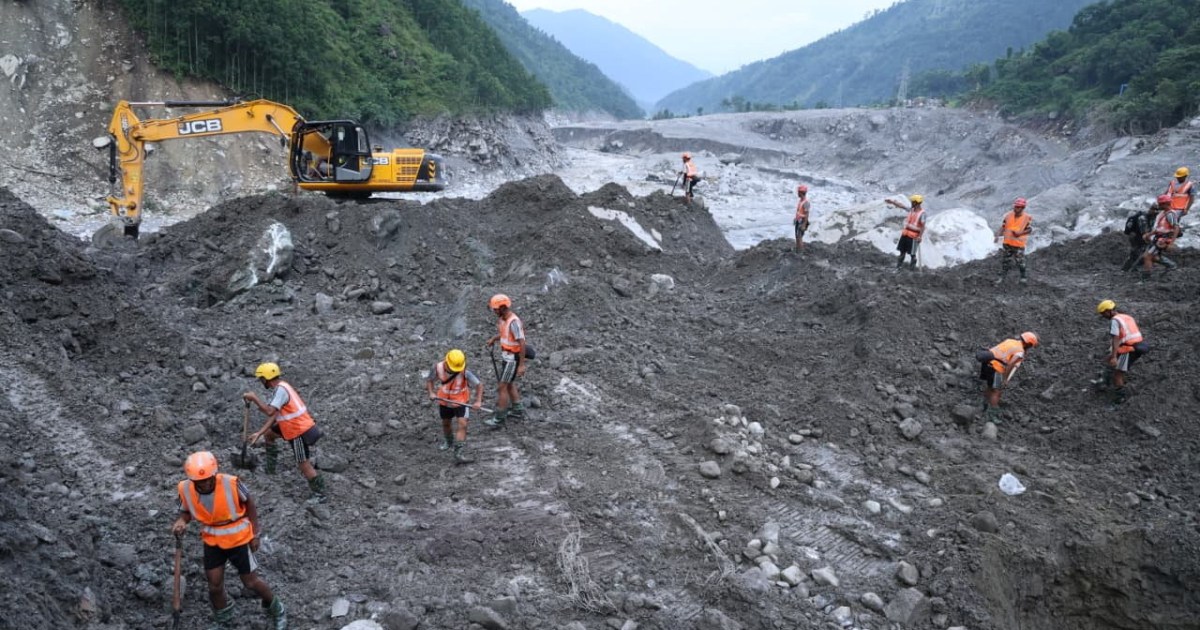
Rescue teams in Nepal continue to search for thousands of missing people, five days after devastating flash floods that have left the Himalayan nation grappling with a major humanitarian crisis.

Several hundred of those missing are believed to be trapped in tunnels swamped by debris from the floods, which started in Tibet and were triggered by a glacial collapse last week. More than 900 people have died, and nearly 5,000 people are missing across Nepal and Tibet.

Here’s what we know about the latest rescue efforts to recover the people missing due to the floods.

A glacier collapse sent a catastrophic flood roaring through Tibet and parts of Nepal on August 26.

A glacial collapse refers to when a large mass of glacier ice detaches from its bed. This sometimes involves millions of cubic metres of ice, rock and water, which can transform into a highly mobile ice-rich avalanche or debris flow.

Scientists believe part of a glacier near the Langtang Lirung peak had collapsed. The glacier, roughly 5,200 metres high in the Himalayas, plunged about 1,200 metres and collected rock and debris before slamming into the Lende River. The resulting surge swept south through Nepal’s Rasuwa, Nuwakot and Dhading districts.

Nepali Prime Minister Balendra Shah wrote in a Facebook post on Sunday that almost 21,000 security personnel were involved in the rescue operations, besides civilian workers and volunteers.

While Nepal had initially rejected foreign help in dealing with the crisis, it has in recent days agreed to allow Chinese and Indian experts in to help with rescue efforts.

China has mobilised over 2,100 rescue workers and disbursed at least 220 million yuan ($33m) to support relief efforts, its state-run CCTV reported. Additionally, Beijing has been airdropping equipment and supplies to front-line rescuers.

Its soldiers are also using life-detection equipment to look for the missing. While details have not been revealed, such equipment typically includes thermal cameras and sound detectors to detect the presence of human life.

Chinese President Xi Jinping said on Monday during a meeting with Kyrgyz President Sadyr Japarov in Bishkek that China is searching for the Chinese and foreign nationals missing due to the floods and mudslides.

Xi added that Beijing is making efforts to relocate and resettle those affected, provide medical treatment for the injured and prevent secondary disasters.

India has flown in 18 army officers who are trained in tunnel rescue operations, along with six teams of forensic experts to help with DNA-based identification of people killed in the floods. It has also sent four tranches of humanitarian aid to Nepal, including portable gensets, food, water purification tablets, tents, blankets, water pumps and medicine.

The Indian army is also supplying Bailey bridges — prefabricated bridges used in military operations — to Nepal to help the Himalayan country’s rescue workers reach areas that have been cut off because highways and bridges have been washed away.

International aid has also arrived from the United Nations, the Red Cross Federation, Australia, South Korea and the United States.

Among those missing are 933 workers who were stationed at a series of hydropower projects that line the rivers that swelled up amid the floods, according to Nepal’s National Disaster Risk Reduction and Management Authority.

Some dams were washed away. But many of the missing are believed to be trapped beneath mud and rock debris in about half a dozen hydropower project tunnels.

“A large amount of debris has been deposited and that is posing us a big challenge to open the tunnels,” Raja Ram Basnet, the spokesperson for the Nepal army, told the Reuters news agency. “Our main focus is on opening the tunnels.”

The Nepali government says key rescue efforts have focused on the Trishuli 3A and 3B hydropower projects.

On Saturday evening, rescue teams used drills to break through into the upper part of a mud-swamped tunnel and began pumping air as well as sending in a camera at Trishuli 3A in Nepal’s Rasuwa District.

Nearly 300 workers trapped in these tunnels have so far been rescued, including several Indian nationals. However, on Sunday evening, officials said that their latest efforts to track more of the missing had not yielded results so far.

Nepali authorities said on Monday that 903 people had died in the floods and 4,247 were missing.

On the Chinese side, authorities said 16 people were killed in Tibet’s Gyirong County and 546 were missing. In Tibet, 261 foreign nationals from 23 countries were unaccounted for, according to Chinese authorities.

The difficult terrain and bad weather have forced rescue operations to a halt several times since Friday.

On Sunday, overnight rain and rising river waters hampered rescue efforts at the tunnels, filling the excavation area with water before conditions eased.

“As the floodwaters have receded, the team has resumed efforts to locate the tunnel entrance using drilling machines, excavators, hydraulic cutters and other equipment,” a Nepal army statement said on Sunday.

Two large barrier lakes formed during the floods. Nitesh Khadka, a Nepali researcher and physical geographer who specialises in glacial floods, told Al Jazeera on Friday that one of them posed a threat to workers and engineers in downstream hydropower tunnels, as well as displaced flood survivors nearby.

The barrier lake began to overflow on Friday, introducing a new flood threat, temporarily halting rescue operations. Khadka said that if a sudden flood rushes down, it could slam into these tunnels and power stations, trapping or injuring anyone who is still there.

Shah deemed the flood an “unprecedented and devastating natural disaster”. The Nepali prime minister added that compiling a complete assessment of the damage remained a challenge.

“Despite the adverse weather, difficult terrain and continuing risks, we are moving forward with determination to save the lives of our citizens,” he wrote in a Facebook post on Sunday.
Comments
You must be logged in to comment.