yahoo Press
Opinion - What happens when Republican senators have nothing left to lose? Not much.
Images
1 / 6
2 / 6

3 / 6

4 / 6

5 / 6

6 / 6
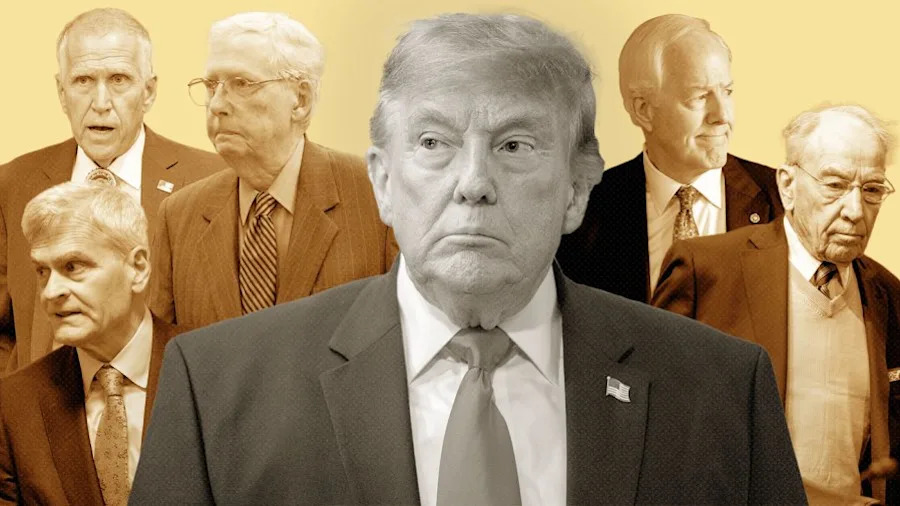
For years, we have been told that Republican senators privately object to many of President Trump's policies and appointments but do not resist because Republican voters would punish them at the ballot box. There are at least four senators who have little to fear from elections or Trump right now, yet remarkably little has changed.

Sen. Mitch McConnell (R-Ky.) is retiring in January. Sens. Bill Cassidy (R-La.) and John Cornyn (R-Texas) both lost primaries to Trump-backed opponents and will not run again. And Sen. Thom Tillis (R-N.C.) opted against seeking reelection after Trump threatened to support a primary challenger against him.

Often called the "Wounded Bear" or YOLO ("you only live once") caucus, these lawmakers have nothing to lose. But despite a greater willingness to voice objections to Trump nominations and policies, they almost never vote "no" when it counts.

Trump's recent nomination of Todd Blanche to be attorney general illustrates the pattern.

Cornyn and Tillis demanded a written commitment ending Trump's proposed $1.8 billion anti-weaponization fund as the price for their support. Neither focused much on the provisions granting Trump and his family immunity from IRS investigations. Widely denounced as a slush fund to reward Trump allies and supporters — including potentially rioters who attacked Capitol police on Jan. 6, 2021 — it was labeled by Cornyn as "politically tone-deaf" and a "payout pot for punks." Tillis called it "stupid on stilts;" McConnell declared it "utterly stupid, morally wrong." Cassidy accused Blanche of showing "poor judgment" in helping negotiate it, questioned his independence, and expressed concern about the Justice Department's "bringing suits against political enemies."

Every Democrat, along with Republicans Susan Collins (Maine) and Lisa Murkowski (Alaska), opposed Blanche. One more "no" vote would have killed the nomination. Hospitalized and unable to vote, McConnell did not take a public position. Cornyn and Tillis voted yes, after Blanche ordered the Justice Department to rescind the fund — an order that can easily be reversed, as Trump has suggested he might do.

With the nomination hanging in the balance, Cassidy put it over the top, holding back tears as he explained that an acting attorney general might be even worse than Blanche.

All four appear no more willing to sink a Cabinet-level nomination, block a major Trump initiative, or defend the Senate's institutional role now than they were before.

McConnell voted against Defense Secretary Pete Hegseth, former Director of National Intelligence Tulsi Gabbard, and Health and Human Services Secretary Robert F. Kennedy, Jr., as well as Trump's Canadian tariff and global tariff "emergencies." As he surely expected, none of his votes changed the outcome.

Cornyn almost never opposed Trump before losing his primary. After losing, Cornyn blocked two controversial ambassadorial nominees for the Foreign Relations Committee, but let them advance after getting "assurances" on AIDS funding.

A member of the Judiciary Committee, Tillis blocked the nomination of Ed Martin to serve as the U.S. attorney for the District of Columbia in 2025 because of his comments about the January 6 attack on the Capitol. After deciding not to run again, Tillis delayed (but did not stop) the nomination of Kevin Warsh as Federal Reserve chair, until the Justice Department dropped its criminal investigation of then-Chair Jerome Powell.

Before losing his primary, Cassidy, a physician and chair of the congressional committee overseeing public health, helped block the nomination of Casey Means for surgeon general. But after expressing grave doubts about RFK Jr.'s views on vaccines, he still cast the decisive vote to confirm him as Secretary of Health and Human Services.

After losing his primary, Cassidy declined to schedule hearings on Heidi Overton's nomination to head the Food and Drug Administration, calling her support for Trump's executive order on vaccines "almost disqualifying." Cassidy also joined Democrats in trying to block Bill Pulte's nomination for acting Director of National Intelligence, an effort that failed in a 49-49 tie.

But Cassidy folded on Blanche's nomination. And after initially supporting a war powers resolution to block further military action in Iran, Cassidy backed down after receiving a briefing he had demanded in a heated confrontation with Trump.

In short, whether it involves Trump's willingness to wage war without congressional approval, appoint his former criminal defense attorney to head an already politicized Justice Department, withhold or redirect funds appropriated by Congress, or demand confirmation of dozens of nominees en bloc, the wounded bears have largely acquiesced.

And why not add Chuck Grassley (R-Iowa) to the list? The dean of the Senate, Grassley has championed government oversight of waste, misconduct and abuse by whistleblowers and inspectors general who, he claims, should be "almost wholly free of supervision." Nonetheless, when Trump removed 18 inspectors general in January 2025, Grassley sent only a letter of concern, which was not even answered for eight months. He did not employ his signature tactic, holding up nominees for other offices, to ensure the watchdogs would be protected. When his current term ends in 2028, Grassley will be 94. We wonder what accounts for his muted response.

In a closely divided Senate, the YOLOs have enormous leverage, but they are not using it to challenge executive branch overreach. No doubt party loyalty, relationships with Republican colleagues, and a reluctance to help Democrats still matter to them. But it should be deeply troubling that compliance seems to have become Republicans' default setting.

If senators with nothing to lose won't insist on preserving the Constitution's checks, balances and separation of powers, who will?

David Wippman is emeritus president of Hamilton College. Glenn C. Altschuler is the Thomas and Dorothy Litwin Emeritus Professor of American Studies at Cornell University.

Copyright 2026 Nexstar Media, Inc. All rights reserved. This material may not be published, broadcast, rewritten, or redistributed.For the latest news, weather, sports, and streaming video, head to The Hill.
Comments
You must be logged in to comment.