yahoo Press
What caused the Nepal flood wave? Here’s what we know
Images
1 / 7
2 / 7

3 / 7

4 / 7
5 / 7

6 / 7

7 / 7
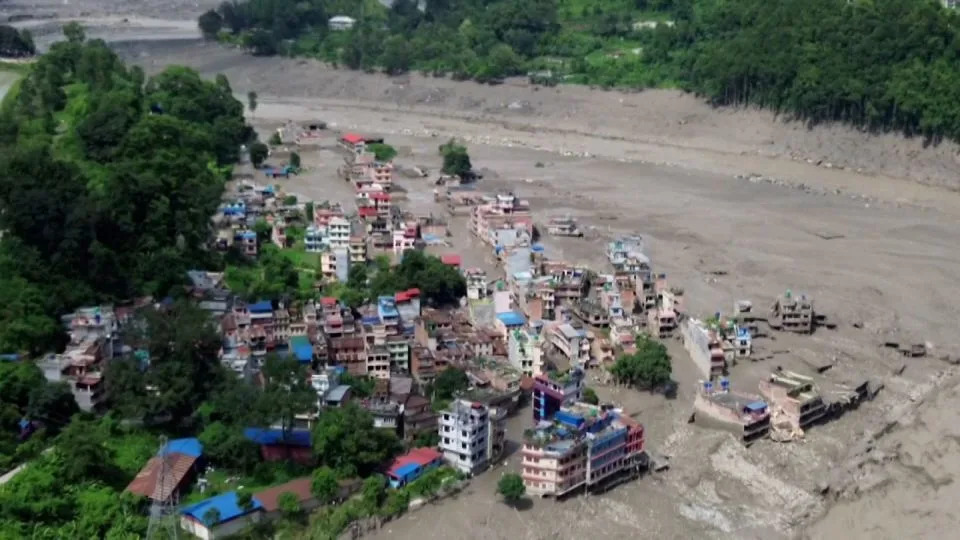
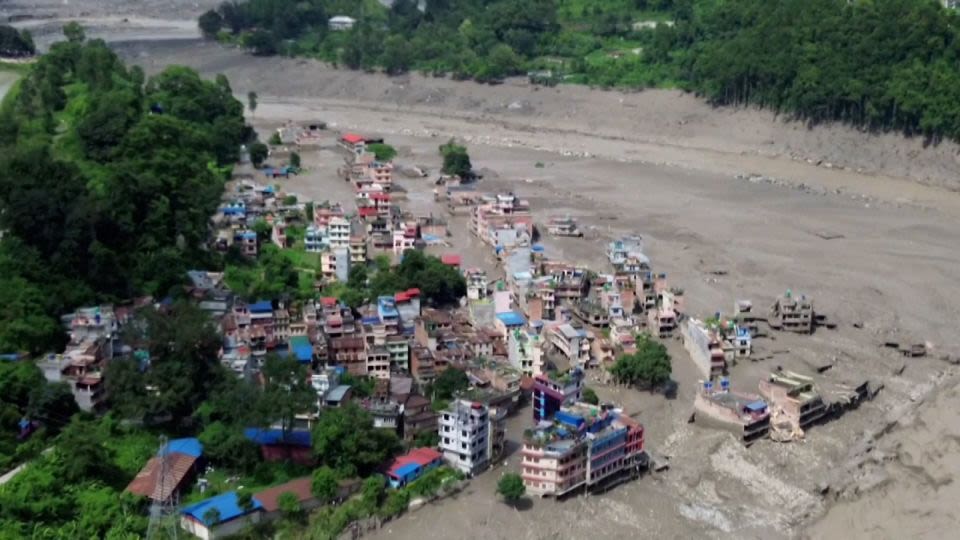
Scientists investigating the cause of the devastating flash floods that tore through the Nepal-China border on Wednesday — swallowing towns, roads and bridges and causing significant loss of life — are zeroing in on the theory that the disaster was triggered by a huge glacier collapse and landslide.

Nepal is a hotspot for climate disasters as the planet heats up. Vast swaths of ice up in the Himalayas are melting, and rocky mountainsides are becoming less solid and more fluid.

Scientists are still working to determine exactly what caused the disaster, but here's what we know so far.

The first indication that something was amiss came at 8:37 a.m. local time, when the earth started shaking along the Nepal-China border, north of Kathmandu.

It was initially reported as an earthquake by the US Geological Survey's automated earthquake detection network, but later clarified the shaking was caused by an exceptionally powerful glacier collapse and debris flow, equivalent to a magnitude 5.2 earthquake.

Comparing satellite images from before and after the disaster, scientists have established that an enormous chunk of glacier sheared off from high on a mountain. From there, it plunged to the river below — a roughly 7,000-foot drop in elevation, a CNN analysis shows, and the section of the glacier that fell was approximately 2,000 feet wide.

They believe a landslide may have happened at the same time, creating a deadly cascade of rock and ice, which tore down the mountainside and into the Lhende Khola River, a tributary of the Bhote Koshi River, which flows from China into Nepal, often through deep gorges.

The sheer force of the collapse melted the ice, and on its way, the torrent also picked up other waterlogged sediment, said Daniel Shugar, a geologist at the University of Calgary in Canada, who is part of the scientific group investigating the collapse.

This could explain the sheer volume of water seen sweeping down narrow mountain valleys, swallowing everything in its path.

The flood wave — a cascade of water, pulverized ice and rock — "descended the first 22 kilometers (13.7 miles) at an average speed of 193 kilometers per hour (120 mph)," said Jeffrey Kargel, a senior scientist at the Planetary Science Institute, a non-profit institute. That means it travelled nearly 14 miles in just 6 minutes and 50 seconds.

"Most people think of flash floods as being caused by heavy rainfall, but in Nepal and Tibet, as in many other high-mountain regions, they can also result from complex chains of hazards, including landslides (and) avalanches," said Liz Stephens, a meteorology professor at the University of Reading.

The complexity makes early warning especially difficult, she added.

Glacier collapses and landslides are complex can be caused by a number of factors, but climate change often plays a role, scientists say. Nepal, in the rapidly-warming Himalayan region, is home to thousands of glaciers which are melting and destabilizing as temperatures rise.

Ice loss rates from glaciers across the Hindu Kush Himalaya, a region which includes Nepal, have doubled since 2000, according to recent research, with enormous risks for the nearly 2 million people who live downstream of them.

Wouter Buytaert, a hydrology professor at Imperial College London, said that while scientists are still studying the exact causes of this disaster, it was "exactly the type of event that is triggered by climate change."

"Global warming shrinks glaciers, making it more likely for them to break apart," Buytaert said.

unknown content item

-

Scientists say there is still work to be done to establish exactly what happened and what made the flooding so deadly.

"What is hard to reconcile is the the gargantuan volumes of water that we see in these these absolutely horrific videos," said.

It's "just a gobsmackingly unbelievable amount of water," Shugar said. "Figuring out where that water came from is is actually probably the hardest thing about all this."

CNN's Simone McCarthy, Thomas Bordeaux, and meteorologists Brandon Miller and Chris Dolce contributed reporting, analysis and expertise.

For more CNN news and newsletters create an account at CNN.com
Comments
You must be logged in to comment.