yahoo Press
Trump signs executive order to rename Lake Ontario amid trade war with Canada: ‘We’re gonna call it Lake America’
Images
1 / 8
2 / 8

3 / 8

4 / 8
5 / 8
6 / 8

7 / 8

8 / 8
President Trump on Thursday signed an executive order directing his administration to change the name of Lake Ontario to "Lake America" amid his ongoing trade war with Canada, following through on a threat from earlier this week.

"We're gonna call it Lake America," Trump said in a video posted to Truth Social. "And all it takes is a good pen and some intelligence."

In the clip, the president crossed out the words "Lake Ontario" on a printout of a map and wrote "Lake America" above it. "So now we have a lake, and now we have a gulf," he continued, referring to his January 2025 executive order to rename the Gulf of Mexico. "Because we have the Gulf of America, and now we have Lake America, without the 'of.'"

Responding in French, Canadian Prime Minister Mark Carney wrote on social media that "this lake is called Lake Ontario — today and forever."

"We know that the United States is changing," Carney added. "Their trade relations, their foreign policy, their national monuments, their hydronyms. Canadian women and men also know that things must be called by their name."

Pierre Poilievre, Canada's Conservative opposition leader, said no executive order will change the lake's name and that "it doesn't belong to President Donald Trump to rename on a whim." Nova Scotia Premier Tim Houston called it "some real foolishness," posting: "It's Lake Ontario, buddy." Canadian Industry Minister Mélanie Joly said Canada would "always call it Lake Ontario."

The move has also drawn pushback from Vermont Republican Gov. Phil Scott. "This is petty and disappointing," Scott, who has been a consistent critic of Trump's approach to Canada, posted on social media. "We should be at the negotiating table, finding a path forward that strengthens both the U.S. and Canadian economies. Further escalating tensions does nothing to help American or Canadian families and businesses."

Democrats went further. Rep. Debbie Dingell of Michigan said she would introduce a bill Monday called the "Hands Off Our Great Lakes Act" to nullify the order, along with Reps. Tim Kennedy and Joe Morelle of New York. "Donald Trump can sign all the executive orders he wants, but it will always be Lake Ontario," Dingell said. The bill would also prohibit any future presidential renaming of the Great Lakes.

House Minority Leader Hakeem Jeffries wrote that Trump "picked a fight with Canada that is costing you money. Instead of fixing it, he is spending your tax dollars to rename Lake Ontario." Sen. Amy Klobuchar of Minnesota, invoking Lake Superior, called the order "superiorly stupid."

Trump's order to rename Lake Ontario comes after trade talks between the United States and Canada collapsed on Friday, Aug. 21, triggering heated recriminations and new rounds of tariffs on both sides.

On Monday, Ontario Premier Doug Ford, whose Canadian province borders Lake Ontario, urged his federal government to inflict "massive pain" on the U.S. while calling Trump a "loser" and instructing the president to "kiss my ass."

Trump responded by dismissing Ford as a "flunky" and describing him as a "less charismatic, intelligent, and overall unimpressive" alternative to his late brother Rob Ford, who was mayor of Toronto from 2010 to 2014.

On Tuesday, the president added in a subsequent post that "the United States is giving serious consideration to changing the name of Lake Ontario to Lake America in that we don't expect to be doing much business with Ontario any longer."

In reality, renaming a major body of water requires more than just a few pen strokes — as Trump's previous experience renaming the Gulf of Mexico as the "Gulf of America" has made clear.

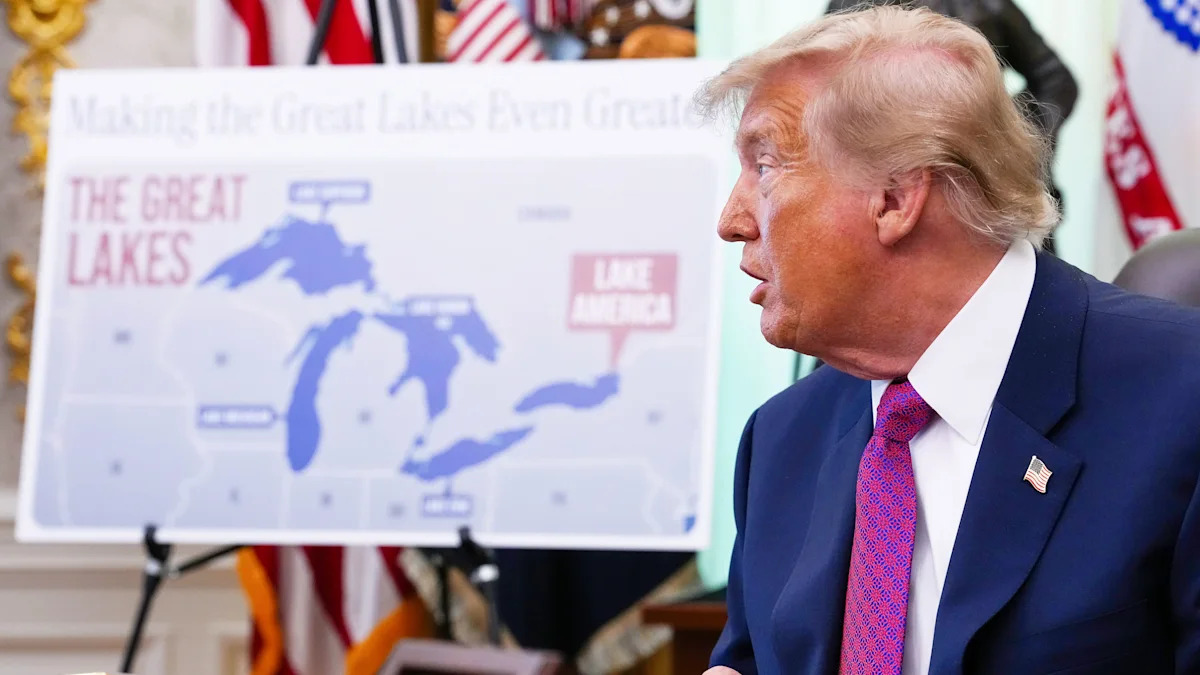
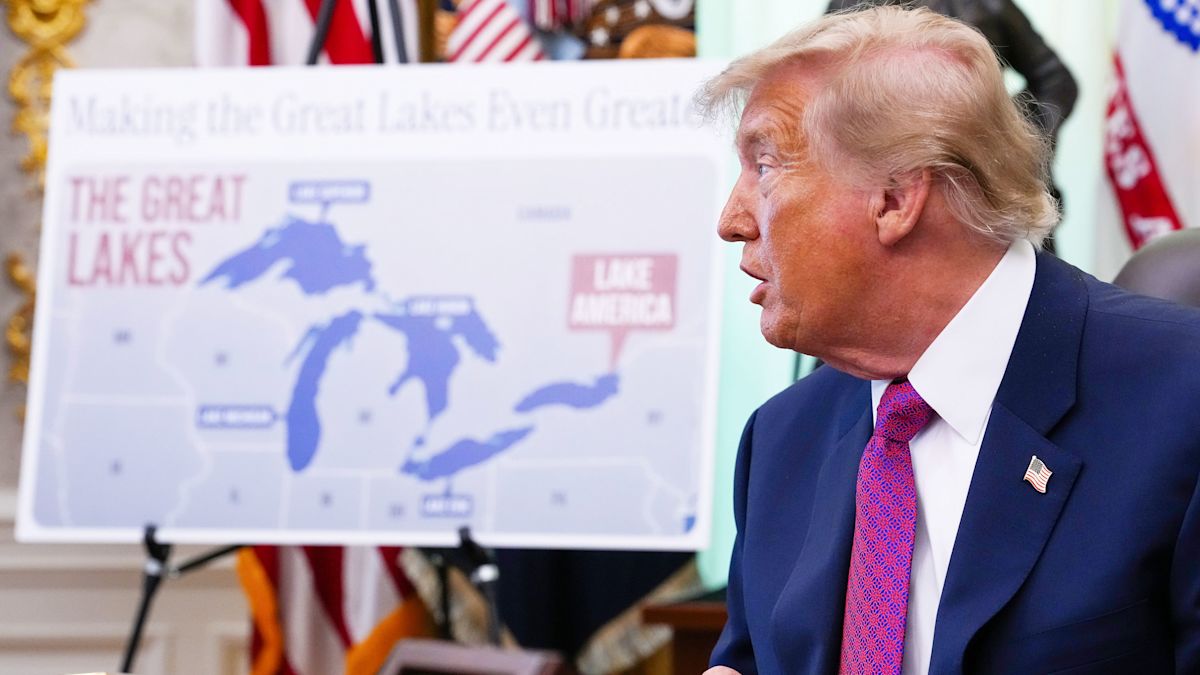
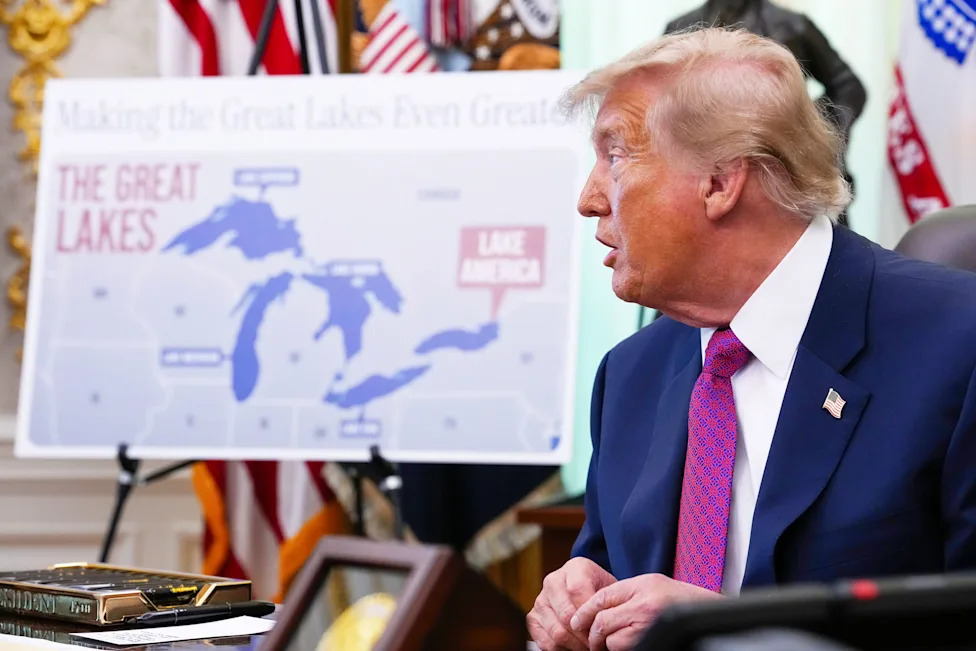
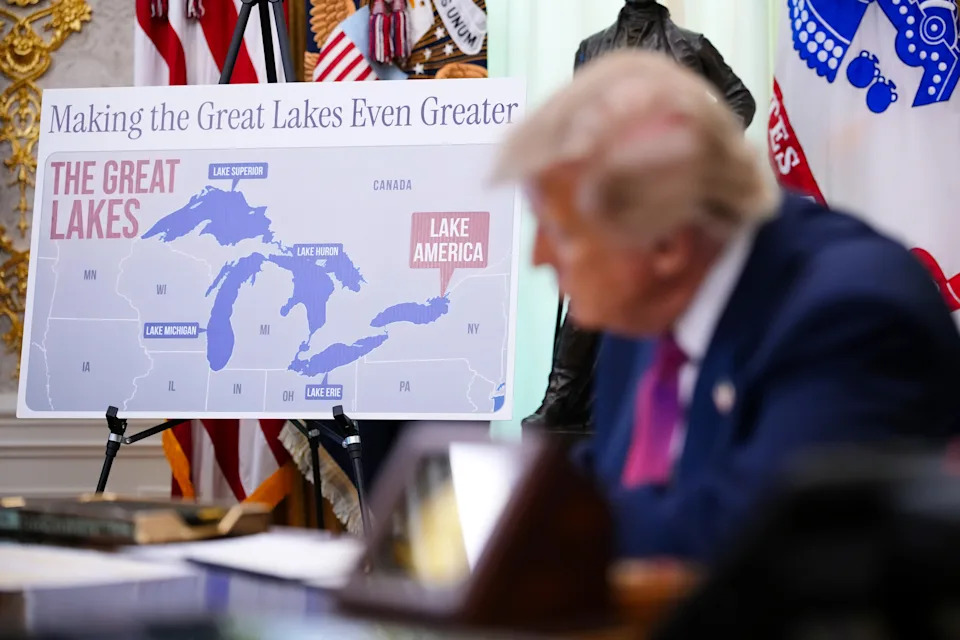
A map labeling Lake Ontario as "Lake America" is displayed as Trump signs an executive order in Washington, D.C., on Aug. 27, 2026.

The text of the president's new "Lake America" executive order directs Interior Secretary Doug Burgum to "take all appropriate actions to rename as 'Lake America' the body of water currently named as Lake Ontario."

Within hours, the U.S. Geological Survey updated the Geographic Names Information System (GNIS) — a database of name and location information for more than 2 million physical and cultural features of the U.S. — to reflect the change. All "executive department and agency maps, contracts, and other documents and communications" will now reflect Trump's preferred naming, according to the order.

Whether anyone else follows suit — any state, country, company or person — is essentially up to them.

On his first day back in office, Trump issued a similar executive order titled "Restoring Names that Honor American Greatness." In it, he gave Burgum 30 days to "update the [Geographic Names Information System] to reflect the renaming of the Gulf and remove all references to the Gulf of Mexico from the GNIS."

After some internal pushback, the federal bureaucracy ultimately complied. But the change was not universally adopted. At the time, Mexican President Claudia Sheinbaum dryly suggested that North America should be called "América Mexicana," or "Mexican America," because that's how a document from 1814 referred to the continent.

"For us and for the entire world, it will continue to be called the Gulf of Mexico," Sheinbaum added.

The Associated Press still uses "Gulf of Mexico" in its news articles. In Florida, Longboat Key leaders voted against changing the town's "Gulf of Mexico Drive" to "Gulf of America Drive." And National Geographic still sells maps that display the "Gulf of Mexico" to U.S. customers.

But Google Maps complied. It shows "Gulf of America" to users in the U.S. and "Gulf of Mexico" to users in Mexico. Elsewhere, both names appear side by side. Apple Maps has a similar policy.

On Friday, Google confirmed it would do the same with Lake America. "The U.S. Geographic Names Information System has formally changed the name for 'Lake Ontario' to 'Lake America' in the United States," the company said in a post on its News from Google blog. "People using Maps in the U.S. will see 'Lake America,' those in Canada will continue to see 'Lake Ontario,' and those outside of the U.S. and Canada will see both names."

Ontario Premier Doug Ford, whose province borders the lake, brushed the whole thing off Sunday. "It was something out of Saturday Night Live when he signed documents saying 'change it to Lake America,'" Ford said. "No one is going to call it Lake America."

In his social media response, Carney noted that "the name of Lake Ontario" is not Canadian, but rather "derives from the Wendat word 'Ontari'io,' which means 'the lake is beautiful, the lake is great.'""This name dates back more than 400 years, well before the Canadian Confederation and the Declaration of Independence of the United States of America," Carney explained.

Grand Chief Pierre Picard of the Wendat Nation in Quebec issued a statement calling himself "outraged, appalled, shocked: there are no other words to describe how I feel following President Trump's decision to rename Lake Ontario 'Lake America.'" Picard said Trump was trying to erase Indigenous history in the region.

Trump's executive order attempts to justify renaming Lake Ontario by arguing that the U.S. has recently invested more money than Canada in "protecting the Great Lakes freshwater ecosystem." The order also says that "the United States claims most of the Lake's volume" because "the deepest parts of the Lake's waters [lie] within United States territory."

At Thursday's signing, Trump joked: "We have a Gulf and we have a Lake — now all we need is an ocean. Maybe we'll have to change the name of the Atlantic and/or the Pacific. Maybe we'll change them both."

Trump appears to have a penchant for renaming things, regardless of whether those names stick. He has ordered his administration to change the name of Alaska's Denali back to Mt. McKinley, and to use the "Department of War" as the secondary title for the Department of Defense. Earlier this year, Trump teasingly referred to the Strait of Hormuz — the contested waterway at the heart of the Iran war — as the "Strait of Trump." In Washington, D.C., Trump's allies tried to put his name on the John F. Kennedy Center for the Performing Arts — an effort halted in May by a federal judge. Today, more than a dozen other initiatives — completed or in development — feature the president's name, image or likeness, including currency, passports and an airport.
Comments
You must be logged in to comment.