yahoo Press
Jackson Hole Fed summit live: Kevin Warsh's keynote speech comes at a pivotal moment for the Federal Reserve
Images
1 / 8
2 / 8

3 / 8

4 / 8

5 / 8

6 / 8

7 / 8

8 / 8
The Kansas City Fed's annual gathering of central bankers, economists, and academics kicked off on Thursday in Jackson Hole, Wyo. The stakes are high for new Fed Chairman Kevin Warsh — and for markets.

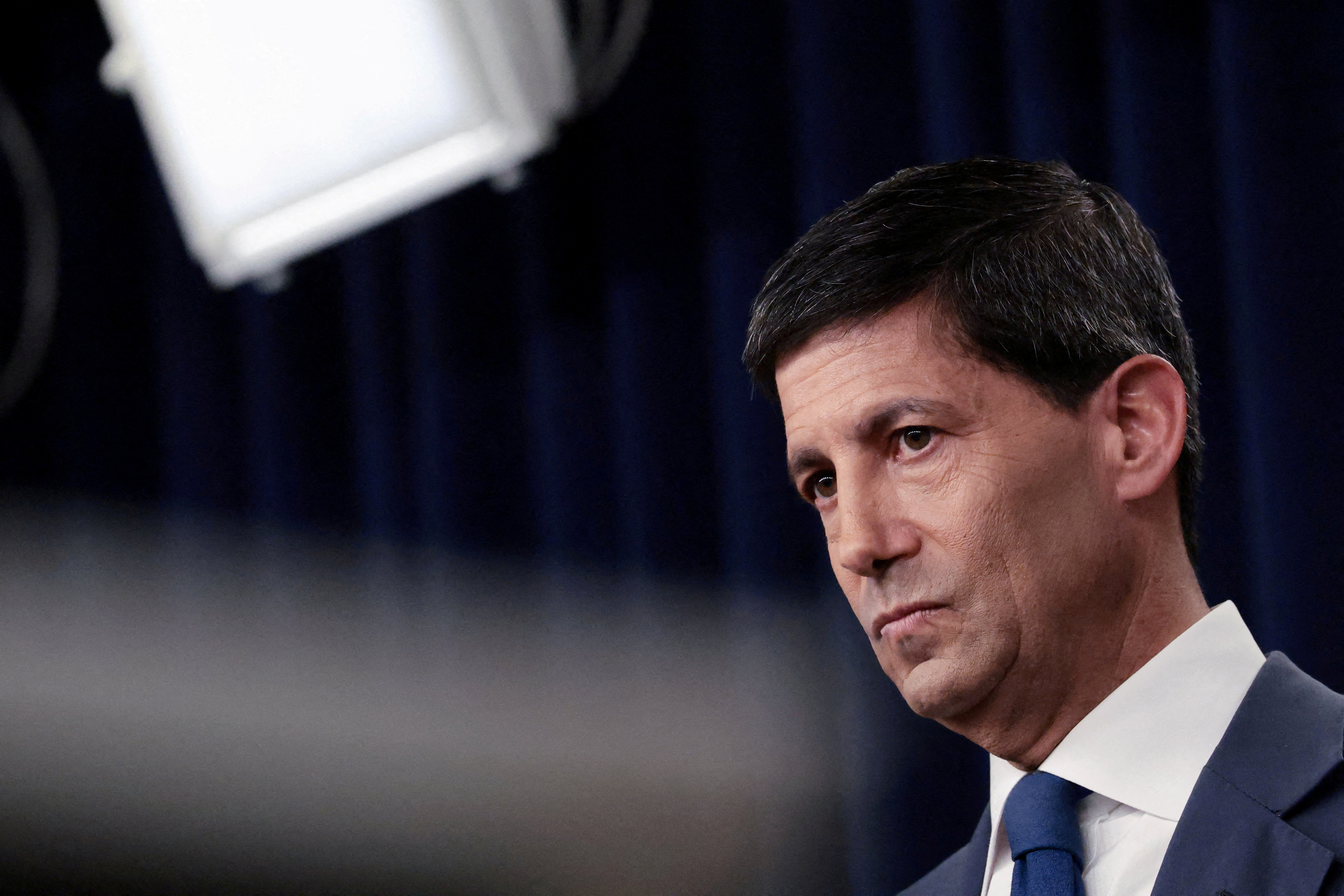
In the closely watched speech Friday, Warsh said inflation is running too high and should be the focus for the central bank, while laying out a strong assessment of the economy for the first time. But he held to his pledge not to provide forward guidance.

"We must be confident that underlying inflation is moving to our objective, clearly and at sufficient speed. Otherwise, we have work to do," Warsh said in his first speech as chairman in Jackson Hole, Wyo. "It is the Fed's job to deliver stable prices."

Markets are likely to put a great deal of emphasis on Warsh's words as they remain on edge after a bond sell-off earlier this month. A subsequent Treasury intervention has raised questions about whether the market can tighten financial conditions in place of the Fed. Following the speech Friday morning, 55% of bond traders expect the Fed to raise rates at its September meeting, a jump from roughly a third on Thursday.

Kevin Warsh didn't directly address eye-popping government debt figures in his first speech as Federal Reserve chairman in Jackson Hole on Friday, just days after the gross national debt passed $40 trillion and debt-fueled Treasury bond market jitters spooked investors.

The word "debt" appeared only once in the prepared remarks, at the beginning of Warsh's speech, when he said "everyone here is in debt" to the meeting's hosts.

Warsh did offer in his speech what was perhaps a hint at how he might be hoping the US economy can bring deficits under control, with a bullish assessment that artificial intelligence could mean "the potential for substantially higher growth is on the rise."

That echoed remarks from both Treasury Secretary Bessent and President Trump, who have downplayed the exploding debt by promising that the US can grow its way out of the problem with outsized economic growth that many economists see as unrealistic.

Read more here.

Markets are pricing in a 25-basis-point hike at the next Federal Reserve meeting in September as more likely than not, with traders digesting a hawkish tilt to Kevin Warsh's Jackson Hole speech on Friday.

Traders were assigning a roughly 56% chance that the Fed will move rates higher, to a range of 3.75% to 4%, in the minutes after Warsh's speech, per CME data.

In the roughly 30-minute speech, Warsh reiterated that "it is the Fed's job to deliver stable prices."

"None of these measures are perfect, but they all tell a similar story: Inflation is running above our 2% target," Warsh said. "So the Fed's predominant focus right now should be on prices."

Those comments sent yields into a bear flattener, as short-dated Treasury yields rose and those on longer-dated bonds fell.

In providing forward guidance, the Federal Reserve risks a "hall of mirrors" problem that blinds the policymakers to new developments, Fed Chair Kevin Warsh said in his remarks on Friday.

"The economic literature has long described the distorting effects [of forward guidance]: a hall-of-mirrors problem," Warsh said. "If markets rely materially on the Fed's guidance and the Fed relies on market prices, we are all more likely to be blinded to new developments, more likely to be caught unprepared for a turn of events, and more likely to commit errors in policymaking."

Markets will always try to anticipate the Fed's next move, given the committee's powerful tools for driving short-term interest rates, Warsh said, but the Fed shouldn't "indulge a regime in which market participants are looking primarily to the Fed for their next trade."

In his first keynote address in Jackson Hole as Federal Reserve chairman, Kevin Warsh is set to say that with inflation running above 2%, "the Fed's predominant focus right now should be on prices."

"One of these measures are perfect, but they all tell a similar story: Inflation is running above our 2% target," Warsh will say, per a copy of his speech released by the Fed. "So the Fed's predominant focus right now should be on prices."

The most recent PCE inflation reading — the Fed's preferred metric for price change — showed that the 12-month change in prices stands at 3.7%, with the so-called core annual measure reading at 3.3%.

The dollar stayed strong, near a one-week high, on Friday, as investors waited for Kevin Warsh's Jackson Hole address.

Bloomberg News reports:

Currency traders are increasing hedges for further gains on the dollar ahead of a key speech from Federal Reserve Chairman Kevin Warsh at the Jackson Hole symposium on Friday.

The greenback has recouped half of its losses since US Treasury Secretary Scott Bessent's surprise move last week to support the bond market, which soured the mood toward the currency.

Options flows and positioning suggest traders are guarding against a continued rebound, hedging for the possibility that Warsh comes across as hawkish or reiterates his view that the Fed should focus on monetary policy and stay out of fiscal matters.

Read more.

Wall Street may be waiting with bated breath for Kevin Warsh's Jackson Hole speech, but history has shown us that these meetings do little to stir the market. On Friday, futures on the Dow Jones Industrial Average (YM=F) and S&P 500 (ES=F) edged higher. While the Nasdaq-100 (NQ=F) dipped, could this time be different?

Bloomberg News reports:

Despite a few exceptions, a Fed chair's speech at the symposium normally isn't a big catalyst for stocks — unless it comes before a crucial shift in monetary policy. Since 2000, the S&P 500 Index has gained just 0.4% on average in the week following the gathering, data compiled by Bloomberg show. And options markets aren't pricing in any fireworks this time either.

Of course, "this time won't be different" are arguably the second-most dangerous words on Wall Street after "this time it's different." As a result, many traders will be ready to take action, especially since Warsh has broken with his predecessors by abstaining from providing guidance on how the central bank is thinking about potential future interest rates moves.

Read more.

As Federal Reserve Chairman Kevin Warsh prepares to make his Jackson Hole debut, here is a list of a few of the key issues he might discuss:

Inflation: Two Fed officials have already called Warsh out for high inflation ahead of Jackson Hole. Fed watchers will expect tougher talk from the Fed chief and a real plan.

Oil markets: Oil prices remain high, leading to a rise in inflation above the central bank's target. Investors may expect Warsh to offer firm guidance on how he plans to handle this.

AI: The rise of AI is driving up borrowing costs. This is an issue Warsh has yet to tackle.

Read more.

The stage is set for Federal Reserve Chairman Kevin Warsh's first Jackson Hole speech on Friday, offering the new head a chance to clarify the central bank's strategy to bring down inflation and rebuild confidence in the Fed itself.

This year's gathering takes place against a challenging backdrop as inflation remains well above the Fed's 2% goal for the sixth consecutive year after a series of shocks. The latest inflation data offers conflicting evidence, fueling arguments for both patient policymakers who favor holding rates steady and hawks who want to hike rates as soon as possible.

Officials are deeply divided on whether to hold rates steady for now to see if inflation will come down on its own, or to act immediately. This internal tension — the "good family fight" that Warsh desires — resulted in three dissents at the last policy meeting.

The gathering also comes amid a distinct lack of clarity about the Fed's willingness to raise rates. During his July press conference, Warsh repeatedly pointed to bond yields shooting materially higher, suggesting it was a good thing and implying that the Fed welcomes higher yields to tighten policy through markets. His stance initially triggered higher long-term bond yields and ultimately led to confusion and damaged market confidence in the Fed's strategy.

"I would like to hear him explain and start with, 'Here's why we made the decision we made in July,'" Robert Kaplan, former head of the Dallas Fed, told Yahoo Finance.

Read more.

Fed Chairman Kevin Warsh's keynote speech on Friday could be a market-moving event, but Warsh may not say what the market wants to hear.

Sevens Report Research Founder Tom Essaye noted that Warsh's Jackson Hole speech "could create a solid pullback" in stocks if it doesn't communicate very much on his stance on inflation or the path of interest rates.

People are already nervous about the Fed, with long-dated Treasury yields remaining elevated, Essaye continued.

"We don't know what's going on for the first time in well over a decade," Essaye told Yahoo Finance on Wednesday. "And part of the elevated yields is Fed uncertainty. So I think Warsh needs to come out and give a very strong response on inflation but also signal to the market that he's not interested in sort of starting an extended rate-hike campaign."

"If he can do that and provide a little bit more clarity on what he's looking at to make rate decisions, I think that the market can breathe a sigh of relief," Essaye said.

When Federal Reserve Chairman Kevin Warsh takes the podium at 10 a.m. ET on Friday, investors will be listening for three things in his speech, according to Vishal Khanduja, senior portfolio manager at Morgan Stanley Investment Management. They are as follows:

First, investors expect Warsh to reaffirm his commitment to 2% inflation after recent data showed price increases remain above the Fed's target.

Second, investors want Warsh to provide more detail on the working groups he set up revolving around communication and data. "We would love to know if there's some initial work being done and what that direction is," Khanduja told Yahoo Finance.

Third, Fed watchers will be listening in for some of Warsh's thoughts on broader economic issues, particularly on the effects of the AI boom. "Where is that productivity boost coming from?" Khanduja said as an example. "What are his thoughts? What data points are they tracking, and how are they looking into it?"

One area where investors don't expect much new information is on forward guidance. Unlike his predecessor, Warsh has been adamant in not providing explicit guidance on future policy as he looks to reform Fed communications with markets.

Ahead of Kevin Warsh's Jackson Hole debut, investors are urging the Federal Reserve Chairman to talk tough on high inflation in order to lift long-term Treasurys.

Bloomberg News reports:

Showing a clear commitment to price stability during his Friday speech in Jackson Hole may trigger buying of 30-year US government bonds. That would bring down yields that last week hit their highest level since 2007. Such a move would also aid Treasury Secretary Scott Bessent's mission to stop a selloff in long-duration debt and manage the country's ballooning interest burden.

Fed watchers at JPMorgan Chase & Co., Apollo Global Management Inc. and Morgan Stanley say Warsh has a chance to convince the market that managing inflation is his priority.

If he can, then "some of the angst on Fed credibility will reduce," said Priya Misra, a portfolio manager at JPMorgan Investment Management.

Read more.

The Federal Reserve's preferred inflation gauge showed prices remained sticky in July, reinforcing division within the central bank on whether to raise interest rates as policymakers gather this week for their annual economic symposium in Jackson Hole, Wyo.

While prices remained sticky year over year, month-over-month data pointed to a slower pace of increase, a positive signal for those who are content to hold interest rates steady, though it's unlikely to quiet the hawks.

Ariane Curtis, senior economist at Capital Economics, predicted that the July reading won't be enough to push the Fed to hike rates in September.

"But," she cautioned, "with the annual rate still at 3.3% and given our relatively upbeat forecast for growth and the labor market, it remains a matter of when — not if — rates are raised."

Read more.

Bloomberg reports:

Federal Reserve Bank of Boston President Susan Collins said she supported holding interest steady for now, but conditioned that on seeing more progress in bringing inflation back toward the central bank's 2% target.

"Maintaining the current federal funds rate target range will require continued evidence that inflation is indeed coming down," Collins wrote in an essay published Tuesday by the Boston Fed. "Should evidence of sustained inflation progress not materialize, I believe it will be appropriate to tighten policy soon."

Fed policymakers are next scheduled to meet Sept. 15-16 in Washington.

The Boston Fed chief said recent inflation prints, showing subdued underlying price pressures, were "mildly encouraging" but added monthly readings can be volatile. "It remains to be seen whether the recent improvements will be sustained."

Fed officials left interest rates unchanged in July. Three policymakers, however, favored a quarter-point hike, reflecting growing division over how to react to persistently high inflation. Two other non-voters have said they also supported an increase. Collins, a non-voter, said she backed the rate hold in July.

Read more.

Kansas City Fed President Jeff Schmid downplayed the significance of the Treasury Department's announcement last week that it will increase buybacks of long-dated bonds by at least double.

"Look, it's a big market.  It's a big portfolio," Schmid told Yahoo Finance ahead of the Fed's annual symposium. "I wonder with a $30 trillion economy, does a $2 (billion) or $4 billion decision really move things?"

Schmid, like other Fed officials, says he remains focused on the central bank's mandate, but is watching the aftermath of the Treasury move. Last week, Treasury Secretary Scott Bessent announced the expanded buyback plan as a mechanism to rein in bond yields, which have been rising worldwide.

"It's not a focus I have," Schmid said. "I actually think the yield curve has normalized to a degree.  I think there is a supply/demand going on between kind of commercial and public debt that is repricing itself."

Indeed, corporate debt issuance is also surging, creating competition for the US Treasury market.

"The bond market is pretty good at assessing risk, and so you know wherever those rates go, I think it's more important to figure out what's happening in our mandate and how are we going to act on this inflation number," Schmid said.

Yahoo Finance asked Kansas City Fed president Jeff Schmid how much the Fed wants the bond market to do its work for it — meaning keeping yields high so the central bank can avoid raising interest rates.

"We're aware of what rates are doing, obviously, on the curve," Schmid said. "We have a very strong relationship with the Treasury, and we do a lot of things, fiscally, administratively, on their behalf."

But the idea of the Fed ceding rate setting to the bond market is "just not something that we explore," Schmid said.

"It's much more of an [analysis] about how is the economy growing, what's creating demand and supply imbalances, and how do we act with the things that we have a duty to react around, and that's mostly with the short end of the curve."

Kansas City Federal Reserve President Jeff Schmid said in an interview on Wednesday, the eve of the central bank's annual economic summit in Jackson Hole, Wyo., that interest rates are too accommodative, amid inflation that remains too hot.

"We haven't achieved our mandated goal of 2%," Schmid told Yahoo Finance. "I'm a very strong believer that if we're going to have a scorecard for the Fed, it's got 2% inflation, it's got stable prices on it. We're not there."

"So the question becomes, and it's the debated question, is the short-term policy rate too accommodative or restrictive? And I would say it's very accommodating."

Schmid pointed to what he called three "thoughtful" dissents at the Fed's July policy meeting and noted that he would have sided with the narrative that inflation is too high and action is needed now to ensure that more severe rate hikes aren't needed later. Schmid, who is not a voting member of the Federal Open Market Committee this year, dissented twice last year at the last two meetings against rate cuts, arguing inflation remained too high.

"I dissented late last year. I'm still consistent with [that]," he said.

Read more here.

Massachusetts Sen. Elizabeth Warren sent a letter to Fed Chairman Kevin Warsh on Thursday, ahead of the central bank's high-stakes gathering in Jackson Hole, calling on him to increase transparency of communication about the state of the economy and monetary policy.

"I urge you to use your scheduled speech at Jackson Hole to start being transparent with the public and start proving you are not Donald Trump's sock puppet," Warren, a Democrat and vocal Trump opponent, wrote. "When the Fed chair lacks credibility with the markets and the American public, it becomes even more difficult to bring inflation under control and interest rates down."

Since taking over at the Fed, Warren wrote that Warsh has reduced, not enhanced, the transparency of communications from the central bank, "which has further eroded your credibility in the eyes of the public and market participants."

Since Warsh assumed the chair's post in May, he has said he won't provide forward guidance and hasn't offered his outlook on the economy or inflation.

At his last press conference in July, Warsh dodged questions about whether he was looking to raise rates in the face of rising inflation, pointing multiple times to higher long-term bond yields, which created confusion and began to sow doubt about the Fed's credibility and strategy to push down inflation.

Warren noted that before becoming chair, Warsh said tariffs are not inflationary, but since then has not communicated his current views on tariffs. She also pointed out that inflation as measured by the Fed's preferred inflation gauge, the Personal Consumption Expenditures Index, remains well above the 2.8% it was in February 2026, prior to the conflict with Iran. Core PCE rose 3.3% in July, according to the latest data.

She also called Warsh's statements that AI could help drive productivity "optimistic assertions" that are no substitute for discussions of what is happening in the economy as a result of the AI industry.

"Your speech in Jackson Hole is an opportunity to start rebuilding your credibility as an independent Fed Chair by being honest about the Trump economy and about how, during these turbulent economic times, you will ensure the Fed serves families, not the President or the elite," Warren wrote.

Bloomberg reports:

Central bankers gathering in Jackson Hole, Wyoming this week will emphasize a global rethink on inflation — and the prospect of higher borrowing costs — in the face of new threats.

A year ago, Jerome Powell used the Federal Reserve's flagship symposium to pave the way for an interest-rate cut, while European officials debated further easing. The message from policymakers this time around will probably be very different.

Faced with upward price pressures from the Iran war, the artificial intelligence investment boom and extreme weather, some have already raised rates, with more expected to follow suit. Like markets, they'll be keen to hear from Powell's replacement, Fed Chairman Kevin Warsh, who's so far avoided a firm stance on tackling prices.

Investors are increasingly jumpy over how the latest inflationary forces will combine with rising debt levels. Long-term bond yields hit their highest levels in decades recently, triggering a controversial intervention by the US Treasury with a plan to buy back long-dated debt.

Read more.

The Federal Reserve's Jackson Hole Economic Policy Symposium kicks off on Thursday against the dramatic backdrop of the Teton mountain range in Wyoming, bringing together central bankers, policymakers, economists, and academics to discuss the major economic policy issues of the day.

This year's theme for the 48th annual gathering, hosted by the Kansas City Fed, is "Financial Innovation: Implications for Payments and Policy."

The highlight of the summit comes on Friday, Aug. 28, when Federal Reserve Chairman Kevin Warsh will give a speech at 10 a.m. ET. The Fed chair's Jackson Hole keynote address has become associated with policy shift announcements over the years.

Note: The Federal Open Market Committee is not expected to issue a policy statement or make any changes to interest rates at Jackson Hole. The next rate-setting meeting is scheduled for Sept. 15-16, and the central bank will issue a policy decision and Summary of Economic Projections at the conclusion of that meeting.

Learn more about the Fed's 2026 schedule of meetings.
Comments
You must be logged in to comment.