bbc Press
Household energy bills to hit three-year high as Ofgem announces 4% rise from October
Images

1 / 20

2 / 20
3 / 20

4 / 20

5 / 20
6 / 20

7 / 20

8 / 20

9 / 20

10 / 20

11 / 20
12 / 20

13 / 20
14 / 20

15 / 20
16 / 20
17 / 20

18 / 20

19 / 20

20 / 20
Energy prices for millions of households will rise to the highest level for three years, under regulator Ofgem's price cap.

Ofgem said the price cap will increase by 4% on 1 October compared with the current level, driven by higher wholesale gas prices due to the Iran war.

A household using a typical amount of gas and electricity paying £60 a year more, but more than a third of households are now on fixed tariffs so their prices will not change.

The government said its cut to VAT on electricity bills will save households £45 and it was doing more to address cost of living pressures, but opposition parties said Labour was not doing enough to address the cost challenges.

The new cap will hit household bills just as the colder weather arrives in October.

Suppliers say energy debt has rocketed and, with high bills likely to persist, have called for more support for those struggling to pay.

What will the energy cap changes mean for my bills?

Energy Secretary Miatta Fahnbulleh said the removal of VAT on energy bills for six months from October was a "down payment" on helping households with energy costs.

She said bills would be £45 less than they would have been and the warm homes discount would take £150 off bills for six million households this winter.

"We know people are under huge amounts of pressure due to the cost of living, and I know that people are really worried about their energy bills, and we are absolutely alongside them and trying to do everything we can," she told BBC's Today programme.

But analysts at the energy consultancy Cornwall Insight have forecast domestic energy prices may rise a further 9% in the new year, bringing renewed concern to households at the coldest time of the year.

Shadow energy secretary Claire Coutinho said the government had to "put cheap energy first".

"Labour promised to cut energy bills by £300, but they have gone up by nearly £400 instead," she said.

Liberal Democrat spokesperson for energy and net zero Pippa Heylings said: "The prime minister must wake up to the scale of the challenge and accept that bold change is needed to bring bills down."

Former Prime Minister Gordon Brown also weighed into the issue, saying the government should introduce a "machine gaming tax" and use the proceeds to help those struggling with energy bills.

Longer term, he said the government should look at a social tariff for energy.

"I think Andy Burnham, I know him well, will want to do something along the lines I'm suggesting", he said.

Neil Kenward, Ofgem's director general for markets, said while gas bills were rising by 8%, electricity bills were actually falling slightly due to the government's VAT cut.

"So we are now seeing for the second price cap in a row a bit of a gap open up between gas bills and electricity bills, and that in a sense is positive because it means the transition for example to heat pumps becomes cheaper for households," he told BBC's Today programme.

Around 35% of households - or 11 million households - are on fixed tariffs already, but 22 million in England, Wales and Scotland are on tariffs affected by the price cap.

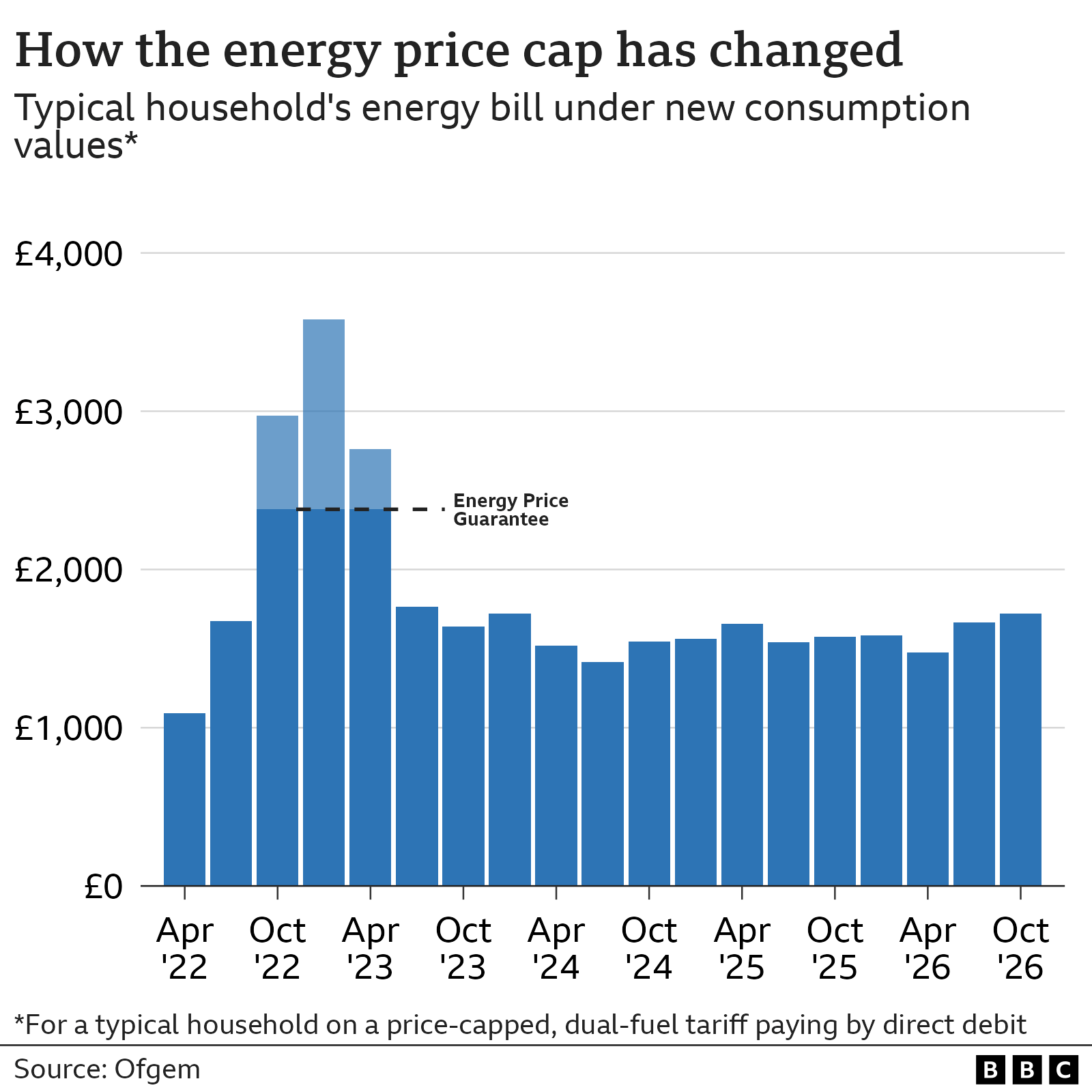
Ofgem said the price cap will rise by £60 per year – or £5 per month – to £1,723 for the average household using both electricity and gas if this level was sustained for a year.

Kenward said: "Savings are available by choosing a fixed tariff, which are available at £100 or more below the October price cap."

The energy cap sets a maximum price for each unit of gas and electricity, not the total bill, so a household's final bill depends on what they use.

In July, Ofgem reduced what it believes to be a "typical" level of energy use, because many homes have cut back owing to high prices of recent years while energy efficiency has improved.

Its new estimate is 9,500 kWh of gas and 2,500 kWh of electricity a year.

Dana says everyone is looking closely at their bills

Single mum Dana Lazarevic contacted BBC News Your Voice over the difficulties facing people with the cost of living.

She says she carefully coordinates washing times to make use of cheaper periods of energy from her supplier at the weekend.

Although the lecturer, who lives in Leeds, said that she was not on the breadline, the cost of essentials meant restricting some activities for her children.

"When winter comes and the cold bites, you need to put on the heating and need to have the money to pay for it," she said.

With the cost of each unit of energy higher than at least the last two winters, Jenny Wilson, from Winsford in Cheshire, said everyone is again going to have to tighten their belts.

"Bills were high enough and bad enough last winter. It was hard for a lot of people," she said.

With her family eating ice creams in the warm August weather, she said: "We have made the most of the summer!"

The price rise has been driven by wholesale costs, which make up just over a third of a domestic dual-fuel energy bill.

The average price of gas has been 61% higher over the past three months compared to late 2025, according to suppliers' trade body Energy UK.

Millions of people have moved on to fixed energy tariffs, some in response to the uncertainty created by the impact of the US-Israeli war with Iran.

But households are still paying hundreds of pounds a year more on average than before Russia's full-scale invasion of Ukraine in 2022 started the energy crisis. Bills have gone up by about 70% compared with the pre-crisis norm, according to industry data.

That means unpaid bills and charges have shot up. Energy UK estimates total debt to have collectively risen to £6bn, with an expectation of it to increase to about £7bn by the end of the year.

The average billpayer in debt, without a payment plan, owed £3,500, it said.

The trade body has called for a flexible discounted tariff for those most in need, funded by taxation. That is supported by many debt charities.

Vanessa Northam, director at debt charity StepChange, said that the increasing number of people coming for help often had high energy debt, averaging at £2,600 on top of other financial commitments.

"Increasingly, we are seeing people have to use credit to afford life's essentials. It is storing up problems further down the road," she said.

The charity has joined calls for the government to introduce a social tariff.

Her advice for those who might only just be managing as winter approaches includes:

Taking stock of all the money that is coming in, and going out, of the houshold budget

Look closely at how much energy you are using, and be alert if there are a series of estimated bills, which might prove to be inaccurate

Get in touch with your supplier if you think you are going to struggle. They have schemes that can help you

Some information is available online, but it is often best to try to talk to someone who can fully understand your individual situation

Suppliers offer a host of support schemes to anyone struggling to pay, or who is likely to find it difficult.

Energy UK has a list of these schemes, external. But it stresses that companies can often only help if you get in touch with your supplier to tell them you are unable to pay.

Are you affected by issues covered in this story?

You could be missing out on £150 off your energy bill - here's how to check

Three reasons why UK electricity prices are so high
Comments
You must be logged in to comment.