huffpost Press
The Way Melania Trump Walked Away From The President Speaks Volumes, Experts Say
Images
1 / 8

2 / 8

3 / 8
4 / 8
5 / 8
6 / 8
7 / 8

8 / 8
Footage of President Donald Trump and first lady Melania Trump at Sunday’s Freedom 250 Grand Prix in Washington, D.C., has been raising eyebrows online, with many social media users speculating about some seemingly tense moments between the couple.

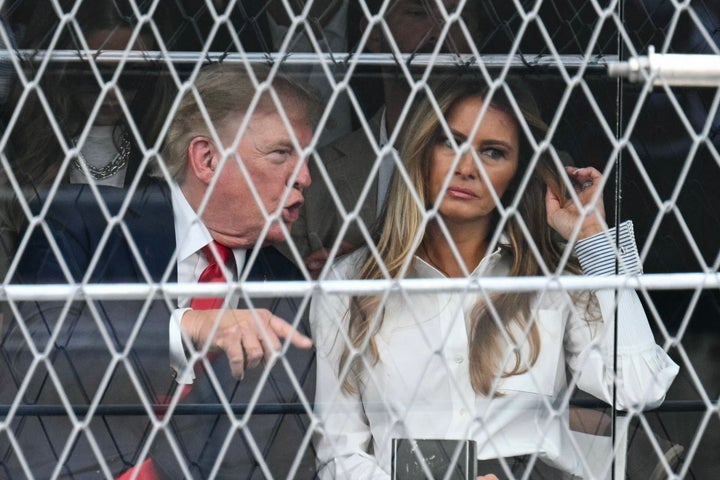
The videos circulating online show the Trumps sitting together in a suite at the race and exchanging some words, after which Melania gets up from her seat and walks away.

When compared to previous first ladies (and even her first four years in the role), Melania has been conspicuously absent from public life during Trump’s second term. But after more than a month with no appearances, she emerged again last week ― a return that seems to have attracted extra attention amid the growing interest in the president’s aide, Natalie Harp.

Of course, silent footage filmed through glass from a distance can only tell us so much. But body language experts who have observed the couple for many years now say the way they are engaging speaks volumes.

Karen Donaldson, a communication and body language expert, saw signals in the first lady’s posture and arm position during their interactions.

“Her arms were across her chest as she spoke to Trump which is a physical barrier that can often showcase defensiveness or disagreement,” she told HuffPost. “We see her lean in to say something to him while she maintains folded arms across her chest, but she does not turn her upper body to face him.”

This conversation between President Trump and Melania Trump actually seemed to start out somewhat positive a few minutes before this clip starts but as you can see, it didn’t end that way pic.twitter.com/vGTHnrSmIt

Donaldson explained that Melania notably does not display “fronting,” which the expert defined as “turning to have your entire body and face in the direction of the person you’re speaking to, which shows respect and a high level of interest.”

“She avoids fully engaging with him, showing a literal reluctance to face him,” Donaldson said. “This can signal dismay with the situation or the person.”

“She literally snaps at him,” she added. “Whenever you see sharp movements like this, there’s lots of anger. Her lips are turned down too, so there’s actual sadness here.”

Looking at the first lady’s face, the experts noted a clear shift in her expression as well.

“They go from sort of pleasant to more serious,” said Denise Dudley, a clinical psychologist and behavioral expert. “There’s more concentrated eye contact. Their facial affect is getting more and more serious, much less playful. She honestly just starts to look downright mad.”

Dudley also noted an absence of what she called “affiliative signaling” ― the small glances, nods and micro-expressions couples typically exchange to signal they’re on the same page.

“There’s no affiliative signaling as the conversation goes further down the road,” she observed. “They’re just both detached.”

Because the Trumps have been in the public eye for decades now, Dudley explained that there is a broader understanding of their baseline body language and behavior, so there is a reference point for seeing how they may carry themselves differently in public at times.

“Everything I see is absolutely consistent with what we’ll call an interpersonal disagreement, or at least a tense moment,” Dudley said. “We don’t know what they’re saying, but the pattern is pretty interesting.”

She observed a particularly sharp departure from typical baseline from Melania.

“She becomes less warm,” Dudley said. “It’s more of a concentrated exchange. She seems more emphatic. She doesn’t seem intimidated or withdrawn or deferential ― she looks at him, responds, seems to be holding her position. She doesn’t avert her gaze. She doesn’t minimize herself. She seems quite there, and that’s not her baseline. She’s much more activated than we’ve seen her be.”

Patti Wood, a body language and nonverbal communication expert, described what she characterized as sustained sadness and tension in the first lady’s expression throughout the footage.

“She looks sad. You can almost feel the tension in her ― it’s like she’s holding herself together, holding her breath to get through that moment,” Wood said. “Her lips are so tense and straight, almost frozen in this specific state which is not what we usually see.”

Several experts were interested in the moment Melania stood up and left her seat during the event.

“Getting up and walking away is the ultimate disengagement,” Dudley said. “If we think about conversations we have with people, we can disagree, we can look away, we can say ‘give me a break.’ But getting up and walking away is the clearest way we have of terminating an exchange with someone.”

She was also careful to note that the first lady’s departure could have been unrelated to their exchange.

“We can’t really say that she got up and left because of the conversation. The timing might honestly be coincidental. It might be that somebody needed her, or she was already going to be leaving.”

Still, Dudley noted that even if Melania had somewhere to be, a more expected behavior in that situation might be to indicate that you are leaving but will be back.

“If I were in the middle of an intense conversation, I would probably touch their arm or do something and say, ‘Listen, I’ve really got to run. We’ll pick this up in a minute, but I know we’ll be OK,’” Dudley said. “But none of that. She’s gone.”

Wood made a similar observation.

“There is a movement you make when you’re leaving a situation you want to brush off, just brush it away, make it go away,” she said. “That is the brush-off motion she made when she got up. She didn’t check in with him. She just got up and left. There wasn’t a goodbye, there wasn’t an end of the conversation.”

Brown also took note of the president’s body language throughout the footage.

“From him, we see silent disagreement ― tight lips,” Brown said. “He’s blowing off whatever her concern is.”

Dudley described Trump as appearing persistent throughout the exchange with the first lady.

“Whatever he’s talking about, I think she doesn’t appear to like it, but he says more,” she said. “He just kind of keeps talking. He seems really invested in what he’s saying, trying to get his point across I guess. He kind of looks back at the race, but he’s still in the conversation.”

Whenever two people experience a disagreement or conflict, it’s important to engage in interpersonal repair.

“There are little repair behaviors after there’s been tension, and it can be anything ― a little smile, a nod, a touch, a small laugh, a softening of the face, just a basically a glance, or even just a, ‘Hey, you know, we don’t agree on that, but we’re good,’” Dudley explained.

If the Trumps were indeed having a disagreement, she added that there did not appear to be any repair at the end.

“It never gets softened,” she said. “There’s no evidence of repair.”

By entering your email and clicking Sign Up, you're agreeing to let us send you customized marketing messages about us and our advertising partners. You are also agreeing to our Terms of Service and Privacy Policy.
Comments
You must be logged in to comment.