foxnews Press
Ten Commandments belong in Texas schools and the Supreme Court can protect them
Images
1 / 20

2 / 20

3 / 20

4 / 20

5 / 20

6 / 20

7 / 20

8 / 20

9 / 20
10 / 20

11 / 20

12 / 20

13 / 20
14 / 20

15 / 20

16 / 20

17 / 20

18 / 20

19 / 20

20 / 20
Austin-area mom Brittany McFarland explains why she welcomes the Ten Commandments in her kindergartner’s public school classroom and pushes back on claims the displays impose religion as Texas families ask the Supreme Court to block the law.

The U.S. Supreme Court has been asked to decide if the Ten Commandments can be posted in Texas public schools.

In the coming months, the justices will decide whether or not to review a decision by the U.S. Court of Appeals for the Fifth Circuit which found that the posting the Ten Commandments in schools is not only constitutional, but also consistent with America’s historical understanding of religion’s role in public life.

Documents and history are not banned in this country because they are religious or have religious content. Are students allowed to read the Rev. Martin Luther King Jr.’s "Letter from Birmingham Jail?" Of course they are.

TEXAS BOARD OF EDUCATION APPROVES REQUIRED READING LIST WITH BIBLE PASSAGES FOR 5 MILLION STUDENTS

Banning parts of our religious history and heritage is not an act of compliance with the First Amendment. It is hostility to religion and a religious cleansing, foreign to our Constitution. The First Amendment forbids the government from establishing an official state religion — something akin to the Church of England, where the state controlled doctrine, compelled worship and punished dissenters.

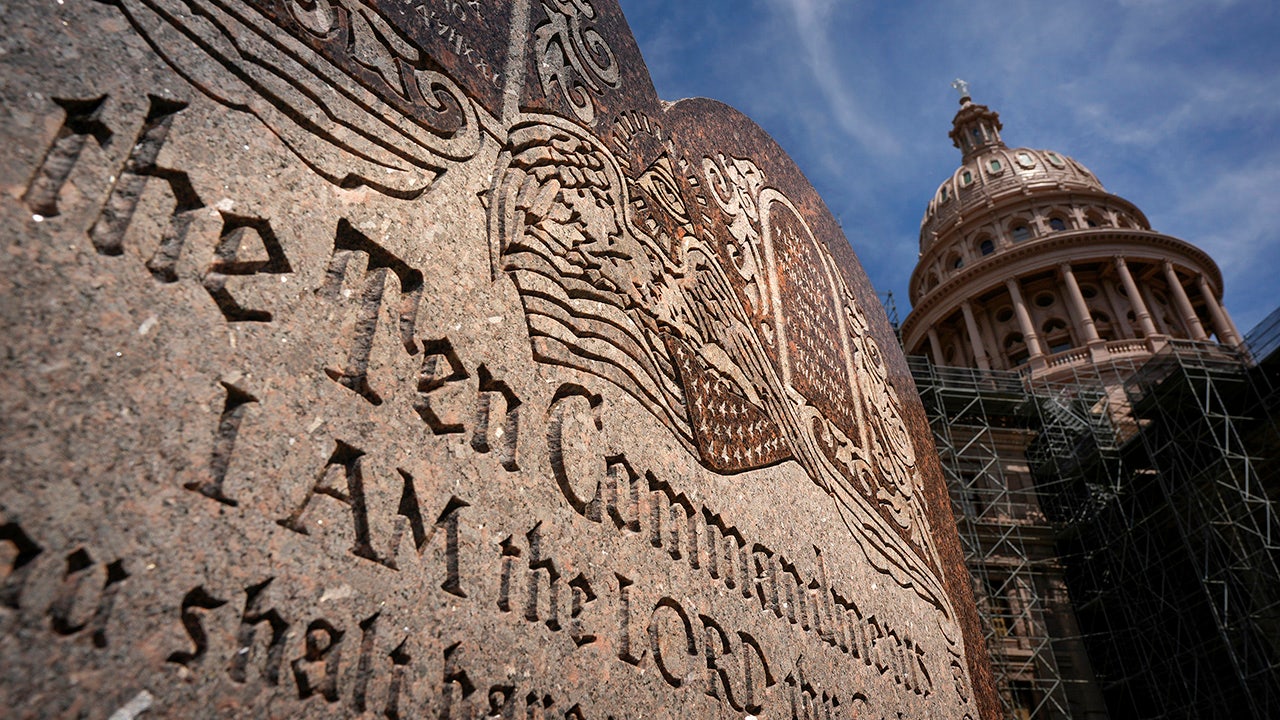
A federal appeals court ruled in favor of a Texas law requiring public schools to display the Ten Commandments. (Jay Janner/Austin American-Statesman via Getty Images)

The Fifth Circuit’s ruling made clear that such "establishments" historically involved acts of coercion such as mandatory church attendance or legal penalties for noncompliance. Displaying a religious text on a classroom wall bears no resemblance to such practices.

SUPREME COURT SHOWDOWN LOOMS OVER ST MICHAEL STATUE BLOCKED FROM PUBLIC SAFETY BUILDING

The Ten Commandments are a foundational moral, literary and historical text. Their influence on Western legal traditions is widely acknowledged, even by critics. The Commandments articulate basic ethical principles such as prohibitions against murder, theft and perjury that underpin modern legal systems. Displaying them in classrooms is simply a recognition of their historical and cultural significance.

A quality education must include instruction on the religious and historical heritage of our country. Without it, students cannot understand the founding rationale of our nation, nor its system of laws.

JUDGE ORDERS WASHINGTON SCHOOL DISTRICT TO LOOSEN LIMITS ON OFF-CAMPUS BIBLE CLUB FOR PUBLIC SCHOOL STUDENTS

Critics argue that posting the Ten Commandments amounts to coercion, especially for impressionable students. But this claim does not withstand scrutiny. The Texas law at issue requires only that a poster be displayed. It does not mandate prayer, belief or participation in any religious activity. Students are not asked to recite the Commandments, affirm their truth or even engage with them at all. In other words, exposure is not indoctrination.

This distinction is crucial. Public education inevitably exposes students to a wide range of historical, philosophical, and, yes, religious ideas. The Constitution does not demand that schools become religion-free zones; rather, it protects against government coercion in matters of faith. As the Fifth Circuit notes, "the mere presence of religious language in a school display is [not] ipso facto religious coercion." If it were, many longstanding features of American public life, from the national motto "In God We Trust" to references to a "Creator" in the Declaration of Independence, would be constitutionally suspect.

GOP LAWMAKERS URGE SUPREME COURT TO STRENGTHEN FIRST AMENDMENT PROTECTIONS FOR STREET PREACHERS

The legal foundation for the Fifth Circuit’s conclusion rests heavily on First Liberty Institute’s victory in Kennedy v. Bremerton School District, which fundamentally reshaped Establishment Clause jurisprudence. As the Fifth Circuit explains, Kennedy abandoned the long-criticized "Lemon test" and replaced it with an approach rooted in "historical practices and understandings."

Under this framework, courts no longer ask whether a government action has a secular purpose, but whether it resembles the kinds of coercive religious establishments the Founders sought to prohibit. This shift is decisive: because a classroom display imposes no religious exercise, no punishment for dissent and no government control over belief, it falls far outside the historical definition of an "establishment of religion." In short, Kennedy clarifies that the Constitution protects against coercion, not mere exposure to religious ideas, history and heritage.

RARE AMERICAN BIBLE AND FOUNDERS’ LETTERS TRACE FAITH’S ROLE IN BIRTH OF THE NATION

The Founders themselves did not envision a strict separation of religion from public education. As Judge James Ho quoted President George Washington in his concurrence, they believed that "religion and morality are indispensable supports" of a free society. Far from excluding religion, early American institutions often incorporated it as a source of moral guidance and civic virtue.

Public education inevitably exposes students to a wide range of historical, philosophical, and, yes, religious ideas. The Constitution does not demand that schools become religion-free zones; rather, it protects against government coercion in matters of faith.

Just consider the U.S. Supreme Court building where the Ten Commandments are displayed both on the outer façade of the courthouse as well as the internal courtroom itself. Do the justices need to sandblast those images from the court?

Removing all the references to the Biblical Decalogue built into the architecture of government buildings throughout Washington, D.C., would require jackhammers, chisels and high-powered sand blasters.

CLICK HERE FOR MORE FOX NEWS OPINION

Allowing such displays respects both the Constitution and the nation’s heritage. It’s also good education. It acknowledges the role that religious ideas have played in shaping American law and culture, without compelling anyone to adopt those beliefs. In a pluralistic society, exposure to diverse perspectives, including religious ones, is not a threat to freedom, it is a reflection of it.

CLICK HERE TO DOWNLOAD THE FOX NEWS APP

Rather than fearing the presence of the Ten Commandments in classrooms, the plaintiffs should recognize it for what it is: a modest, constitutionally sound acknowledgment of the moral and historical foundations that continue to influence our society today.

CLICK HERE TO READ MORE FROM KELLY SHACKELFORD

Kelly Shackelford is president, CEO and chief counsel for First Liberty Institute, a nonprofit law firm dedicated to defending religious freedom for all. Learn more at FirstLiberty.org.

Get the recap of top opinion commentary and original content throughout the week.

By entering your email and clicking the Subscribe button, you agree to the Fox News
        Privacy Policy
       and
        Terms of Use
      , and
      agree to receive content and promotional communications from Fox News. You understand that you can
      opt-out at any time.

Subscribed

You've successfully subscribed to this newsletter!
Comments
You must be logged in to comment.