yahoo Press
China postpones launch of unprecedented water-hunting moon mission amid space race
Images
1 / 6
2 / 6

3 / 6

4 / 6

5 / 6

6 / 6
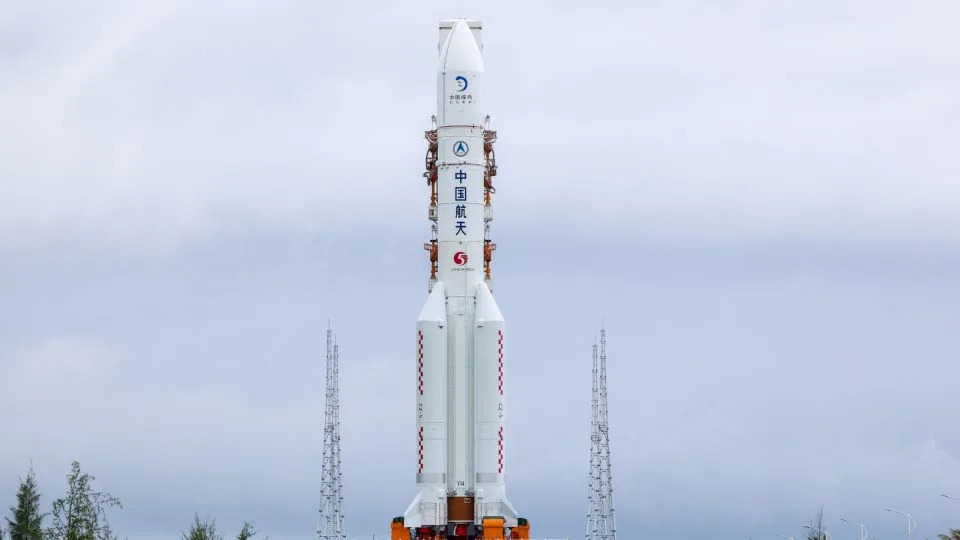
The anticipated launch of China's robotic Chang'e-7 mission, designed to scour the moon's south pole for water ice — a highly valuable resource that the US also hopes to use — "cannot take place during the planned window this year," according to a statement from the China Manned Space Engineering Office shared by Chinese state media.

The mission had been expected to lift off as soon as Sunday evening, or Monday morning Beijing time from southern China's Hainan province. Official statements did not specify how soon China may be able to attempt to get the mission off the ground.

The precise reason for the delay was not immediately clear. State media shared only that the "lunar probe does not meet launch conditions," and the "assessment was conducted following the principle of prudence, reliability and absolute mission success."

Wiphu Rujopakarn, the executive director of the National Astronomical Research Institute of Thailand (NARIT), told CNN Monday that the mission is now expected to take place next year, potentially during one of two windows in spring or mid-summer. He received updates on the mission from the Chinese team, as NARIT is among seven international partnerships that had prepared research instruments as part of the probe.

The length of the delay is due to the technically challenging and "unprecedented" nature of the mission, in which the probe needs enter an exact orbit in order to later land at an optimal site on the moon, said Wiphu.

"No one has ever tried to send a spacecraft to land on the rim of a crater at the south pole of the moon before, and that's extremely difficult." he said, adding the launch window each year was "very short."

Wiphu said that the main driver of the delay appeared to be due to weather, specifically higher-altitude winds as a weather system moves through southern China.

"It's not impossible that there may be other considerations," he said, adding even if there were additional technical issues they wouldn't have been likely to result in a delay of this length – had it not been for the narrow launch window.

Chang'e-7 had aimed be the first probe to directly analyze water on the moon, with a complex mission plan involving a robotic "hopper" designed to deploy from the lander and navigate to lunar south pole craters and drill for ice.

Though the US has detected and begun estimating the size of water ice stores using remote sensors on orbiting satellites, it has never successfully sent a probe to drill for the resource.

Both the United States and China are racing to build settlements on the moon's south pole. Understanding, and utilizing, water resources there is seen as key to lunar development.

One Texas-based company, Intuitive Machines, sent a water-hunting drill to the moon in 2025, but the spacecraft tripped while attempting to land on the south pole's notorious treacherous terrain and could not complete its mission objectives.

Chang'e-7's launch delay could put this chapter of the space race — as US officials have referred to the standoff with China — back on competitive footing.

The US has several spacecraft heading for the same lunar region as Chang'e-7 is targeting within the next year. Pittsburgh-based company Astrobotic Technologies could launch its Griffin lander to the moon's south pole as soon as late 2026. And Jeff Bezos' space venture, Blue Origin, has plans to send up to two robotic landers to the moon next year, one of which may include the VIPER rover, a prospecting robot specifically designed by NASA to hunt for water ice and other lunar resources.

The belief that the lunar south pole contains vast stores of frozen water is a key reason this region has become the main stage for this international competition. The resource holds enormous value for deep-space exploration and a potential lunar base because it can be converted to breathable air, drinking water or even rocket fuel.

The presence of water ice in sufficient amounts to be useful for such purposes is not currently known, according to James Head, a professor emeritus at Brown University who worked on NASA's Apollo lunar program. He added that Chang'e-7 could help make "important progress on this question, sharpening and focusing experiments for further exploration and testing."

Yuqi Qian, a lunar geologist at the University of Hong Kong, told CNN that with Chang'e-7, China's lunar program is "shifting from an exploration program to a resource utilization program."

"You can see that for China and other countries, we are evolving from exploring the moon and using Earth's resources to a more sustainable lunar exploration using lunar resources," he said.

For more CNN news and newsletters create an account at CNN.com
Comments
You must be logged in to comment.