yahoo Press
Norway’s Oil Output Falls Nearly 200,000 Bpd as Gulf Supply Crisis Drags On
Images
1 / 4
2 / 4

3 / 4

4 / 4
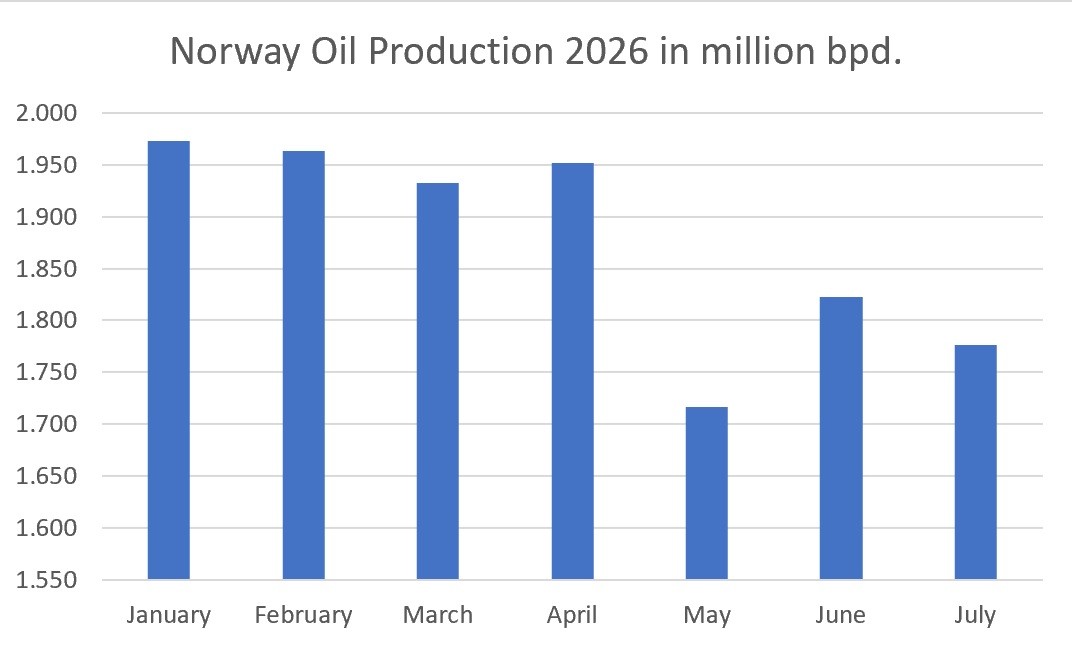
Norway's crude oil production averaged 1.776 million barrels per day in July, according to preliminary figures from the Norwegian Offshore Directorate.

The country also produced 183,000 barrels per day of natural gas liquids and 17,000 barrels per day of condensate, bringing total liquids production to 1.976 million barrels per day.

The year-over-year comparison is striking. Norway produced 1.971 million barrels per day of crude in July 2025, according to the Directorate's latest revised figures. Crude output was therefore down by approximately 195,000 barrels per day, or nearly 10%.

Total liquids production declined by around 197,000 barrels per day, or 9.1%, from 2.173 million barrels per day a year earlier.

The timing gives the decline greater significance than the Norwegian numbers alone would suggest.

The International Energy Agency estimates that 8.3 million barrels per day of Gulf production remained shut in during July as severely restricted traffic through the Strait of Hormuz continued to limit exports. Although global supply increased during the month, it remained 6.3 million barrels per day below year-earlier levels.

Renewed hostilities and maritime disruptions have also prompted the IEA to reduce its projected third-quarter oil supply by 1.7 million barrels per day compared with its previous estimate.

In that environment, the market is becoming increasingly dependent on production from outside the Persian Gulf, particularly barrels that can reach refiners without passing through a geopolitically exposed chokepoint.

Norwegian Production Falls from June

Norwegian production also declined from June.

Revised figures show that crude output averaged 1.823 million barrels per day in June, while total liquids production reached 2.021 million barrels per day.

Crude production therefore fell by 47,000 barrels per day, or 2.6%, month over month. Total liquids output declined by 45,000 barrels per day, equivalent to 2.2%.

In a well-supplied market, a monthly Norwegian decline of this size could be absorbed relatively easily. Its significance increases when the global market is already relying on inventories, emergency reserves and alternative export routes to compensate for disrupted Middle Eastern supply.

The problem is not that Norway lost enough barrels to move the market on its own. It is that the loss comes from the part of the supply system the market still expects to work.

Norwegian crude is produced close to Europe's refining system, supported by established infrastructure and largely insulated from the maritime constraints affecting Middle Eastern exports. Its value to the current market is therefore greater than Norway's share of global supply alone would suggest.

A Weak Month, But Not Yet a Structural Decline

The annual decline should be viewed against an unusually strong comparison period.

Norwegian crude production in July 2025 was 9% above the Directorate's forecast, while total liquids output exceeded expectations by 6.2%. July 2026 is therefore being measured against an exceptionally strong month.

Production on the Norwegian Continental Shelf also tends to fluctuate during the summer maintenance season. Planned shutdowns, unplanned operational issues and the timing of output from individual fields can produce significant changes from one month to the next.

The July reading should therefore not be treated as evidence that Norwegian production has entered a structural decline.

Norway entered the summer from a relatively strong position. Through June, cumulative oil production was 5.7% above the Norwegian Offshore Directorate's forecast.

Total petroleum production—including oil, natural gas, NGL and condensate—was also 5.9 million standard cubic meters of oil equivalent higher than during the same period in 2025.

July has reduced some of that production cushion, but one weak month is not enough to overturn the stronger first-half performance.

The Next Production Report Matters

The market impact of Norway's July decline will ultimately depend on whether it proves temporary.

A recovery following the summer maintenance season would confirm that the weakness was primarily operational. Continued production below 1.8 million barrels per day would be more consequential, particularly if Gulf exports remain constrained and global inventories continue to absorb the supply deficit.

Norway cannot replace the millions of barrels disrupted in the Persian Gulf. But if production remains below 1.8 million barrels per day after the maintenance season, the market will lose part of the reliable supply buffer it increasingly needs. That makes Norway's next production report more consequential than usual.

By Jan-Thore Bergsagel for Oilprice.com

More Top Reads From Oilprice.com

Iraq-Syria Oil Pipeline to Bypass Hormuz Is 4 Years and $15 Billion Away

China's Renewables Boom Faces Record Clean Power Curtailments

$100 Diesel Cracks Signal a Much Tighter Oil Market Than Brent Suggests

Oilprice Intelligence brings you the signals before they become front-page news. This is the same expert analysis read by veteran traders and political advisors. Get it free, twice a week, and you'll always know why the market is moving before everyone else.

You get the geopolitical intelligence, the hidden inventory data, and the market whispers that move billions - and we'll send you $389 in premium energy intelligence, on us, just for subscribing. Join 400,000+ readers today. Get access immediately by clicking here.
Comments
You must be logged in to comment.