huffpost Press
You'll Never Unsee RFK Jr.'s 'Gish Gallop' After You Watch This Clip Of His CNN Meltdown
Images
1 / 8

2 / 8

3 / 8

4 / 8

5 / 8

6 / 8

7 / 8

8 / 8
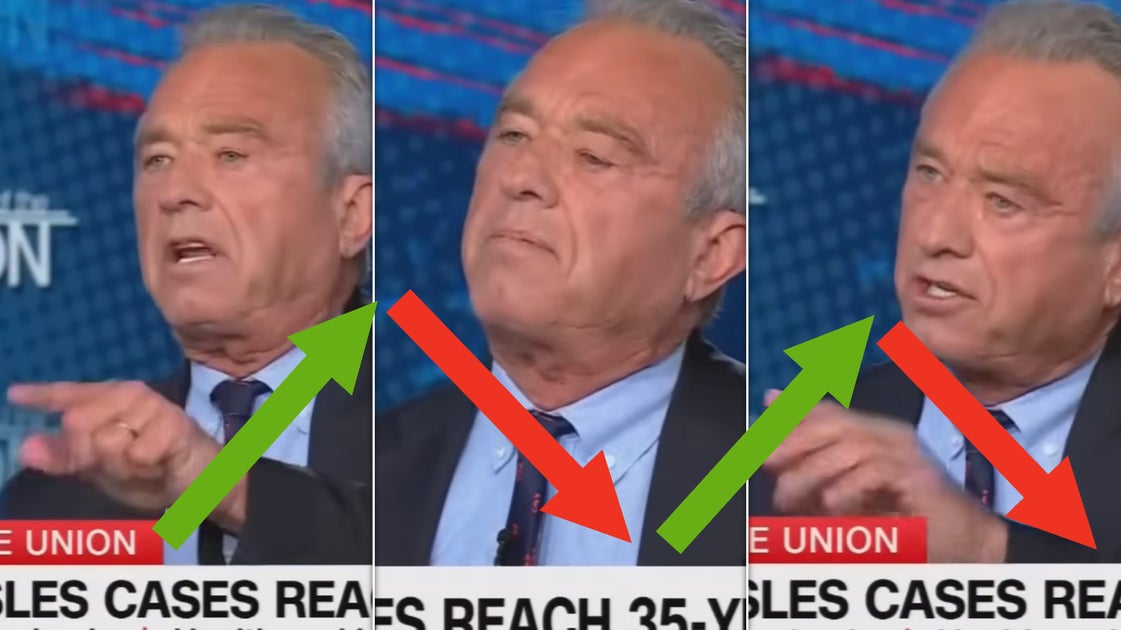
Robert F. Kennedy Jr., the U.S. health secretary, got into an argument with CNN host Dana Bash on Sunday over his views on vaccines, using a debate tactic some experts call “Gish gallop.”

Throughout the interview, Kennedy claimed he has never questioned the efficacy of the MMR vaccine (he has expressed concerns about it), challenged Bash to point to one study that showed children were protected by COVID-19 vaccines (the CDC published one in December), alleged that ICUs “were empty all across the country” during “the height” of COVID (they were at unprecedented capacity strain), and brought up President Donald Trump’s unfounded claims linking taking Tylenol in pregnancies to autism (which has been repeatedly disproven).

What Kennedy excels at here is called a Gish gallop debate strategy, a term coined in 1994 by anthropologist Eugenie Scott. Scott named it after the creationist Duane Gish, who publicly argued against the theory of evolution.

“It’s a rhetorical trick, but remarkably effective, and the onslaught of point after point can be mesmerizing to the audience,” Scott told HuffPost. “It has little to do with the quality of the evidence behind the points — the point being to overwhelm the opponent with so many ‘facts,’ it’s impossible to refute them in the time available.”

The purpose of this tactic is not for Kennedy to change Bash’s mind, but to win over the viewers, experts argued.

“It’s a kind of leveling tactic,” Scott Aikin, an associate professor of philosophy at Vanderbilt University and co-author of “Political Argument in a Polarized Age,” told HuffPost. “[Kennedy says], ‘I’m going to give you a bunch of objections and you need to give me answers to all of them. If you don’t answer them, I now have evidence of you being evasive.’”

Aikin compares it to a baseball metaphor: A pitcher intentionally throws some balls in the dirt so the batter might chase them and swing at a ball outside the strike zone. If a speaker throws an objection, the opponent is under an obligation to answer it.

“The frequency of the arguments, without allowing rebuttals, is essentially like turning the volume up on one voice and muting the other — it’s an amplification technique,” Jennifer Sclafani, an assistant linguistics professor at the University of Massachusetts, Boston, told HuffPost. “One way that Trump amplifies himself is through expressions like “People tell me that...” or “Everyone knows that...” He amplifies his own point of view by making it sound like it is consensus.”

Part of why the Gish gallop works is because it also relies on identity rather than just the facts.

In several instances throughout the interview, Kennedy accused Bash and CNN of “absolute press malpractice” and “talking nonsense … scaring people.” These were not rebuttals so much as they were signals to try to convey to the audience who is trustworthy and who isn’t, regardless of what’s being disputed.

“A lot of these aren’t just objections, they’re identity markers,” Aikin said. “The more the objections invoke identity — ‘us versus the Washington elites, the captured press’ — the bigger the purchase you get with the onlooking audience.”

Sclafani, who studies how political figures use language to build their authority, sees the same mechanism at work in Kennedy’s jabs. These kinds of personal, ad hominem comments have become more common in political discourse over the last few years, she said, and let the speaker appear to control the discussion, despite not offering any factual information.

“For instance, when Bash mentions that ‘There is study after study after study…’ [Kennedy] accuses her with a mocking statement, ‘You’re repeating like a parrot,’” Sclafani said.

Both experts pointed to the same underlying move: Kennedy doesn’t necessarily need facts to win over viewers. He just wants the audience to be inclined to trust him more than Bash.

“It’s useful for the opponent to point out to the audience how they are being manipulated,” Scott said. “A large number of thin or misleading arguments is not superior to having a few well-supported arguments.”

In terms of responses to more personal attacks, Sclafani said Bash’s “best comeback” was when Kennedy said, “You’re not a scientist” to challenge the data she reported, to which she responded, “Well, you’re not either.”

“Fight fire with fire, but only when you do it with truths,” Sclafani said.

RFK Jr: Dana, you probably don't understand this because you're not a scientistBASH: Well you're not either!RFK Jr: I know you're flustered now pic.twitter.com/h8c95Scsq7

But what complicated things further is that Bash plays two roles in this debate: the moderator and the opponent.

“As moderator, she has to cut the interviewee off to allot herself a turn to rebut. Then she needs to supply arguments that counter his claims,” Sclafani said. “When he starts personally attacking her, she needs to decide whether to call him out or redirect the conversation.”

The segment was only 21 minutes.

“The irony is that CNN’s got 24-hour news,” Aikin said. “Why are they running out of time?”

By entering your email and clicking Sign Up, you're agreeing to let us send you customized marketing messages about us and our advertising partners. You are also agreeing to our Terms of Service and Privacy Policy.
Comments
You must be logged in to comment.