yahoo Press
H2 2026 Distressed Outlook: Elevated cost of capital, software debt in focus
Images
1 / 4
2 / 4

3 / 4

4 / 4
Distressed investors are, by their nature, optimists. They must be, since they see bargains and opportunities where other investors fear to tread. True to form, recent conversations with a number of distressed players reveal a significant distressed opportunity set in the back half of 2026 in the face of a roaring US equity bull market and a vibrant US economy.

Beginning on a positive note, "the US economy is doing well and isn't likely to turn south in the next six to 12 months," says Jeremy Burton, managing director and portfolio manager at PineBridge Investments. Even the rise of oil prices isn't of great concern for Burton, as he believes that the hit to consumers from rising oil prices in one region of the country will be offset by a healthy oil-and-gas-based economy in another region. As a result, the opportunities are more sector-specific, he believes.

Concurring with Burton's relatively sunny view are Morgan Stanley strategists Vishwas Patka and Joyce Jiang, who, in a recent piece covering their mid-year outlook, said "capex growth and a resilient consumer support a stable macro environment with strong earnings, while attractive yields anchor robust [debt] demand." This bodes well for business growth and equity generally, the pair said.

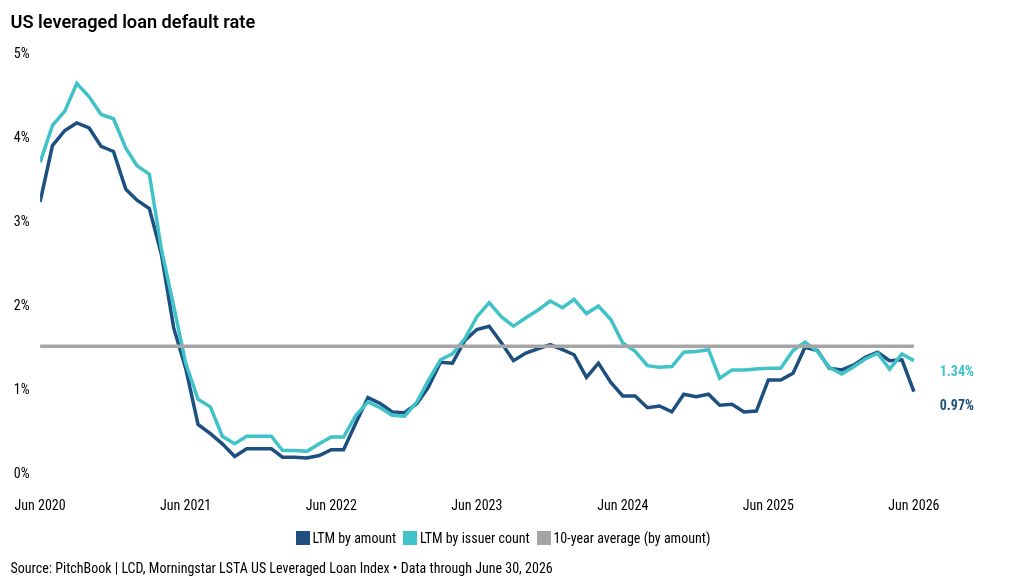
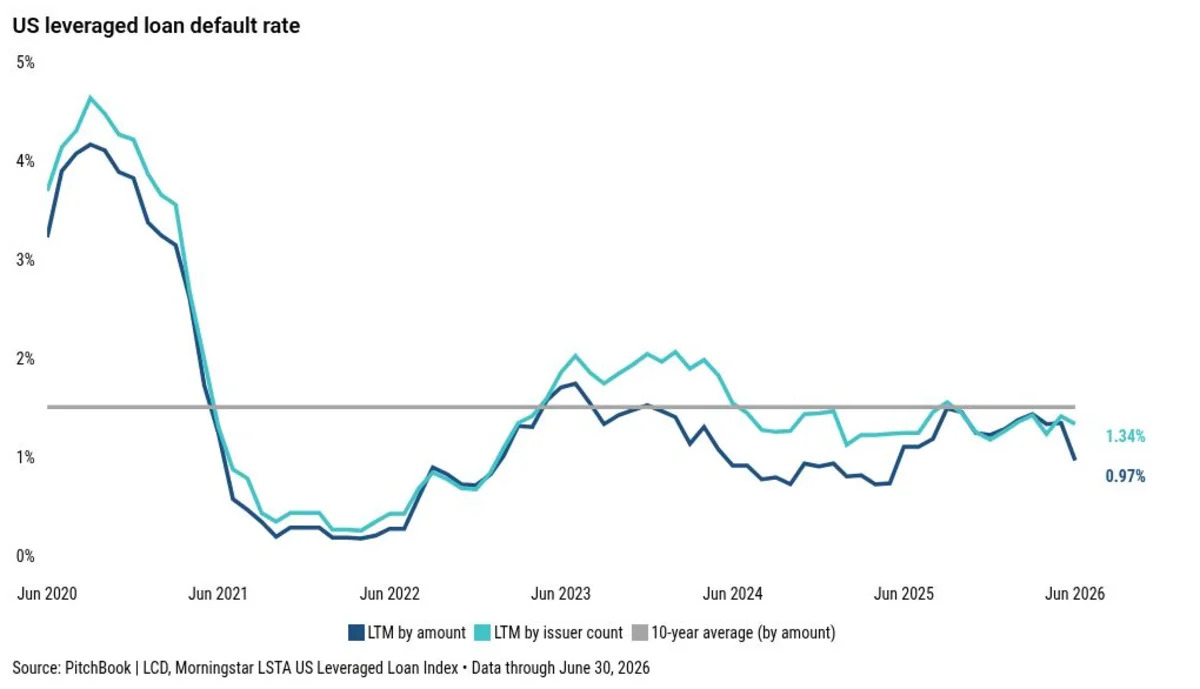
That health is reflected in the numbers. PitchBook LCD reported on July 1 that the trailing 12-month default rate for the Morningstar LSTA US Leveraged Loan index was only 0.97% by dollar amount and 1.34% by issuer count. The default rate by count, including Liability Management Exercises (LMEs), was 2.77%.

But danger in the leveraged loan index lurks. The index's distress ratio by amount (defined as the share of loans trading below 80 cents on the dollar) rose 34 bps in June, to 6.87%. In fact, the distress ratio has trended higher over the past nine months after plumbing a near-term low of 2.59% in September 2025. The peak for 2026 is 7.23% in March, which was the result of six consecutive monthly increases and marked the highest level since the distress ratio hit 7.36% in December 2022, in the midst of a series of US fed funds rate hikes by the FOMC. Roughly 45% of the debt trading under 80 is in software-related sectors.

PitchBook LCD tracks distress in the US high-yield market via the Morningstar US High Yield bond index, which includes a relatively light representation of software/services companies (2.9%, vs. 12.2% in the leveraged loan index). The value of bonds in the index trading above an option-adjusted spread of 1,000 bps — considered where distress begins — is approaching October 2025 lows, with the par value of distressed bonds around $60 billion, and market value near $35 billion. Also falling close to its autumn 2025 low is the index's distress ratio, at 4.20% as of July 22.

The high cost of capitalThose we spoke with who are less sanguine about the markets uniformly cited elevated rates and yields. Surbhi Gupta, a managing director in Houlihan Lokey's restructuring practice, believes that the current rate environment, exacerbated by the overhang from tariffs and the protracted conflict between Iran and the US, creates an expansive opportunity set for distressed investors.

Gupta believes that "until we fully cycle through the 2021-2022 vintage [of debt deals] we are going to continue to see LMEs" and other forms of restructurings. She believes the salient questions for credits yet to be restructured are whether — and when — sponsors will engage with their creditors.

Jonathan Barzideh, co-head of opportunistic credit at Canyon Partners, is also seeing LMEs of 2023-2024 — which he says were designed to help the class of 2021-2022 deals — limping along. "Things are not getting better," he noted. Drilling down, Barzideh said, "For instance, packaging companies took their hit last year, chemical companies this year, and we had the 'SaaS-pocalypse' for software companies earlier this year, as well."

Andrew Axelrod, CIO and co-founder of Axar Capital Management, points out that when the 2021-2022 vintage debt deals first did LMEs, they were really more Band-Aids than permanent solutions. Now, as these companies default for a second time, a new distressed cycle may begin.

Josh Baumgarten, president and CIO of investment firm Beach Point Capital, sees a "day of reckoning approaching the debt markets as businesses grapple with a higher cost of capital." He believes that both the cost of capital — and the limited availability of it — will directly lead to the next wave of distressed opportunities.

Baumgarten also doesn't see the broader US economy as a zero-sum game. Instead, he sees the lower part of the current K-shaped economy, namely the lower-end consumer, continuing to get battered by rising gas prices and rising consumer debt. Meanwhile, he foresees interest rates remaining elevated and even continuing to rise because of crowding out — that is, high borrowing demand from investment-grade companies and the US Treasury's need to fund the federal deficit are competing for fixed-income dollars and contributing to higher yields.

Rick Miller, group managing director and CIO of the TCW private credit group, noted generally that he is seeing a steady stream of opportunity in distressed private credit. "We're in year five of higher for longer in interest rates," he said, and as a result, "this is forcing companies to spend cash flow on interest costs, instead of on capex, working capital or new hires." In fact, Miller said that a catalyst for a new wave of distress could come from a contraction of enterprise multiples, possibly driven by a decline in the public equity markets.

Sector selectionBeach Point's Baumgarten generally thinks that sectors with high energy and commodity inputs are particularly vulnerable in the current market environment. Baumgarten also believes that housing is a challenged sector because of mortgage rates and affordability. He noted that sectors going through rapid change, such as software, have capital structures that are at risk, as well.

Speaking of the software sector, Canyon's Barzideh says that underwriting terminal values for software companies is going to be particularly difficult for bankers, given the still-developing impact of AI on the sector.

Axar's Axelrod sees housing, cyclicals, and building products as sectors to focus on for distressed investments.

Miller from TCW said distressed opportunities will come in the consumer discretionary sector as a result of the K-shaped economy, while he sees the lack of housing turnover having ongoing negative implications for the US economy.

Houlihan's Gupta believes that on the question of sectors, "given weak consumer confidence, the high interest rate environment and geopolitical instability, investors are generally 'sector agnostic' regarding where to invest distressed capital." Gupta did mention specific industries that are presenting particular opportunities, including industrials, building products, software & tech, and healthcare.

Sign up for The Credit Pitch

Weekly coverage of US and European loans, bonds, private credit, and more.

Subscribe

Featured image by Ekin Kizilkaya/Getty Images

This article originally appeared on PitchBook News
Comments
You must be logged in to comment.