yahoo Press
Energy M&A kicks into high gear amid AI's thirst for power
Images

1 / 4
2 / 4

3 / 4

4 / 4
M&A in the energy sector is soaring as developers of AI projects look to bypass the growing practical and regulatory hurdles to launching new power generation projects.

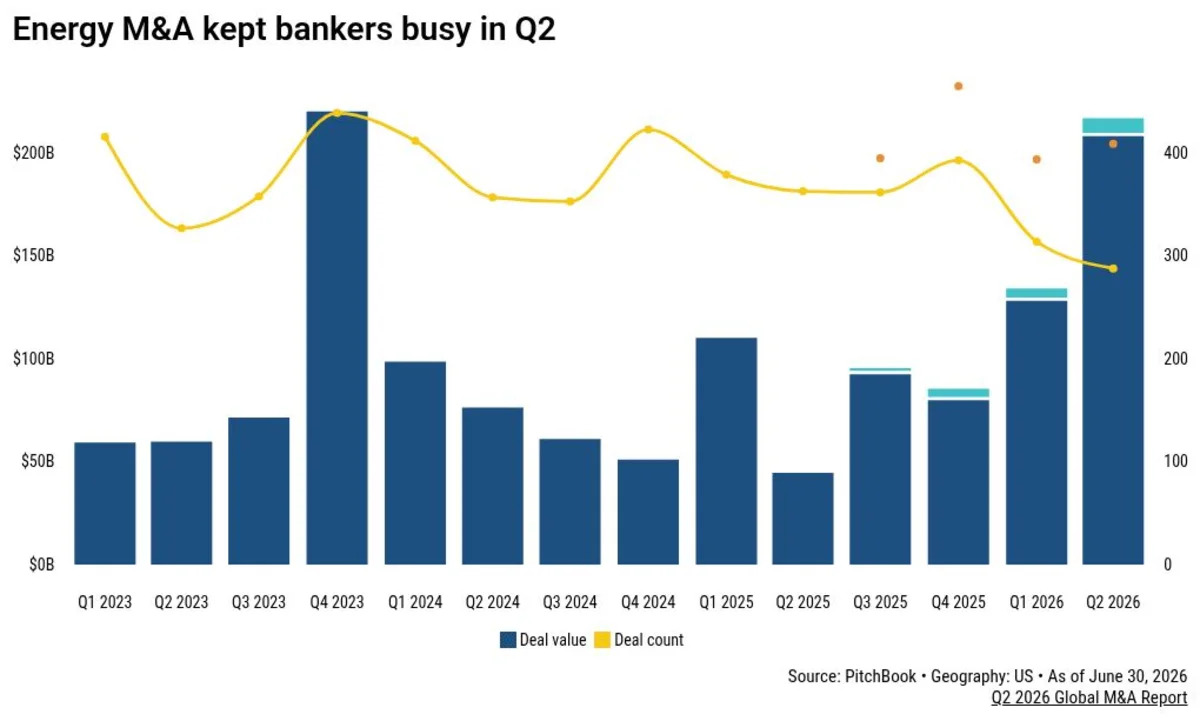
The total value of global energy M&A reached an estimated $217 billion in Q2, growing 62% from the prior quarter and nearly fivefold year-over-year, according to PitchBook's latest Global M&A Report. That figure lands just shy of the $220.3 billion record for the energy sector set in Q4 2023.

Deal count shows a more modest growth, rising roughly 13% year-over-year to an estimated 409. North America alone accounted for 77% of total deal value, at $166.9 billion.

The momentum was propelled by a mega-trend: the need to meet explosive electricity demand driven by the breakneck expansion of AI data centers.

It's now the largest driver of M&A activity in this sector, if not the only one, said KPMG partner Stephen Binz.

"People are willing to pay a little bit higher today with the expectation that the value will grow and they can still make it on the other end," he said.

Building new generation plants, transmission lines and other power infrastructure from scratch is not only time-consuming but also requires extensive regulatory approvals—too slow to keep pace with AI's demand.

Sign up for The Daily Pitch newsletter Subscribe

The median time new power projects spent in the interconnection queue, as it is known, was 61 months in 2025, compared to 36 months in 2015, according to data from the University of California, Berkeley.

New power generation and storage facilities must undergo a series of studies before they can be built and connected to the grid, and projects invariably require upgrades or modifications before being given the green light.

M&A has emerged as a more practical workaround, giving power producers access to parts of the country where the data center buildout is most active.

The largest energy deal of the past quarter—the $67 billion all-stock merger between NextEra Energy and Dominion Energy announced in May—is a prime example of this trend.

The tie-up will create the largest utility company in the US, with 110 gigawatts of generation capacity—enough to power 11 New York Cities at once—and 10 million customer accounts across Florida, North Carolina, South Carolina and, most importantly, Virginia.

"Dominion owns all the transmission and grid over Virginia, which houses 'data center alley,'" said Benny Wong, a PitchBook analyst covering energy. "Buying it is NextEra's way of controlling that great infrastructure and better positioning itself to supply power for AI demand."

NextEra operates a regulated electric utility network covering most of Florida and holds generation assets spanning from Texas to the Northeast.

Power demand from US data centers is expected to rise from 75.8 gigawatts in 2026 to 134.4 gigawatts in 2030, according to a forecast by 451 Research, part of business intelligence provider S&P Global. The availability of power, not capital, has become the biggest bottleneck, with growth in electricity demand from the manufacturing and residential sectors compounding the problem.

The thirst for power is not only driving consolidation among large utilities but also drawing private capital into the market.

A consortium led by BlackRock's Global Infrastructure Partners and EQT acquired AES in March, in a deal valuing the global power utilities company at $33.4 billion. Over the past five years, the company's average project size has grown by more than 50%, driven by demand for power from new data centers.

In April, Stonepeak Partners and Bernhard Capital Partners agreed to acquire Louisiana-based regulated electric utility Cleco Group at a valuation of around $17 billion.

The power surge has triggered dealmaking in other segments of energy, such as natural gas, a popular power source for data centers.

In January, independent power producer Talen Energy agreed to pay $3.45 billion for three natural gas plants from Energy Capital Partners.

"It is sort of the rising tide lifting all boats," Wong said.

This article originally appeared on PitchBook News
Comments
You must be logged in to comment.